The Calcasieu Courthouse in Louisiana is said to be haunted by Toni Jo Henry, a notorious figure in local history who was executed there in 1942. Visitors often report unexplained occurrences like strange sounds as well as the smell of burning hair from the way she died.
The Calcasieu Courthouse in Lake Charles, Louisiana, is steeped in history since it was built in 1912. And the old Parish Court House on 1000 Ryan street is also believed to be haunted by the lingering spirit of its most infamous prisoner, Toni Jo Henry. She was the first, and for now, the only female executed by the electric chair in the state.
The Haunted Courthouse: Calcasieu Parish Courthouse in Lake Charles, Louisiana. Listed on the National Register of Historic Places. // Source. It is said that the court building is haunted by the murderer, Toni Jo who were put to death by the electric chair: Wikimedia
The Life and Crimes of Toni Jo
In the early 1940s, Toni Jo, a former sex worker, gained national notoriety for her cold-blooded murder of a man named Joseph P. Calloway.
Her real name was Annie Beatrice McQuiston, and she had lived a rough life. After her mother died early on from tuberculosis, she ended up as a prostitute. She started out working in a factory, but after her foreman knew about her mother, fearing her to contaminate other workers,he fired her. When she told her father about what happened, he beat her up and she ended up leaving home in search of a new life.
She fell in love with a man named Claude Henry, or simply Cowboy when she was working in a brothel, and it is said she got clean and wanted a new life in California. He, on the other hand, was a fugitive after killing a cop, awaiting 50 years in jail. She married him, but he was arrested soon after.
Toni Jo wanted to get him out of the Texas jail he was serving time. She teamed up with a homeless man named Arkie and brutally tortured and killed a car salesman named Joseph Calloway who picked them up along the road in Jennings, Louisiana.
They dumped the body in a ditch and went straight to a dive bar the same night. Drunk at a bar they bragged about it and the other people present reported them to the cops at once.
Her charm and beauty couldn’t save her, as it took three grueling trials before a jury finally convicted her of the heinous crime three times. On November 28, 1942, Toni Jo made history as the first and only woman in Louisiana to be executed in the electric chair. And the place it happened was in The Calcasieu Courthouse.
She said in an interview right before her execution to the the American Press’ Eliot Chaze:
“The victim does not return to haunt me. I never think of him. I’ve known all along it would be my life for his. I believe mine is worth as much to me as his was to him. I wonder, though, sometimes, why it’s legal now for another fellow to kill me.”
Outside, thousands of people had gathered. Some to see justice be done as the court had ordered, some supported her, thinking that killing her as well was no justice at all.
The Haunting of Toni Jo
Since her execution, tales of Toni Jo’s restless spirit have permeated the The Calcasieu Courthouse where the execution took place. Employees and visitors alike have reported feeling an unsettling presence, particularly in the areas where she spent her final days. Some have even claimed to smell the distinct and eerie scent of her perfume or even of burning hair, a grim reminder of her tragic end. There are also stories about hearing the sounds of her footsteps or even her dying screams.
The ghost of Toni Jo Henry is said to be mischievous, often disrupting the daily routines of The Calcasieu Courthouse staff. Locked doors that were previously open, office equipment that malfunctions without explanation, and lights that flicker ominously are just a few of the strange occurrences attributed to her. Some workers have even reported hearing soft whispers and feeling an icy chill when passing through certain hallways.
Perhaps some have even seen her as she looked in her final moment in a simple white dress holding a white ivory crucifix. Her long black hair she got much attention for, cut off.
Face of a Killer: The case got a lot of attention by the media. Both for her terrible crime as well for her good looks. Here is a photo of Toni Jo Henry being held for press photographers by Sheriff Henry W. Reid on February 21, 1940. // Source
Toni Jo’s spirit seems determined to leave her mark on the place where she met her fate, making the Calcasieu Courthouse a focal point for ghost hunters and paranormal enthusiasts. The haunted legend of Toni Jo Henry continues to captivate and terrify those who walk the halls of the courthouse, ensuring that her story—and her presence—remain an indelible part of Lake Charles’ dark history.
Pale and with blood shot eyes, a group of mysterious women set their foot on Louisiana ground for the first time. Shipped from France, they were the promised girls for the colonial men to be their wives. Who were the Casket Girls? Just innocent women far away from home, or blood thirsty vampires?
In a city saturated with ghost stories, voodoo queens, and haunted mansions, few legends hold as eerie a grip on New Orleans folklore as that of Les Filles à la Cassette — the Casket Girls. Even today, the colonial mail order brides of Louisiana suffer from inaccurate memories and dark legends and it is difficult to separate fact from fiction..
Their tale, with its whiff of vampirism, colonial intrigue, and the restless dead, is as much a part of the French Quarter’s haunted past as the foggy alleys and crumbling tombs of St. Louis Cemetery. And like all great New Orleans ghost stories, it begins with a boat ride and ends with a coffin.
The Casket Girls: The Les Filles à la Cassette as they were originally called, were a group of women shipped to the colonies in order to marry and grow the colony of New France. They got their name from their little trunks they carried all their belonging in. Years later, the supernatural rumors surrounding these women, doesn’t seem to be letting go.
Daughters of the King or the Women Without a Future
The Casket Girls were a group of mail order brides sent from the old country to New France to populate the colonies, severely lacking European females. It was not the first time the country had sent a shipment of women for this purpose. In the early 18th century, when New Orleans was a young, swampy French colony teeming with soldiers, fortune-seekers, and rogues, women were in short supply. In a move both practical and ominous, the French government arranged for young, virtuous women from convents and orphanages to be shipped to Louisiana to marry settlers and help “civilize” the rough colony.
It was not only to get the men a wife, but a white and European wife, because, as Commissary Jean-Baptiste Dubois Duclos said: “[i]f no French women come to Louisiana, the colony would become a colony of mulastres” (people of mixed race).
The Governor of Louisiana hoped for something like the Filles du Roi of Quebec in New France and Jamestown, that had young gentlewomen volunteering to go to colonies to marry the men in exchange for a dowry by the king. These were seen as proper brides and a welcome addition to creating a new world in the colonies. At first at least, and they too would later be remembered as prostitutes by many. Although much needed, the much needed brides are remembered through a thin veil of misogyny and sexism.
The Pelican Girls Comes to Louisiana
When the southern part of North America started to form as a colony, they needed brides for the frontier men here as well. The first shipments to the French colony in Biloxi in Mississippi on the Pelican in 1704. This was the capital of the French owned North America called La Louisiane. Coming on a boat known as Pelican, the woman was later known as: The Pelican Girls. The women there had been chosen for their virtue and piety.
The King’s Daughters: The Arrival of the French Girls at Quebec, 1667.This is the type of group they were hoping to get with The Casket Girls.
Their voyage over the Atlantic held them chained together in the ship’s hold and some never made it across and died of yellow fever. After six months at sea where they stopped at Havana for supplies, twenty three women with their nun chaperones arrived. The women were accompanied by three gray nuns called soeurs grises from the charity hospital La Salpêtrière in Paris.
The women, seeing the harsh conditions and lack of comfort felt tricked and tried to leave. Dirty shacks as houses, deer skin over the windows as curtains and men that were never home. Many of them returned to France, some were denied and forced to marry. In the end, no one wanted to come to Louisiana. They rebelled and refused to cooperate in what was known as the Petticoat Rebellion.
Comfort Women: Engraved by Pierre Dupin ( 1690-1751 ) after Antoine Watteau, this Departure for the Islands represents the deportation of the “comfort women” to America, to whom the legend ironically invites in these terms: “Come on, we must leave without being asked, Darlings,…”
After the women started to demand a decent living, the French men changed their perspective on them, thinking the women difficult because of their demands. They thought about sending a different set of women. For the next shipments to the colonies, the government went to darker places to pick out the brides.
A Strange Cargo from France
Then there was the Casket Girls, and there is little documentation that they ever did exist, at least as to how they are remembered in legend.
258 women were shipped from France to Louisiana between 1719 to 1721. 80 of them came over on La Baleine in 1721 to Mobile bay in Alabama. 29 of them were orphanages, 35 were from poor houses and 194 were convicted criminals from La Force prison. French officials called them “women without futures.” Some of the womens families had even sent them there themselves to be rid of them.
Cassette: 17th century chest, similar to what the Casket Girls must have been carrying. // Source: Courtesy of the Canadian Museum of History.
These young women, the youngest a 12 year old former sex worker in Paris, arrived from France carrying small rectangles that were rather coffin-shaped luggage trunks called cassettes, meant to hold their modest belongings — linens, and clothes, caps, chemise, stockings. Over time, the word cassette became casquette and was translated from French to casket.
Mail order Brides: In 1713 a group of 12 women arrived. They were described as ugly and poor with no linen, clothes or beauty vallet The Casket Girls. Rumours circulated that the captain had raped all of them during their voyage. Only three of them married, and that the future mail order bride should be more beautiful than pretty. Image depicting Women coming to Quebec in 1667, in order to be married to the French Canadian farmers. Jean Talon, intendant of New France, and François de Montmorency-Laval, bishop of Quebec, are waiting for the arrival of the women.
To the lonely, desperate colonists, these girls seemed heaven-sent at first, but then, fear and suspicion crept up on them. As the shipment started to give them other than the “virtuous” like the Pelican Girls, the treatment of them also worsened. To the officials in Louisiana, they were appalled by the backstory of the women they had been sent.
Many complained about their behavior and some men even refused to marry them, although most of The Casket Girls were married within six months of stepping off the ships. Some of the women were also forced to marry. To the more superstitious locals, they seemed to bring with them something… unnatural.
The Casket Girls have later in legends been described as looking more dead than alive when they stepped off the boat. Pale from the lack of sunlight and emancipated after the long months at sea. In the harsh sun, their skin burned quickly and blistered.
The Vampire Rumors Take Root
Soon after the arrival of the Casket Girls, strange happenings reportedly plagued the colony. Having been picked out from prisons, there was certainly an uptick in crime and prostitution from the little female population.
Illness swept through the settlements, livestock died under mysterious circumstances, and tales of bloodless corpses began to make the rounds. Was it the humid and harsh environment of Louisiana, or something darker? Legend spoke of bodies found with their throat ripped open and drained of blood.
The Vampires at the Old Ursuline Convent
The most persistent version of the story of The Casket Girls claims that the cassettes were taken to the Ursuline Convent in the French Quarter of New Orleans, still an outpost of the colony. The building is still on Chartres Street and is the oldest in the Mississippi Valley. On the first floor, there was an orphanage with classrooms and an infirmary, and the nuns lived on the second floor. On the third floor there was an attic and a couple of living quarters for those in need.
Ursuline Nuns: Sister Marie-de-Jesus, “Arrival of the Ursulines and the Sisters of Charity in New France,” Painted in 1928. Photo from the Virtual Museum of Canada.This nun order was the first nun order to set their foot and work on the New France colony.
The Ursuline Order came from Rouen in France, to the marshy frontier of New Orleans, or Nouvelle Orleans as it was then. They were said to chaperone a shipment of The Casket Girls when they arrived, but the order has denied their involvement with the mail order brides.
In 1728, a group of Casket Girls arrived from France. They were taken to the convent for safekeeping until they could find suitable husbands to them, but soon, rumors started to form. Strange sounds were heard at night — rustlings, scratching, and sighs that no mortal throat could make.
The Sealed Attic Mystery
Perhaps the creepiest element of the legend involves the convent’s attic The Casket Girls were said to have been placed in. Some of the nuns were suspicious of the casket-like trunks they traveled in (here the lore has enlarged the trunks). Their suspicion grew when the strange deaths kept happening around the convent. When the nun checked them, the coffins were empty. Some say that the Casket Girls smuggled the vampires to the crescent city of New Orleans in the trunks or that they themselves were the vampires, sleeping in their coffins when the sun was out.
Local lore insists that after unnerving occurrences and when the nuns discovered that the brides were actually vampires, the nuns moved the cassettes — and possibly something else — to the third-floor attic and sealed the shutters tight with silver nails blessed by the Pope himself to keep them trapped. 800 of these nails to be exact. How the Pope heard about this and sent them from the Vatican is never mentioned though.
More Than Vampires Haunting the Convent: In addition to stories about the Casket Girls, there are also stories about ghosts of soldiers from the War of 1812 haunting the former convent as it was used as a hospital then. Ghost children from the time as an orphanage are heard laughing and playing in the garden. Later, bones from children were dug up on the property. // Source
To this day, it’s said the shutters on the attic’s windows remain closed and secured, even through the fiercest hurricanes. Some claim that attempts to open them have been met with bad luck, death, or worse. Occasionally claim to see pale faces or flickering figures at the darkened windows, said to be the spirit of The Casket Girls or perhaps the starved vampires they turned out to be.
And when tourists pass by the convent at night, many report a lingering sense of being watched — or of catching fleeting movement from the sealed windows above or hearing their footsteps from the third floor, following them through the building.
The Undead Legacy of the Casket Girls
In the legends, the caskets are often told to fit the girls themselves, being shipped in lockdown. In truth, these trunks they were named after were small so that the women could carry them themselves. The legend of the Ursuline Convent mostly talks about them arriving in 1728, however, historical records claim that only Ursuline nuns came over to New Orleans that year and that the Casket Girls came as mentioned earlier. New Orleans wasn’t founded as a city until 1718-1721. Some even argue that there were no Casket Girls in New Orleans at all.
In addition, the convent building we see today wasn’t even finished until 1752-1753. So where did the legends come from? Is it simply something made up in the 20th century after the meaning of the words transformed over time? There are, after all, no sources found for the casket girls being vampires until then.
Some speculate that them being vampires, were something that came from the Anne Rice novels about vampires in New Orleans.
But the legend is far from dead. There is also a persistent rumor that a group of ghost hunters did some investigation to the legend in the 70s. They turned up dead the next morning, and all the footage they got from their investigation was destroyed and the evidence for the lingering casket girls having anything to do with it, erased.
New Orleans, a city forever teetering between life and death, has a knack for breathing unholy life into its own legends. Whether born from coincidence, homesick imaginations, or darker forces, the tale of the Casket Girls has never truly been laid to rest.
Join a haunted pub crawl through Dublin’s ancient streets for ghosts and a pint of Guinness. From plotting revolutionaries to somber writers, these pubs and bars are said to be a place where some of the patrons have been lingering for a long time.
In 1852, the alleged psychic Erika Larsdatter Bogen, arrived at Børholmen, a small island in western Norway. She claimed that she had found the ghost and corpse of the dead child, and she named the mother who allegedly buried it. But what was the truth?
Ghostly whispers in the old castle ruins, soldiers haunting the bloody battlefields and even the drums of pagan druids still lingering, Ireland is certainly a haunted country. This is only a small portion of the most haunted places in Ireland and the ghost stories behind them.
Who is the ghostly priest in brown, haunting the old Vicarage in Sande? Legend says he still carries guilt for the young boy he failed that had tragic consequences.
In the rural mountainside in Catalonia, Spain, there have long been talk about a vampiric beast of a hound that has tormented the livestock and the unfortunate person walking outside after dark. Could this legend be the one where other iberian vampire legends sprung from?
A story of doomed lovers and haunted ivy leaves, the Lady in Green is said to haunt Caerphilly Castle in Wales together with the spirit of Gwrach-y-Rhibyn, wailing as an omen of death.
After the battles during world war two, Hegra Fortress was a place that became known to withstand the Germans, although they too in the end had to raise the white flag. After the war, people started to believe that one of the fallen soldiers was still there, wandering the deep and damp tunnels.
In a cemetery turned into a public park, the Wolfe Tone Square is said to be haunted by John Toler, one of Ireland’s most haunted man and remembered as the Hanging Judge.
The old cabin high on Hardangervidda, Norway is said to be haunted by its very first caretaker. But although Krækkja DNT cabin is said to be his eternal home, it seems like the more people visiting, the more he retreats to the plateau.
Preying on the blood of the young one, the vampiric Guajona from northern Spain is said to stalk the villages and valleys in Cantabria, thirsting for blood.
On the hills where the last wolves in Ireland roamed, ghosts have been spotted on Feltrim Hill, always moving towards the sacred spring that were said to have healing powers.
A gathering place for the elite class in Norway, Losby Manor house in the countryside outside of Oslo housed kings and queens. It is also said that some of its residents are haunting the place, especially the ghost of The Lady of Losby, who dedicated her life to her home.
After jumping from a balcony in New Orleans, a woman claimed the hosthad tried to bite her. After searching his house, police found blood and bloodstained clothes from every time period. Who was this Jacques St. Germain, dubbed the Vampire of New Orleans? And what was the connection to a mysterious immortal aristocrat from Europe?
In a city overflowing with ghost stories, grisly murders, and old-world superstition, few legends endure like that of Jacques St. Germain, the mysterious 20th-century aristocrat believed by some to be an immortal vampire stalking the streets of New Orleans’ French Quarter.
His story intertwines with the rich, eerie folklore of the city — a place where fact and legend blur in the mist rising from ancient cobblestones. But before he became the legendary vampire of New Orleans, he was the immortal aristocrat of Europe who dined with kings and queens and watched empires rise and fall.
French Quarter: A view of historic buildings in New Orleans, reminiscent of the eerie tales surrounding Jacques St. Germain, the city’s legendary vampire and the French Quarter where it is said he roams.
A Familiar, Yet Ageless Name of the Count of St. Germain
To understand how the vampire legend took root, we have to backtrack to the old country who the New Orleans vampire was thought to be. The origins of Jacques St. Germain’s legend trace back to an 18th-century European figure, The Count of St. Germain, a nobleman, alchemist, and alleged immortal who appeared in courts across Europe for decades without ever seeming to age.
He really was a real man at the European royal courts, but his life and identity was a mystery, even to his peers. He ate at the dinner with kings and queens, philosophers like Voltaire, musicians like Mozart and historians like Casanova. Known for his dazzling charisma, impossible wealth, and claims of ancient wisdom, the Count of St. Germain vanished from records in the late 1700s — though some say he never died.
Count of St. Germain: This mysterious person is largely thought to be a prince of Transylvania, hiding his identity for political protection all his life. Although many speculations have been made, he still remains a mystery.
His background seems shrouded in mystery as well. He was born maybe in 1691 or in the early 1700s. Perhaps by then, he was already centuries old by then. He was perhaps from Spain, Italy or Poland, and his real name is not known as St. Germain’s refusal to give his true name, except maybe to the King of France, Louis the XV as he kept him close at his court. He knew many languages, was a skilled musician, chemist and alchemist. So much so that some believed that he had found the way to an immortal life.
The renowned historian Giacomo Girolamo Casanova wrote of St. Germain in his memoir: “This extraordinary man, intended by nature to be the king of impostors and quacks, would say in an easy, assured manner that he was three hundred years old, that he knew the secret of the Universal Medicine, that he possessed a mastery over nature, that he could melt diamonds, professing himself capable of forming, out of ten or twelve small diamonds, one large one of the finest water without any loss of weight. All this, he said, was a mere trifle to him. Notwithstanding his boastings, his bare-faced lies, and his manifold eccentricities, I cannot say I thought him offensive. In spite of my knowledge of what he was and in spite of my own feelings, I thought him an astonishing man as he was always astonishing me.”
At the Royal Court: The Count of St. Germain knew a lot of the inner circle at the royal court in France. Here, pictured a reading of Voltaire’s L’Orphelin de la Chine (a tragedy about Ghengis Khan and his sons, published in 1755), in the salon of Madame Geoffrin
Already then he claimed to be centuries old and sold women liquids that supposedly would make them younger and stop the aging process. He would not be seen eating anything, but only drinking this mysterious tea. He claimed to have had conversations with Cleopatra and the Queen of Sheba and been present at countless historical milestones like the council of Nicea and the wedding in Cana when he turned water into wine. He was also rumored to be involved in helping Catherine the Great seize the throne, being employed by the French King although speculations about him being a spy were ever present.
The Transylvanian Prince Theory: Prince Ferenc Rákóczi II (1676–1735) was a Hungarian nobleman who played a significant role for independence from Habsburg rule. Despite his efforts, the uprising ultimately failed, leading Rákóczi into exile in France. Some speculate that Count of st. Germain was one of his sons with a hidden identity for his protection.
At a party at the manor of Madame de Pompadour, who was the mistress of the king of France in 1760, Countess von Gregory approached him. She thought he was the son of a man she had known in 1710, but discovered that it was the same man, and he hadn’t aged a bit. A French ambassador from Venice called Rameau testified that he had known St. Germain in 1710 and that he had still looked like a man in his fifties.
In a letter from Horace Walpole, the 4th Earl of Oxford, he describes Comte St. Germain with: “An odd man, who goes by the name of Comte St. Germain. He had been here these two years, and will not tell who he is, or whence, but professes that he does not go by his right name. He sings, plays on the violin wonderfully, composes, is mad, and not very sensible. He is called an Italian, a Spaniard, a Pole; a somebody that married a great fortune in Mexico, and ran away with her jewels to Constantinople, a priest, a fiddler, a vast nobleman. The Prince of Wales has had unsatiated curiosity about him, but in vain.”
In 1779 he moved to Germany and spent time with Prince Karl of Hesse-Kassel. He said he was 88 years old and the son of Prince Ragoczy of Transylvania, who had lost his throne. Some have claimed him to be his youngest son born in Bohemia and that his parents were Prince Franz-Leopold Ragoczy, of Transylvania and Princess Charlotte Amalia of Hesse-Wahnfried. Then he was placed as an infant under the care of the last Medici family, Gian Gastone.
According to records, he died February 27 in 1784, but there were sightings of him long before he reached New Orleans. But did he really die? According to more than one source, he kept appearing throughout different times, never aging at all.
The Active Afterlife of the Count of St. Germain
Some would even venture that Comte de St. Germain was not his first life, and that he had been alive long before the 1700s, perhaps even since the time of Christ. Historian and philosopher Voltair allegedly said about him: “He is a man who knows everything and who never dies.”
In 1785 he was known to reside in Germany, befriending Anton Mesmer, the pioneer hypnotist and it was said that he had given Mesmer the ideas of it. He was also chosen as the Freemasonry representative for the annual 1785 convention. in their own records.
He went back to France after the taking of Bastille and was a counsel to Comtesse d’Adhémar who last saw him in 1822, not looking a day older. She wrote in 1821: “I have seen Saint-Germain again, each time to my amazement. I saw him when the queen [Antoinette] was murdered, on the 18th of Brumaire, on the day following the death of the Duke d’Enghien, in January, 1815, and on the eve of the murder of the Duke de Berry.”
Storming of Bastille: According to some records, Count st. Germaine appeared and told about the danger of the oncoming revolution.
Then he took on a new identity and Albert Vandam wrote: “He called himself Major Fraser, lived alone and never alluded to his family. Moreover he was lavish with money, though the source of his fortune remained a mystery to everyone. He possessed a marvelous knowledge of all the countries in Europe at all periods. His memory was absolutely incredible and, curiously enough, he often gave his hearers to understand that he had acquired his learning elsewhere than from books. Many is the time he has told me, with a strange smile, that he was certain he had known Nero, had spoken with Dante, and so on.”
The Vampire Reaches New Orleans
So how did this European aristocrat end up in New Orleans centuries later? According to the legend, by boat. In 1902, a man bearing the same name arrived in New Orleans. Like his supposed predecessor, Jacques St. Germain was described as charming, urbane, impossibly wealthy, and oddly ageless. He threw extravagant parties at his home on Royal Street, where guests marveled at the fine wines and exotic art — though curiously, no one ever saw him eat.
Jacques St. Germain knew many languages and captivated his audience with tales from hundreds of years ago, strangely with so much detail, you would almost believe he was there.
The Terrifying Incident on Royal Street
It was said Jacques St. Germain was only observed drinking what appeared to be red wine. He claimed to be a descendant of the Comte and people pointed out the physical resemblance from portraits. Some started to wonder if it could be him. He was said to be a charming womanizer, often venturing out to the French Quarter to meet young women.
The legend took a sinister turn when a young woman, invited to his home one evening, fled the house in terror. Some say that she jumped out from the second-story of his house. She was either a prostitute or one of the guests at one of his lavish parties he had invited to his balcony.
Royal Street: The iconic mall building on Royal Street in New Orleans, the street where Jacques St. Germain, the vampire of New Orleans are said to have lived. // Source: Falkue/
According to police reports, she claimed that Jacques St. Germain had tried to bite her neck to draw blood. She escaped by leaping from a second-story window and running to the authorities, battered and terrified.
When police arrived at the house, St. Germain was nowhere to be found. What they did discover was deeply disturbing: bloodstains everywhere and all of his belongings gone. There were wine bottles filled not with wine, but with human blood. The incident sent ripples through the community, and though a warrant was issued for his arrest, Jacques St. Germain was never seen again. Or… perhaps he was.
A Haunting Presence in New Orleans Lore
Since his disappearance, stories of a pale, well-dressed gentleman seen walking the French Quarter at night have persisted. There are reports about him up until the 1970s. Richard Chanfray was the man who claimed to be the Count in the 1970s.
During the 1970s, Chanfray began appearing on television, claiming to be the count and supposedly demonstrating the ability to transmute boring old lead into gold in front of an audience. However, Chanfray later died by suicide in 1983.
New Orleans: 1039-1041 Royal St. where it is said that Jacques St. Germain lived.
Witnesses describe a tall figure in old-fashioned clothing, speaking in a strange, antiquated accent, vanishing into alleyways or slipping into buildings long abandoned.
Some local historians and paranormal enthusiasts believe Jacques St. Germain to be one and the same as the immortal Count of St. Germain, relocating from Europe to America in search of fresh hunting grounds. Others remain sceptical, as there are no police reports found from the incident, and not a trace of him ever having lived on Royal Street.
Today, his supposed Royal Street residence still stands, a stop on many New Orleans ghost tours, with guides recounting the legend of the vampire aristocrat whose thirst for blood was hidden behind a facade of sophistication and charm. One of the second floor windows is bricked up, said to be the one the woman jumped from.
Whether an immortal alchemist, an old-world vampire, or simply a creation of New Orleans’ love for the macabre, Jacques St. Germain remains one of the city’s most enduringly eerie legends. If you find yourself walking Royal Street on a misty evening, keep an eye out for the elegant stranger with a pale complexion and ageless face — and if he offers you a drink, you might want to politely decline.
Join a haunted pub crawl through Dublin’s ancient streets for ghosts and a pint of Guinness. From plotting revolutionaries to somber writers, these pubs and bars are said to be a place where some of the patrons have been lingering for a long time.
In 1852, the alleged psychic Erika Larsdatter Bogen, arrived at Børholmen, a small island in western Norway. She claimed that she had found the ghost and corpse of the dead child, and she named the mother who allegedly buried it. But what was the truth?
Ghostly whispers in the old castle ruins, soldiers haunting the bloody battlefields and even the drums of pagan druids still lingering, Ireland is certainly a haunted country. This is only a small portion of the most haunted places in Ireland and the ghost stories behind them.
Who is the ghostly priest in brown, haunting the old Vicarage in Sande? Legend says he still carries guilt for the young boy he failed that had tragic consequences.
In the rural mountainside in Catalonia, Spain, there have long been talk about a vampiric beast of a hound that has tormented the livestock and the unfortunate person walking outside after dark. Could this legend be the one where other iberian vampire legends sprung from?
A story of doomed lovers and haunted ivy leaves, the Lady in Green is said to haunt Caerphilly Castle in Wales together with the spirit of Gwrach-y-Rhibyn, wailing as an omen of death.
After the battles during world war two, Hegra Fortress was a place that became known to withstand the Germans, although they too in the end had to raise the white flag. After the war, people started to believe that one of the fallen soldiers was still there, wandering the deep and damp tunnels.
In a cemetery turned into a public park, the Wolfe Tone Square is said to be haunted by John Toler, one of Ireland’s most haunted man and remembered as the Hanging Judge.
The old cabin high on Hardangervidda, Norway is said to be haunted by its very first caretaker. But although Krækkja DNT cabin is said to be his eternal home, it seems like the more people visiting, the more he retreats to the plateau.
Preying on the blood of the young one, the vampiric Guajona from northern Spain is said to stalk the villages and valleys in Cantabria, thirsting for blood.
On the hills where the last wolves in Ireland roamed, ghosts have been spotted on Feltrim Hill, always moving towards the sacred spring that were said to have healing powers.
A gathering place for the elite class in Norway, Losby Manor house in the countryside outside of Oslo housed kings and queens. It is also said that some of its residents are haunting the place, especially the ghost of The Lady of Losby, who dedicated her life to her home.
In the haunted swamps of Louisiana, Manchac Swamp is said to be the home of the ghost of a voodoo priestess that once destroyed her town with her curses. It is also said that you can hear the howling cries of the Rougarou werewolf at night among the trees.
Beyond the vibrant streets and enchanting mystique of New Orleans lies a realm of shadow and intrigue—the Manchac Swamp and is also known as Ghost Swamp. Less than an hour from the bustling heart of the city, this labyrinthine wetland has become the canvas for chilling tales of curses, ghostly apparitions, and Cajun legends all while the alligator’s eyes light up red in the night.
As the Spanish moss hangs low and the murky waters ripple with secrets by the bald cypresses, the haunting aura of Manchac Swamp beckons those brave enough to delve into its enigmatic depths.
The Voodoo Princess and her Curses
One of the most haunting legends surrounding Manchac Swamp revolves around the voodoo princess Julia Brown, also called Julie White or Black by some. Her real name though seems to have been Julia Bernard and seems to have been born in Louisiana in 1845, and she certainly had an eerie end.
As the tale goes, this supposed once dwelled within the swamp’s shadows, wielding mystical powers to cast curses upon those who crossed her.
She was said to have lived in the small town of Frenier in the midst of the swamp in the late 1800s and early 1900s. The town on the shores of Lake Pontchartrain grew out from German immigrants that farmed mostly.
It was said that the little village had no doctors, and the locals would turn to her for help and she was the local traiteuse, or a faith healer. But in her later years she started to change and sat on her porch in her rocking chair as she played her guitar and sang:
When I die, I take the whole town with me. When I die, I take the whole town. — Julia Brown
Why she changed to this ominous person is unknown. Were the villagers starting to take her for granted? Didn’t they treat her as well as she should have? Is this when they changed and called her a voodoo priestess and not a healer? She continued to foretell about the coming misfortunes of them all, until the greatest misfortune hit them all.
Eventually she did and most of the village gathered for her funeral on September 29 in 1915. Around 4 there was a hurricane that came and nearly destroyed the town around Manchac Swamp. After the 13 feet hurricane howling at 125 miles per hour passed, it was estimated that it killed over 50 in Frenier alone and 275 people in Louisiana.
Today, it is said that Julie White’s ghost lingers among the cypress trees, forever haunting the green and murky Manchac Swamp that was once her domain. But one can wonder if it really was a curse she put on the village, or if it was meant to be warning of oncoming danger. Some even claim to hear the screams of those that died in the swamp during the hurricane.
Voodoo: also known as Vodou, is a spiritual and cultural practice that originated in West Africa and evolved in the Caribbean, particularly in Haiti. Combining elements of African folk religions with Catholicism, Voodoo is a belief system that encompasses a diverse array of rituals, ceremonies, and traditions. Contrary to popular misconceptions, Voodoo is not inherently associated with malevolent practices, as depicted in popular culture. Instead, it serves as a source of cultural identity, community, and spiritual expression for those who practice it.
The official writings doesn’t really mention her work as a voodoo priestess, but there are writings about one Julia Brown working in New Orleans in the 1860s before moving to Frenier according to a Mental Floss Article. The New Orleans Times-Picayune wrote this on October 2nd in 1915:
“Many pranks were played by wind and tide. Negroes had gathered for miles around to attend the funeral of ‘Aunt’ Julia Brown, an old negress who was well known in that section, and was a big property owner. The funeral was scheduled … and ‘Aunt’ Julia had been placed in her casket and the casket in turn had been placed in the customary wooden box and sealed. At 4 o’clock, however, the storm had become so violent that the negroes left the house in a stampede, abandoning the corpse. The corpse was found Thursday and so was the wooden box, but the casket never has been found.”
The Rougarou’s Howl in Manchac Swamp
In addition to the voodoo princess’s spectral presence, Manchac Swamp is also said to be home to the Rougarou, a creature akin to the Cajun werewolf. It comes from French communities in America and is said to be connected to the French loup-garou werewolf.
Tales of this mythical being prowling the Manchac Swamp add an extra layer of supernatural intrigue to the already haunted landscape. The Rougarou’s howls are said to pierce the stillness of the night, echoing through the ancient trees and instilling fear in those who dare to venture into the darkness.
It is said to be a creature with a human body and the head of a wolf or dog. Common legends say that the Rougarou is cursed for 101 days, often by a witch, and after this the curse is given to another person that the Rougarou draws blood from.
Mostly it is used as a cautionary tale toward Cajun children, but like the French counterpart, the Rougarous has also said to haunt down Catholics that don’t follow Lent rules of fasting for seven consecutive years.
Dangers and Hauntings in the Swampy Shadows
As if curses and Cajun legends weren’t enough, the very real presence of alligators in the swamp waters adds a tangible element of danger to the mystique of Manchac Swamp. The slithering reptiles, eyes glinting in the moonlight, serve as a reminder that, in this haunted realm, nature itself can be as formidable as the supernatural.
Or perhaps the red eyes in the swampy waters at night is not a gator, but a blood sucking Rougarou, or a vindictive voodoo priestess?
Now a quaint Bed and Breakfast, the old Myrtles plantation manor houses more ghosts than living guests.
The old splendor of a plantation in Louisiana, not so far from Baton Rouge, is still quite clear when looking at the Myrtles Plantation. The antebellum mansion was first built in 1796 and is decorated with hand-painted stained glass featuring a French cross to allegedly ward off evil, the walls filled with Aubusson tapestry and from the ceiling, Baccarat crystal chandeliers hang.
But among the Carrara marble mantels and French furnishing there is something more sinister, more primitive than any riches, gold and luxury can cover over — The blood stained history and the legend of ghosts still haunting the place.
The old plantation was handed down from many people and in 1950, the house was sold to Marjorie Munson. It was she who started noticing strange things happening around the Myrtles Plantation and started talking about ghosts, that we still talk about today.
And the tales that are told are many — supposedly, the old plantation is one of the more haunted places in America with reports of at least 12 ghosts inside this Creole cottage style manos sitting on a hill. Although it is only historical records about the murder of William Winter, the number of murders in the house is allegedly 10.
The Legend of Chloe
The most famous ghost on Myrtles Plantation is without a doubt Chloe, or in some records, Cloe. She was supposedly a slave owned by Clark and Sara Woodruff, who took over the plantationin 1817 after Saras father, General David Bradford, who first built the plantation.
Advertisements
In 1992 a picture surfaced after the plantation took some photos of the property to send to the insurance company. When looking closer at the picture, something that looks like a girl can be seen. This is believed to be the ghost of Chloe, who still haunts the Myrtles Plantation with her green turban.
According to the stories, Chloe was one of the slaves that worked in the house rather than out in the field, which was a much more straining work than inside doing the cleaning and cooking. But perhaps it came with other dangers than grueling labor. According to the stories, she was forced by Clark Woodruff to become his mistress.
In some accounts though, Woodruff started having an affair with another girl and Chloe feared she would have to start working in the fields instead of in the house. And she started listening in on conversations to find out her faith or pick up on something that she could use against them.
In any case she was caught listening by the doors and punished by her slave owners. One of her ears was cut off and she wore a green turban to conceal it.
The Revenge
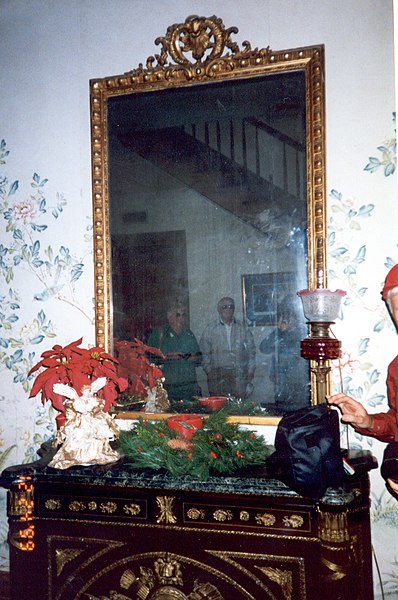
The Haunted Mirror: Where the spirit of Woodruff and her children lingers. Photo: Chris Light/1999
But it wasn’t the end at all, as Chloe planned her revenge on her slave masters. She baked a cake that she had poisoned with oleander leaves, which is extremely poisonous. Even the question of why she poisoned the cake is up for discussion.
Most accounts claim she did it for revenge after cutting off her ear. Another variant saying she was trying to gain favor with the family again as she was planning to cure the family for the poison and come out as a hero instead.
But according to the story, the plan backfired and only Sara Woodruff and the two daughters ate the cake and died from the poison. Chloe was then hanged by the other slaves and thrown in the Mississippi river, as a sort of final punishment for her or to not be punished themselves by Clark Woodruff for harbouring her.
A mirror in the house is supposedly holding the spirit of Sara Woodruff and her children. According to custom at that time, the mirrors were covered by a cloth so the spirit would not disappear into them. But after the poisoning, this particular mirror was forgotten and the ghosts of the victims can be seen in the mirrors and there are reports of handprints being left in the mirror, as their spirits are now trapped in the mirror.
The story about Chloe as a ghost is also told by the previous owner, Frances Kermeen, who also wrote a book on all the strange hauntings that she herself reported about experiencing on her second night in the house:
“I looked up and standing over me was a black lady. Her head was wrapped in a green turban,” I could see her [holding an] old-fashioned tin with the loop in it [through] the candlelight and I lost it. I started screaming…I reached my hand out to touch her, I could tell she was a ghost because she was see-through, but as my hand passed through her, she faded away.”
Do historical records support this though? There is currently not found any records of the Woodruffs owning a slave named either Chloe or Cloe. The legends say that Chloe killed both the wife and the daughters, but one of the daughters, Mary Octavia, survived and grew up to become an adult. And it is said that Sara and the other daughter, Cornelia, were not killed by poison, but by yellow fever in 1823 and 1824.
Either way, despite the historical records refuting the story, the legend about a woman wearing a green turban haunts Myrtles Plantation. Perhaps trying to tell a story that no historical records can?
The Other Ghosts
There are several pictures you can find on the postcards found in the souvenir shop at the plantation, the Chloe postcard being one of them. Another picture that stirred up quite some stories was the picture of a young girl dressed up in classic antebellum clothing that seems to look out from a window. She is now referred to as “The Ghost Girl” on the plantation.
Burial Ground
But the legend of Chloe is not the only claim of ghost sightings at the plantation among the Spanish Moss hanging from the giant oak trees. There is the classic tale that the house itself is built on an Native American burial ground, a trope of American ghost story tales that rarely can be substantiated. But even so, the ghost of a young Natice American woman has been reported.
In this case, the burial ground would be of Tunican tribes in the Mississippi River Valley, and the truth is that the land the manor now stands on used to belong to the Natives before being seized by the Spanish.
Civil War Soldiers
Advertisements
Another legend is about the Civil War and about how the houses were ransacked by union soldiers, and three people were killed. But exactly who was killed? The soldiers or the people living in the mansion? At the time, it was then Ruffin Gray Stirling and his wife Catherine Cobb that lived on the plantation with their slaves. It is true that they were robbed of their fine furniture and luxury items.
According to some of the variations of the legend though, it was the Union soldiers that were shot dead on the premises by the Confederates.
But something that is more up for debate is the supposed blood stain in the doorway, around the size of a human body remains that never will be completley clean after the supposed murders that happened then, no matter how well you scrub it.
The Voodoo Practitioner
The plantation is also the home of the ghost of a young girl that died in 1868, sometimes thought to be the girl in antebellum clothes from the picture. She was treated by a local voodoo practitioner in one of the 22 rooms in the manor, but died. She appears now in the room she died in and has been reported to practice voodoo on people sleeping in the room.
William Drew Winter
One of the other ghosts haunting this place is someone that either staggers or crawls up the stairs. He always stops on the 17th step. This is rumoured to be the ghost of William Drew Winter, the verified murder victim in the house. He was shot on the front porch of the house by a stranger. To get away, he crawled up the stairs but only reached the 17th step before he collapsed and died.
Several guests staying at the now B&B have claimed to hear the crawling coming from the stairs, and believing it could be other guests have gone to check. But when reaching the stairs, they find that no one is there, or worse, the apparition of his ghost, begging for help.
Although here, we have discrepancies in the story as a local newspaper reported that Winter died of a single shot that killed him instantly, and he had no possible way of crawling the stairs after the shot. But did he manage to in his afterlife?
The Plantation
No matter the fact we can now verify, the stories found of plantations from way back cast long shadows. All from the first contact between the natives and Spanish, throughout slavery and a bloody war. The darkest chapters of this plantation, is most likely the stories that we don’t know about.
An online magazine about the paranormal, haunted and macabre. We collect the ghost stories from all around the world as well as review horror and gothic media.