Tag Archives: innlandet

The Cabin in the Woods where the Forest Watches Back

Advertisements

The DNT Cabin Flisberget deep in the mystical forest of Finnskogen, bordering Norway and Sweden has a lot of strange tales coming from it. So much so, that it was voted the scariest cabin in the country. 

Deep within the endless forests of Finnskogen stands Flisberget cabin, alone among towering pines and moss covered stones. Outside of the cabin, the poisonous Badger’s-bane grows. It has been voted the scariest cabin as well as the people’s cabin, operated by the Norwegian Trekking Association.

Read More: Check out all ghost stories from Norway

By day, Flisberget is described as a jewel in the northern trail network. It is easy to reach, even for families with children. The path is clear. The cabin is welcoming. Smoke curls gently from the chimney. But when night settles over Finnskogen, the forest changes character.

Photo: Ingunn Holm/Wikimedia

A Place Apart from the World

Flisberget is part of the DNT cabin network north of Finnskogen, a place settled by lumber farmers from Finland centuries ago, creating a new culture, with their own customs and language. Because of the foreignness and shamanistic traditions of the Forest Finns, the Norwegians looked at these parts of the woods as a mysterious and supernatural place. 

The cabin is the main house on an old Forest Finn farm. The first known residents of Flisberget, or Ulvimäki as it is in their language, lived there in 1703. There was never much housing on Elverum Finnskog, but Flisberget is one of the places that the Forest Finns used. Some think that this place used to be a farm before the Black Plague even. People lived permanently on Flisberget until 1973. Today’s farmhouse was built c . 1850.

DNT proudly promotes the cabin as peaceful and accessible. Visitors, however, tell another story once darkness falls. They speak of uneasy sleep, of sounds that do not belong to wind or wildlife, and of a persistent feeling that someone is standing just beyond the tree line.

The members have spoken. From time to time you will find phrases in the guest books at Flisberget that “there is a lot of good in the walls here”, “there is a special peace here”.

When the Forest Breathes

Those who stay the night often report the same sensations. Footsteps circling the cabin without leaving tracks. The sound of movement between trees where no animal can be seen. Knocks that come once, then never again.

Inside, the wooden walls creak as if responding to unseen pressure. Some wake abruptly with the certainty that they are not alone. Others refuse to sleep at all. The last people that lived in the cabin, Oline and Hans Olastuen, told about strange things going on inside of the walls as well. 

But what is lurking around the cabin? The farm was written about in a book about Finnskogen and magic, or trollskap, as it’s called in Norwegian. There he talks about trollkjella, a monstrous troll woman that was nearby the farm by a water, and where a “trollkar”, a sorcerer who lived on the farm, sacrificed goats. Legend has it that they found a huge amount of bones at the bottom of the water.  

Trollkjella: Hans Olastuen has ventured to Trollkjella – he admits that it is eerie to see his reflection in the deep water. At this cellar, the trolls from Flisberget and Storsvea met every Midsummer night. No one knows what happened here, but just up until our time, large bone remains have been found on the cellar floor, probably from the sorcerers’ sacrifices. And there are still those who see a bit of everything at Trollkjella. // Source

Every Jonsok night, midsummer, he went there with other sorcerers. The sorcerer at Flisberget was also believed to be behind at least the murder of several men he cursed. 

Outside of the cabin it is said that he buried his black book of magic together with his silverware, hidden away. 

The Old Saying of Finnskogen

According to Åsmund Skasdammen, chairman of Finnskogen Tourist Association, the region has its own understanding of such things. In Finnskogen, the supernatural is considered natural.

For centuries, these forests have been home to wanderers, hunters, and people living on the edge of society. Finnskogen has always been a borderland, both geographically and spiritually. Folklore speaks of spirits tied not to buildings, but to the land itself.

The cabin remains popular. Visitors continue to arrive, keys in hand, unaware of the stories waiting for them. Many leave with nothing but memories of nature and quiet nights. And when the forest grows dark and still, it becomes clear why so many believe that something else has always been there, watching patiently among the trees.

Newest Posts

  • The Lafayette Vampire Grave in Colorado
    For decades, parents have told their children to be home before dark in Lafayette, Colorado. The reason being that local lore tells of a vampire rising from his grave in the cemetery. But who exactly was the man behind the story, buried under the tombstone?
  • Grave of the Helhest in Roskilde Cathedral
    Buried in the same place as the Danish kings and queens, a legend about one of the smaller graves haunts the Roskilde Cathedral. It is said that a horse was buried here before any people, and it haunts the graveyard as the three legged helhest, an omen of death.
  • The Haunted Ruins of Lier Hospital in Norway
    As a place of dubious drug testing and the place where most lobotomies were done, the Lier Hospital and former asylum was left with a haunted rumor lingering in the decaying walls. Although most of the buildings are now torn down, it is still remembered as one of Norway’s most haunted places.
  • A Haunting Helhest in Odense St Canute Cathedral
    The Danish ghostly horse spirit Helhest is said to roam around St. Canute’s Cathedral in Odense, Denmark. It is believed seeing the three legged horse is an omen of imminent death.
  • The Helhest Haunting Saint Olaf’s Church in Helsingør
    According to old legends and Danish folklore, there are stories of three legged horses haunting the churches and graveyards in the country. in Saint Olaf’s Church, the spirit of the helhest is said to be the omen of death.
  • The Hauntings of Gamle Aker Church Over a Dragon’s Den
    Could it be that the oldest church in Oslo also has the oldest haunting? From legends about a dragon’s den underneath the structure and the ghostly silhouette haunting, the Gamle Aker Church perhaps has more activity than what meets the naked eye.
  • The Janissaries Vampires in Veliko Tarnovo
    During a time when Bulgaria was under the Ottoman Empire, there was talk about a vampire haunting the streets of Veliko Tarnovo. The rumours got so bad, that the Islamic rulers had to turn to pagan belief to rid themselves of the bloodthirsty creatures.
  • The Legend of the White Lady of Utstein Monastery
    In the windswept landscape of Norway’s west coast lies the Utstein Monastery, a site steeped in history and haunting tales. Known as Norway’s best-preserved medieval monastery, its ancient stone walls and iconic Gothic windows whisper stories of faith, love, and loss as well as the ghost of a Lady in White.
  • The Lord Edward Pub: The Rebel’s Restless Spirit
    After dying for the cause of Irish Independence, it is said the ghost of Lord Edward is haunting the pub he is buried close to and bears his name.
  • St. Patrick’s Cathedral: The Restless Spirit of Jonathan Swift
    In the ancient St. Patrick’s Cathedral in Dublin, there are said to be restless spirits still lingering. One of the more well known is said to be the ghost of Jonathan Swift, perhaps best known as the author of Gulliver’s Travels.
  • The Hauntings of Stortorvet Gjestgiveri Restaurant
    In one of the city’s oldest buildings, the freshest food is served in the ancient locale. For years though, there have been talks about Stortorvet Gjestgiveri restaurant being haunted, and even made it as one of the most haunted clips in the national ghost hunting show.
  • The Headless Ghost of Buck Jones: Dublin’s Restless Sheriff
    Haunting Jone’s Road in Dublin, a headless horseman is said to roam after his life turned dark after scheming peers. And the former Dublin Sheriff, Buck Jones has become one of Ireland’s most well known headless horseman ghosts.

References:

Dem vart skræmt, ja 

Flisberget ble kåret til folkets hytte

Flisberget

Flisberget – Wikipedia

Finnskog og trollskap

The Haunted Legends of Stenberg Gård, Hoff Church and Toten Legends

Advertisements

Deep in the farmland of Norway, Toten has a lot of ghost stories lingering on the old farms and buildings. Who were the priests said to haunt the Hoff Church and rectory, and who are the ghosts said to linger at the old Stenberg Manor?

The district of Toten is rich in farmland landlocked east in Norway with old churches, and quiet waterways, and a few ghost stories lurking beneath its peaceful surface that have unsettled locals for generations. 

Read More: Check out all ghost stories from Norway

Among these tales are three locations bound together by whispers of the supernatural: Stenberg gård, the brook at Bøverbru, and Hoff Church. Each is said to be touched by a presence that refuses to fade.

Haunted Toten: Toten was part of a small kingdom in the early Viking Age and Halvdan Kvitbein was the most famous king who ruled there. The origin of the name is linked to the Old Norse Þótn , which supposedly means “something one likes”.Toten has traditionally been one of Norway’s largest agricultural areas, and the industrial park at Raufoss is one of the largest industrial centers in the inland.

The Ghost of Stenberg Gård

Stenberg (or Steinberg) is a large open-air museum that shows the cultural landscape, building practices and social conditions in Toten in the 19th century. The museum is built around the county manor Stenberg.

County magistrate Lauritz Weidemann (1775-1856) developed Steinberg into a county magistrate’s residence. He took over the farm in 1802 and laid out today’s yard and an almost 30-acre park in the English landscape style. Weidemann was also known as one of the men at Eidsvoll when Norway received its constitution in 1814.

Stenberg Manor, or Gård (farm) is widely believed to be home to Toten’s most famous ghost. The historic farm, known for its cultural significance and well preserved buildings, has long been surrounded by rumors of unexplained activity. people claim to this day that they have experienced a number of unpleasant incidents on the farm. It has been said that the Weidemann family is going again.

Visitors and staff alike have reported strange sounds after dark, shifting shadows in empty rooms, and the unsettling feeling of being observed. Though the identity of the spirit is never clearly agreed upon, local lore insists that something still walks the halls of the old estate, guarding its past or reliving a tragedy long forgotten.

Blind Ola of Bøverbru

Near the brook at Bøverbru, another chilling legend is often told. According to reports shared in Oppland Arbeiderblad, a blind man known as Blind Ola is said to have drowned in the water long ago. 

Since then, swimmers and passersby have described eerie experiences near the stream. Some claim to feel unseen hands pulling at them beneath the surface, while others speak of sudden cold currents and strange sounds rising from the water. The story has made the area a place of caution, especially after dusk.

Whispers Around Hoff Church

Hoff Church in Lena, east Toten is also the subject of debate among those who believe the past never truly rests. Parishioners and visitors have spoken of unexplained noises, shadowy figures, and an uneasy atmosphere within the church grounds. For believers, these phenomena are signs that the dead still linger close to the sacred site, bound by unfinished business or ancient traditions.

In 2009, the legends stirred when the church bells started ringing and the police were called. The priest stopped the bells, but they found no sign that anyone had been there. The bells are controlled by a remote, and when they checked it out, there was no sign of technical faults, although they could never completely rule out that someone had put on an elaborate prank. 

Haunted Church: Hoff church at Østre Toten by Lena, Oppland, Norway. Hoff kirke ved Lena på Østre Toten. //Source: Øyvind Holmstad

But who is haunting the church? Could it have something to do with the old ghost story? At a Christmas party at the widow Bolette Cathrine in Kristiania (Oslo) in the late 1870s in the presence of several witnesses. 

The event is said to have taken place at Hoff rectory “some time ago”. Author and the storyteller, Marie Wexel came to Hoff rectory one Christmas Eve with a lady from Kristiania. At the dinner table, the priest said a few words about a haunted room on the second floor, but the priest reproached her for mentioning it; it could only frighten the guests unnecessarily. The two ladies got up early to go to bed. 

Marie sat down in the armchair instead to read before going to bed as her companion had done. When she had finished, she put the book in her lap to think about what she had read. “As she looked up, she caught sight of a priest in old-fashioned vestments standing just in front of her with a pleading look and pointing in the direction of the cake oven. Then the vision immediately disappeared. She wiped her eyes and thought it was a figment of her imagination, perhaps brought on by what the priest had said. She went to bed, however; but as she extinguished the last candle she saw the same figure standing before the table and bending over it towards her, as he now pointed with the same pleading look towards the cake oven”.

The Haunted Hoff Rectory on a sunny summers day

The next morning she took a lighted candle with her to get a better look at the attic and the stairs. But as she was about to go out the door, it went out. To get it burning again she took a match from a container on the wall and struck it against the firewall. At the same moment as the light was lit, the priest stood before her for the third time, but this time next to the tiled stove and pointing towards the firewall. Terrified, she rushed downstairs and told her host what she had seen. He told her to keep quiet about it. 

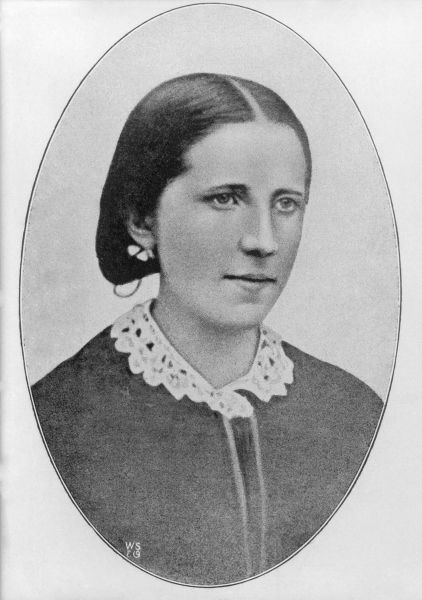
Marie Wexelsen: (born 20 September 1832 at Sukkestad in Østre Toten, was a hymn writer and author. Her full name was Inger Marie Lycke Wexelsen. She is best known for the Christmas hymn Jeg er så glad hver julekveld.

But after the service, he and Miss Wexelsen stayed back in the church, where there were painted portraits of a number of Toten priests. He told her to look at them carefully and point out the one who resembled the ghost. After looking at all the pictures carefully, she went back to one of them and said: “If I haven’t seen a fantasy fetus, then he’s there.”

This was the portrait of a priest (“the name should not be mentioned”) who, according to legend, was supposed to have killed a small child he had with his maid; the child’s body was never found. “Late in the Christmas period, the parish priest quietly made an agreement with a bricklayer and another person – probably the churchwarden – to punch a hole in the firewall in the room upstairs in the rectory. And here they found a child’s skeleton, which was buried in complete silence by the priest. And later there was never a “ghost” at the East Toten rectory. Source

The Ghost of The Yellow Hall

One of the rooms in Hoff vicarage was called “The Yellow Hall” and also have a story of the ghost of a former priest lingering. There is a legend connected to this room, which can be read about both in Totenmål and Anna Mål 12 and in The Great Book of Ghosts (Espeland). 

The legend goes that there was a priest who was once a resident of the manor. One evening, as the parish priest was busy with his Sunday sermon, he was said to have seen a figure in a bluish tinge, and he got the feeling that this was someone in deep spiritual distress. The figure led the priest to the yellow hall, where the ghost knelt by a fireplace and appeared to be praying. After the service the next day, the priest recognized the figure in one of the priest pictures in the church. He had the fireplace examined, and there they found the skeleton of a woman. After the skeleton was buried in consecrated ground, the ghost is said to have been seen no more.

Newest Posts

  • The Lafayette Vampire Grave in Colorado
    For decades, parents have told their children to be home before dark in Lafayette, Colorado. The reason being that local lore tells of a vampire rising from his grave in the cemetery. But who exactly was the man behind the story, buried under the tombstone?
  • Grave of the Helhest in Roskilde Cathedral
    Buried in the same place as the Danish kings and queens, a legend about one of the smaller graves haunts the Roskilde Cathedral. It is said that a horse was buried here before any people, and it haunts the graveyard as the three legged helhest, an omen of death.
  • The Haunted Ruins of Lier Hospital in Norway
    As a place of dubious drug testing and the place where most lobotomies were done, the Lier Hospital and former asylum was left with a haunted rumor lingering in the decaying walls. Although most of the buildings are now torn down, it is still remembered as one of Norway’s most haunted places.
  • A Haunting Helhest in Odense St Canute Cathedral
    The Danish ghostly horse spirit Helhest is said to roam around St. Canute’s Cathedral in Odense, Denmark. It is believed seeing the three legged horse is an omen of imminent death.
  • The Helhest Haunting Saint Olaf’s Church in Helsingør
    According to old legends and Danish folklore, there are stories of three legged horses haunting the churches and graveyards in the country. in Saint Olaf’s Church, the spirit of the helhest is said to be the omen of death.
  • The Hauntings of Gamle Aker Church Over a Dragon’s Den
    Could it be that the oldest church in Oslo also has the oldest haunting? From legends about a dragon’s den underneath the structure and the ghostly silhouette haunting, the Gamle Aker Church perhaps has more activity than what meets the naked eye.
  • The Janissaries Vampires in Veliko Tarnovo
    During a time when Bulgaria was under the Ottoman Empire, there was talk about a vampire haunting the streets of Veliko Tarnovo. The rumours got so bad, that the Islamic rulers had to turn to pagan belief to rid themselves of the bloodthirsty creatures.
  • The Legend of the White Lady of Utstein Monastery
    In the windswept landscape of Norway’s west coast lies the Utstein Monastery, a site steeped in history and haunting tales. Known as Norway’s best-preserved medieval monastery, its ancient stone walls and iconic Gothic windows whisper stories of faith, love, and loss as well as the ghost of a Lady in White.
  • The Lord Edward Pub: The Rebel’s Restless Spirit
    After dying for the cause of Irish Independence, it is said the ghost of Lord Edward is haunting the pub he is buried close to and bears his name.
  • St. Patrick’s Cathedral: The Restless Spirit of Jonathan Swift
    In the ancient St. Patrick’s Cathedral in Dublin, there are said to be restless spirits still lingering. One of the more well known is said to be the ghost of Jonathan Swift, perhaps best known as the author of Gulliver’s Travels.
  • The Hauntings of Stortorvet Gjestgiveri Restaurant
    In one of the city’s oldest buildings, the freshest food is served in the ancient locale. For years though, there have been talks about Stortorvet Gjestgiveri restaurant being haunted, and even made it as one of the most haunted clips in the national ghost hunting show.
  • The Headless Ghost of Buck Jones: Dublin’s Restless Sheriff
    Haunting Jone’s Road in Dublin, a headless horseman is said to roam after his life turned dark after scheming peers. And the former Dublin Sheriff, Buck Jones has become one of Ireland’s most well known headless horseman ghosts.

References:

https://www.filmweb.no/filmnytt/de-mest-hjemskte-stedene-i-norge

Stenberg

Stenberg, Stenberg gård | Reporterne flyttet inn på spøkelsesgården

Leter etter spøkelser på Toten

Mystisk klokkeklang – NRK Innlandet – Lokale nyheter, TV og radio

Hoff prestegard (Østre Toten gnr. 94/1) – lokalhistoriewiki.no