Notre Dame Cathedral in Paris has been a site of intrigue and mystery for centuries— its haunted halls filled with stories that spark the imagination with ghosts on the roof and an ironworker that sold his soul to the Devil.
The Notre Dame Cathedral in Paris has captivated visitors for centuries with its stunning architecture, stirring religious artifacts, and gripping tales of mystery. People come to hear the bells ring to remind us about the hunchback of Notre Dame and see the frightening gargoyles along the roof.
Rumors of hauntings have further cemented the cathedral’s reputation as a supernatural hot-spot, leaving its visitors to ponder whether these rumors are just urban legends or based on fact.
History of the Notre Dame Cathedral
Noted by visitors from all across the world, the Notre Dame Cathedral’s captivating architecture has inspired many throughout the ages. Built of limestone and characterized by its two towers flanking its main entrance, it has stood tall for centuries as a testament to Gothic style. Its intricate carvings, majestic details, and mesmerizing sculptures carve a path for learning about the history that lies within its walls and contributes more to the speculation of paranormal activity.
From its construction in 1163 to its destruction by fire in 2019, the iconic cathedral has served as a beacon of faith for thousands of years and amassed tales that might never be fully unraveled.
The Devil and the Ironworker
One of the most enduring tales of hauntings in Notre Dame is that of a mysterious ironworker who sold his soul to the devil in exchange for mastery over his craft. According to legend, the best ironworker, Biscornet was commissioned by the church to create the metal for the cathedrals door at the inauguration in 1345.
The work was too much and he was in danger of not being done in time. But at the inauguration the metal work was done, there was only one problem. No matter how hard they tried, they were unable to open the door.
When they went to Biscornet to ask him about it, they found him hanged with a note warning them to spay holy water on the door to make them open.
It was then believed that the ironworker had made a pact with the devil and sold his soul to get the work done in time for the opening day.
The Women on the Notre Dame Roof
The creepy story about the demonic front door is not the only legend about the old cathedral. According to legend, there are also spotted some ghosts as well.
Two female ghosts haunt the roof of Notre-Dame cathedral were they can be seen between the grey gargoyles and gothic carved stone. Apparently you can see them walking on the cathedrals roof before either jumping off the roof or disappearing as soon as you see them.
A haunted chapel known as Hardtkapelle Wielenbachcan be found in the darkness of the Bavarian forest, surrounded by black hellhounds and a woman in white. This place is of the more unholy sorts.
Forests in Germany are where the darkness creeps in and where stories about ghosts and ghouls take form.
In this particular Bavarian forest in the city of Weilheim in Wielenbach, perhaps a mere hour away from Munich, there is a small but still frightening chapel according to the legends that is said to be particularly dark and where the devil himself appeared.
The Haunted Hardtkapelle Wielenbach
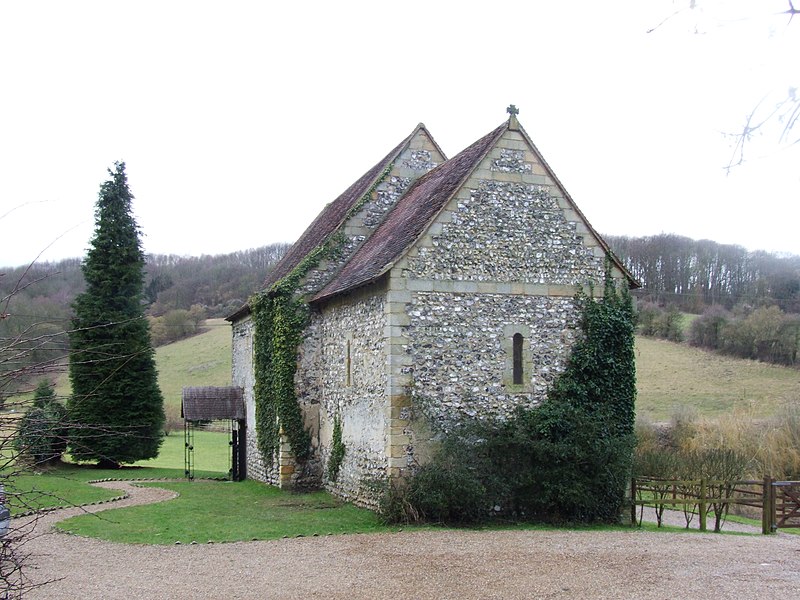
The building from the outside of the Hardtkapelle Wielenbach looks innocent enough as the white walls and church tower looks like any other little chapel in these parts.
Still, there are many young and hopeful visitors who visit each year to get a taste of the haunted place, not necessarily of the godly kind, but perhaps many of them get a little more than they bargained for. Because according to those visiting, they report about being nauseous and being dizzy, some even suffering a panic attack after spending enough time in that place.
It is said that the Hardtkapelle Wielenbach is surrounded by huge black hellhounds as the dark forces have been plentiful around these parts for centuries. One can wonder if the chapel is really what keeps the evil inside, or if it attracts it all together. You can hear the hellhounds growling in the background between the trees.
The Haunted Hardtkapelle Wielenbach: The chapel look cozy and innocent at day among the green trees, but when the sun goes down and the trees grows darker, the ghosts come out to play. Gras-Ober/wikimedia
At night a light is always burning at the small chapel when no one is there to light it up. Sometimes a woman in white is suddenly appearing at night close to the chapel. Who she is, friend or foe, is difficult to say.
The chapel we see today was built as a pilgrimage church in 1865 with the Patroness being Saint Anne, the mother of Mary. It was built on the grounds of a chapel that used to be there but was demolished back in 1250.
The Devil’s Kick
There have been many reports about this strange place and one of the legends dates back to the time before there ever was a Hardtkapelle Wielenbach there. When this was is unclear as not much of Germany’s history dates back in written form before the 1200s.
But according to this legend there was a huge fight among the neighboring villagers. Citizens of the town of Weilheim and Haunshofen fought about grazing rights for their animals in the surrounding area and the arguments were getting heated with harsh words being thrown back and forth.
A man stepped out from the crowd and they say he was the devil in the form of a shepherd who had come to join them. He put a big stone on the ground and yelled out
“When I kick this stone, this belongs to Haunshofen”
Then he kicked his foot into the ground, creating a hoof-like hole that he disappeared into.
This stopped the argument and the Hardtkapelle Wielenbach was built around the stone with the hoofprint to protect the evil from it to come out again.
If they really were successful remains to be seen.
The Devil’s Hole: At the altar at the Hardtkapelle Wielenbach in Bavaria, Germany, you can see the hole the chapel was built around. // Source: Henning Schlottmann//wikimedia
The tidal island of Mont Saint-Michel in France holds many secrets of the sea and is said to be haunted by both monks disturbed of their eternal rest as well as soldiers from the bloody battlefields of the Hundred Year War.
Mont Saint-Michel, the mysterious and spectacular island off the coast of France, has fueled an array of mysterious stories for centuries. It’s a little tidal island in Normandy, northwest in the country, one-half nautical mile off the mainland.
The tidal island of Mont Saint-Michel has served many purposes, mostly as a monastery and today it is a small village with around 50 villagers. It has also been a location for many battles and a prison known as The Bastille of the Sea.
While people may debate if Mont Saint-Michel is really haunted, locals and visitors alike have shared stories about eerie figures, ghostly voices, and strange sightings which add to the legends surrounding this awe-inspiring destination.
History and Legends of Mont Saint-Michel
Mont Saint-Michel is an ancient destination and pilgrimage site that has been embraced by nature. Its sides are steep and nearly inaccessible from the mainland, with huge cliffs around its shoreline. The island was a great reminder of pilgrimages that they were indeed on the right path.
Mont Saint-Michel’s tides are the product of complex natural interactions between wind, waves and the gravitational pull of the sun and moon. This happens when large masses of water on the earth’s surface respond to these forces.
The tides of Mont Saint-Michel vary greatly, at roughly 14 meters between highest and lowest water marks. Popularly nicknamed “St. Michael in peril of the sea” by medieval pilgrims making their way across the flats, the mount can still pose dangers for visitors who avoid the causeway and attempt the hazardous walk across the sands from the neighboring coast.
Ghost Monks of Mont Saint-Michel
Most of the people living in this little tidal island were pious monks in the abbey. When the monks died it was common to bury them inside of the walls of churches and abbeys. When the French Revolution came around for Mont Saint-Michel, a lot of abbeys and churches were desecrated as they needed the building material of the building or even the fortune the monks kept.
Some say that the monks buried inside of the walls who had their eternal rest disturbed by the revolution are haunting the place as their souls were awoken to roam Mont Saint-Michel.
The Ghost from the Hundred Year War
Mont Saint-Michel has had a long, dark history and its fair share of battles. One of the most famous and mysterious tales is that of “Le fantôme de la guerre de 100 ans” because this haunting story dates back to an incident during the Hundred Year War.
The Hundred Year War really impacted generations of French people and the mindset of the French. It was here heroes like Joan of Arc stepped forward, but also many lost their lives during it as most of the waring happened on French soil. And even if the victory ended with French victory, the people, the land as well as their history going forward would be tainted by the blood of the long war.
During the Hundred Year War, England tried several times to take over the Mont Saint-Michel, but were unable to because of the natural as well as human made fortifications. They tried in 1423 and 1433 but the island knew how to protect itself.
It is said that there were several soldiers who were killed in battle defending Mont Saint-Michel from the English troops on the nearby beaches on one of the bloodiest days in the war. More than 2000 Englishmen were killed under the command of Captain Louis d’Estouteville.
According to legend the souls of the soldiers that perished in the battle are now haunting Mont Saint-Michel, especially near the water. The ghost of Captain Louis d’Estouteville has also been spotted around Mont Saint-Michel, still protecting the abbey.
Discover the secrets and legends of Abbaye De Mortemer, an infamous haunted abbey in rural France. Explore its haunting history from Dames Blanches, ghost monks, werewolves and a goblin cat guarding a treasure.
Hidden deep within the French countryside lies the Abbaye De Mortemer, an ancient structure with a chilling past. The former Cistercian Monastery in the Forest of Lyons is the home to eerie sightings and ghostly apparitions.
Origins of the Abbaye De Mortemer
Established in 1134, the Abbaye De Mortemer was an ancient abbey that was a gift to the Cistercians by Henry I of England.
Read Also: There are many supposedly haunted abbeys and monasteries around the world. Check them out: Here
The name comes from the stagnant water of the lake that was dug out by the monks. It was called the Dead Pond which in French is Morte Mare.
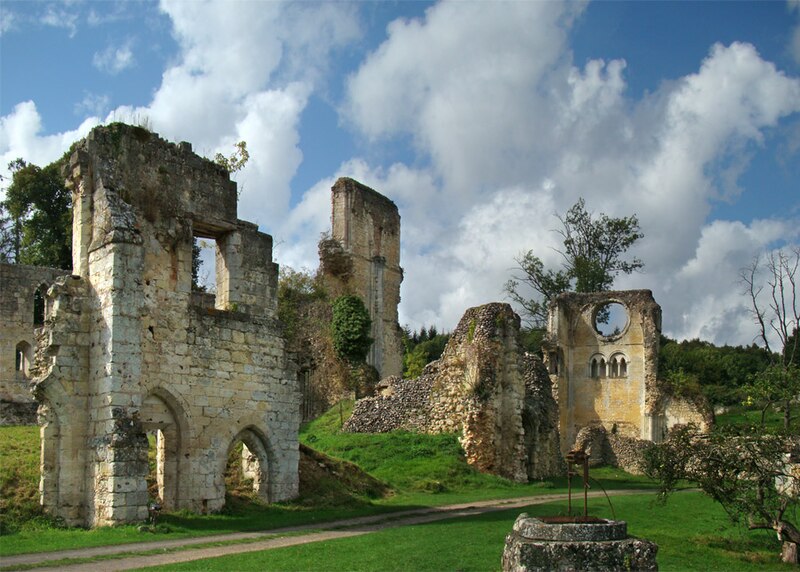
Abbaye De Mortemer Ruins: Most of the once grand abbay in France is now only ruins and is said to be haunted by more than one ghost. //Source//Wikimedia/Tango7174
Who owned the abbey depended on who owned the land from year to year. It was founded by the English king, but ended up under the French crown after the Hundred Year War ended in 1453.
It held out despite it falling into disrepair until 1790 when it was dissolved under the French Revolution. Only 4 monks remained alive living in the abbey. They would end up remaining there, even in their afterlife.
Dame Blanches of Mathilde I’Emperesse
The one thought to be haunting the place is the daughter of Abbaye De Mortemer founder, Mathilde I’Emperesse or Matilda of England.
Her father was King Henry I of England and she was one of those with a claim to the English throne in the civil war between England and Normandy between 1138 and 1153 which was known as The Anarchy.
Why she is haunting this abbey is unclear as she died at an old age far away. She had close ties to this abbey as it was said she was a very spiritual woman and the order of the Cisterican monks because of the importance of the Virgin Mary, a saint of great importance to her.
A picture supposedly depicting her ghost got well known in 1999, however French television has since debunked the image as lighting trickery.
According to legend she walks by the ancient pools and mist is created on them. By local lore you do best to look away if you spot her. If she wears black gloves it means bad luck and misfortune. If she is wearing white, there is a happy event in the coming year. If you see her twice though you are condemned to death.
The Helpful Ghost Monks
People have reported a number of sinister legends and stories about the Abbaye De Mortemer. One popular story involves sightings of the infamous Black Monks, which are said to appear on dark nights in the abbey’s ruins.
This is believed to be the ghosts of four monks who were murdered during the French Revolution in 1789 when the churches and abbeys were robbed for their wealth to fund the revolution and the monks were hunted down and dragged to the old cellar were the last brothers of the orders were massacred.
Other visitors have experienced ghostly apparitions, chills, strange voices, and other forms of supernatural activity. Both the Delarue family that were going to move into the former abbey reported about seeing the monks as well as an English paratrooper in the second world war.
He said that he was spotted by the enemy and was running around in the forest to hide. A monk came forward and guided him to safety before disappearing. The people at The Resistant Cell the paratrooper found, knew it had to be a monk from the Abbey.
The Goblin Cat Haunting the Treasure
The haunted abbey is also said to be the home to a certain Goblin cat you can meet in the ruins in the form of a black cat.
According to the legend, the cat is guarding a certain treasure of the abbey said to be so grand it could restore the abbey to its former glory.
The She-Werewolf
One of the most famous legends concerning the Abbaye de Mortemer is the story of a werewolf haunting its grounds. According to legend, a cursed woman transformed into a wolf every night and terrorized all who crossed her path.
This was thought to be a female werewolf known as the Garache in French Folklore with yellow eyes. This is the only tale of a Garache in Normandy apparently, a weird thing perhaps as French Folklore is filled with legends of shape shifting werewolves.
A man named Roger Saboureau was out poaching in the forest in 1884 when he encountered this werewolf and he shot it dead without hesitation.
When the Garache died though it returned to its human form and he saw it was his own wife.
The Demonic Pink Room
In 1863 the building, restored somewhat and made into a family home, was bought by a rich Parisian named M.Delarue. He moved into the place with his wife and two children, but they soon found that it wasn’t without its history.
One of the most notorious stories revolves around Abbaye De Mortemer’s so-called “Pink Room.” The room is mentioned by some of the owners who experienced so much hauntings it even broke an engagement.
A young girl who was the fiance of the son, Charles Delarue, the owner of the building and living there came to stay with them once. She was given the pink room as it was the only one available. She was found in the morning, terrified of all the paranormal activity that had happened during the night. She announced she would never live there, broke off the engagement and hurried back to Paris.
M.Delarue’s daughter had been a nurse during the First World War and told her father she had never been afraid in the trenches and would not be afraid of the pink room either. She made it her own and lived in it, but said that she always felt observed, but not threatened in the same way the former fiance of the family had.
The Exorcism of the Abbey
The Delarue family stayed in the former abbey for quite some time, but in 1921 they thought it was about time with an exorcism. Not the first one though, and they called once again upon Abbé Humbolt who had done the previous ones also.
They ordered another exorcism of the Pink Room and the Abbey and it did become quiet for some time. But then it started again. How is it today?
Explore the mysterious Basilique du Bois-Chenu, a church dedicated to the French national hero and saint Joan of Arc, where rumor has it is haunted by her spirit.
Have you ever heard the dark and mysterious tales of the haunted Basilique du Bois-Chenu? This neo -Romanesque style church in Domremy is dedicated to Joan of Arc close to her hometown and is also called Sainte-Jeanne-d’Arc de Domrémy-la-Pucelle.
Bois-Chenu basilica is rumored to be a hotbed for paranormal activity where it is nestled far away from the crowd in the French countryside. Learn about its history and legends here, and find out why it’s one of the most haunted spots in Europe!
History of Basilique du Bois-Chenu
The Basilique du Bois-Chenu was originally built in 1881 close to the place where it is said that Joan of Arc started hearing voices in the hills where she was herding sheep. These visions were those that would eventually lead her to fight the English. It took a long time to build the Basilica and it wasn’t completed until 1926.
It was originally meant to be dedicated to SAint Michael as Joan of Arc wasn’t made into a saint until 1922. Since the building of the Basilica, many strange events have been reported at the church, attributed to the saint that it was dedicated to.
But who was really Joan of Arc before she became a symbol? The young girl were a French heroine and now a patron saint of France who fought against the English in the Hundred Years War before being burnt at the stake.
Before becoming this iconic warrior of her country under God’s command, Joan of Arc was born into a peasant family in Domremy in northeastern France in the middle of the long war. She didn’t read or travel much, but was regarded as a very intelligent person and well spoken that would convince even the King of France that she was the chosen one.
Prophetic Visions: Joan of Arc claimed she was visited and given visions from God when she was a young girl. The portrait depicts Joan of Arc’s awe upon receiving a vision from the Archangel Michael. Painted by Eugène Romain Thirion
In 1425 when Joan of Arc was around 13, she started having these visions from the archangel Michael that she was chosen to be guided to help save France from English attacks. But where did this girl even get this idea from? Was it really from an angel, or did she have a personal ambition to be the country’s savior?
The Prophecies about the Maiden Saviour
During Joan’s youth, a prophecy circulating in the French countryside, based on the visions of Marie Robine of Avignon, promised an armed virgin would come forth to save France from the English. Marie Robine, known also as Marie of Gascony, or of Avignon, had arrived at Avignon in 1387, on a pilgrimage in the hope of being cured of an illness.
Another prophecy, attributed to Merlin from the Arthurian Legends, stated that a virgin carrying a banner would put an end to France’s suffering.
Joan of Arc herself meant she was this promised maiden, reminding the people around her that there was a saying that France would be destroyed by a woman but would be restored by a virgin. Now the only thing that remained was to make people believe in her.
Becoming a National Hero Before Being Burnt at the Stake
Joan of Arc claimed that she was under God’s guidance and became a military leader despite her gender, her social status and gained recognition as a savior of France. Her arrival had already been predicted by multiple so-called prophets before her and when she came as a hope it was much needed as France was in turmoil politically and financially and needed a hero.
Battle Heroine: Joan of Arc is well known for leading France to victory during the battle of Orleans. Painted by Eugène Lenepveu.
She insisted on going to Charles VII of France and he was convinced of her and sent the 17 year old girl to Orleans to fight. The battle was a French victory and helped boost the morale of the troops and the Hundred Years War ended in French victory a couple of decades later. Because of this she is also known as The Maid of Orléans.
However, all of her battles were not as successful and she failed under the siege of Paris in November 1429 and siege of La Charite in November. This made the court lose faith in her.
In 1431 Joan of Arc was put on trial for heresy, blasphemy because of wearing men’s clothes, acting upon demonic visions and not doing as the church told her. She was declared guilty and burned at the stake on 30 May in 1431, just 19 years old.
The Paranormal Phenomena at Bois-Chenu
After her death there have been a number of reports that claim they have seen the spirit of Joan of Arc around in France. Little girls in particular claimed they have spoken to her, and there are between 50 to a 100 people written reports of it.
There have been several claims that people have seen her ghost close to the Basilique du Bois-Chenu as well as around her birth home and the church she attended and started having visions.
It is said that strange noises and apparitions have been experienced throughout the grounds of Bois-Chenu, both during the day and in the dead of night. Mysterious presences have been spotted roaming around the desolate Basilique du Bois-Chenu and it’s thought that at least two ghosts are permanently resident here.
Visiting the Basilique du Bois-Chenu Today
Today, a visit to Bois-Chenu is still an experience filled with mystery and intrigue. The Basilique du Bois-Chenu is far out in the French countryside where a young and illiterate girl started out before becoming one of the most famous people in history.
In the heart of the British countryside, the past of the plague, death and history haunts the desecrated church. But amid the mystery of the paranormal and pagan ley lines, the once cursed site has found back to being sacred.
There are a lot of magical and mysterious things surrounding the church that stands in solitude in the countryside in Kent. The original building on top of the hill was built around 1100 during William the second rule. But the man made ground it was built on has perhaps been used as a holy place to gather long before Christianity reached the British shores.
Around this church there also used to be a village, alive and thriving. But together with the black death the villagers were swept away, and with them, the village of Dode died as well.
Ley Lines and Ghosts
Haunted church: Dode church was left abandoned for centuries with rumours of being haunted and used for black magic rituals. Source: Chris Whippet
All left from the lost village of Dode is the old Norman church that is said to be haunted by a little girl. This is not the only paranormal and mystical rumours surrounding this place, this particular church. The old ruins are built on not only one, but eight ley lines, mystical lines that allegedly connect several holy buildings, monuments and places around the world according to modern paganism.
The place is filled with history as archeologists have found evidence of it being inhabited since the roman empire, perhaps even much further back in time.
The church was eventually not used as a place of worship and they changed the name of the land it was built on. Because of the rumours about it being cursed, the name Holy Hill was changed to Holly Hill as no one felt the presence of anything holy there anymore, as rumours and legends of it being cursed grew.
The Dodechild
But who was this ghost said to haunt the abandoned church? Legend has it it was the last survivor of Dode village. After the Black Death in the 14th century, the village of Dode was abandoned. Nature claimed back the signs of living, leaving only the church as proof humans once lived there.
Advertisements
However, there was still one of the villagers left. A seven year old girl was one of the last survivors in the village, seeing how everyone was being taken by the plague. She took refuge inside the church, eventually dying herself, but never really leaving. And according to local legends, she would appear on the first Sunday morning of every month, haunting the grounds of were her and her entire village perished in the plague that killed millions of people across Europe.
Since the time of the plague, the village was abandoned, the church forgotten and time, weather tore down the roof, the stones taken to build a medieval church nearby. It was only known as the haunted and lost place to the locals. It was believed the place was a cursed one, and that it was used for black magic rituals. Thus the Holy Hill was renamed Holly Hill and the church boarded up, taken apart and left for centuries until someone would find the place sacred once more.
A Sacred Place for All
Wedding: The church is now used as a wedding venue for all types of ceremonies.
The church was rebuilt in the 90s after being abandoned for centuries, with the vision of bringing the holiness back to it and the work to get it back to how it would have looked originally began. With the restoration, life also came back into the hidden valley. Although this time, not a strictly catholic religious house as it used to be, but more of a sacred place for all, both for Catholics, members of the Church of England and pagans alike.
Since then it has been a venue for weddings, making it a place for eternal love declarations, bringing the serenity back over the once holy hills. Other events such as baby namings, memorials and other cultural events also takes place in it, as long it is more of a spiritual than religous event.
And with the new life that has been breathed into the valley and nearby woodland, the ghost of the little girl also has been seen less and less.
From medieval times, history and bloody memories lingers in one of the only and longest standing cathedrals in Norway. This is the story of the Bloody Monk in Nidarosdomen and the haunting of the Cathedral.
Once upon a time in history, the Nidarosdomen in Norway was the most visited place for pilgrimage in Northern Europe and is situated in Trondheim in Norway. People came a long way to seek salvation, peace and God in that holy place. That was those days and today it is mostly a big tourist attraction as well as some of Norway’s most well known buildings.
Nidarosdomen in Trondheim: The Cathedral has been rebuilt many times and started as a wooden chapel and the cathedral was finished by the 1320s. This is Nidarosdomen from 1821 by Carl Johan Fahlcrantz. This was how the cathedral looked before its major restoration and additional towers and much more like how it would have looked in medieval times.
Perhaps far from it today, Norway was a country of Catholics in medieval times, having nearly rid itself with its pagan roots of the Vikings and Norse Mythology, much later than rest of Europe perhaps. It was a church, much more mysterious than the one today that built upon both the learned Catholic as well as the pagan viking traditions.
Read more: Check out all of our ghost stories from Norway
Today the monasteries in Norway is from ancient times and most of them are turned to ruins, made to museums and stands as a memory of the power the catholic church once had of the country. Other cathedrals and churches from the time like Nidarosdomen were transformed to act as a house of God, even after the country became protestant.
The Haunted Cathedral in Trondheim
A place where the fantastical cathedrals continues its mission in a new suit is the Nidarosdomen, in the heart of Trondheim and one of the countries most precious religious buildings. But one can still hear the echoes of the past in the big halls and the memories of the monks still lingers in the walls.
Monks were men that gave up most of the earthly life to serve their lives in God’s service. They forsake the right to marry, have children and own properties in their name. The monks became anonymous, one of many and a part of an order with a strong hierarchy. They all dressed the same as their order, in robes to hide, to look the same. Even the face could be covered to not give away the identity. And at least on of these monks are said to still be wandering the halls of the cathedral in Trondheim.
The Bloody Monk: The Cathedral Nidarosdomen in Trondheim, Norway is said to be haunted by the ghost of The Bloody Monk. Tales of ghosts that looks like monks or nuns are often reported on appearing in old churches and even just the ruins of them, haunting after a great dishonor to their faith was done or perhaps they themselves couldn’t live the strict life of a monk without a sin?
Nidarosdomen is built over the burial site of King Olav II (c. 995–1030, reigned 1015–1028), who became the patron saint of the nation after his death as he was the one who really brought Christianity to the country, and is the traditional location for the consecration of new kings of Norway.
Over centuries the cathedral grew from a small chapel to one of the biggest churches in Norway. It has withstood fires, the reformation, the roof blowing off and if we are to believe the rumours, it has even managed to preserve one of the long residence ghosts.
The Bloody Monk in Nidarosdomen
The first encounter we have found on the monk haunting the Nidarosdomen, comes from the month of January in 1924. It is a cold day in the city of Trondheim and the stone walls do little to keep the cold winter outside from the Maria Chapel in Nidarosdomen. Still, the people flock to Sunday service, now turned to a protestant church.
The congregation gathered together in the hall in prayer and song. Perhaps that is what brought the The Bloody Monk in Nidarosdomen forward this day? A hymn sung for centuries, a prayer heard this Sunday that acted as a summoning for ghosts? Was is the chanting voices from the whole congregation joined in the song as a choir? Something the monk recognized from the time he was alive?
People were gathering, chanting songs and prayers as the monk themselves once did, wandering with their incense? It’s hard to know exactly what with this particular sermon that brought him out. But since then, he has been a ghost observed many times in the cathedral and has been dubbed The Bloody Monk.
Holy Church: The Cathedral of Nidarosdomen is important for Norwegian christians as it is the resting place to one of the greatest saints in Norway, King Olav the Holy that died on the battlefield after bringing the religion to the country. After his death it was said his hair and nails continued to grow after death. Is it the holiness of the cathedral that keeps the ghosts haunting it, or is the place just built upon haunted ground already?
Marie Gleditch, wife of the bishop was the one that saw The Bloody Monk first. She claimed she saw a ghostly figure glide through the crowd gathered for service. She described him as a middle aged man with the monk robe hanging over him. This would not have been an unusual sight in medieval times, but in 1924, long after the monk orders had disbanded, this was not normal. Furthermore, Gleditch described the The Bloody Monk in Nidarosdomen to have glowing eyes when she got a better look. But perhaps more striking is that he had a bloody stripe across over his throat, almost as if it was cut right through, giving him his name.
The Ancient Chant of the Ghost Monk
What really happened to this ghost? Was he really beheaded as the bloody throat would suggest? Was he murdered in cold blood? Or perhaps executed for a crime? We will probably never now as details of who came and went to this place was too may to count and keep track of.
Since that time, the ghost of The Bloody Monk in Nidarosdomen with glowing eyes have created headlines several times in the country. It was for instance also seen by a bishop Alex Jonson who saw the figure in the cathedral in 1933. The Bloody Monk has perhaps become one of the more famous ghosts in Norway and people have visited the cathedral, just to try to get a glimpse of The Bloody Monk.
In 1966 a guy named Jon Medbøe forward with his story when he claimed to have encountered The Bloody Monk with his students when they had nightly walks in the cathedral and could hear something that sounded like footsteps dragging over the floor as well as a mysterious chant.
Medbøe who was a music historian and tried to pinpoint exactly what the music was like. He claimed the monk chanted a song, more specific, a choir song from the middle ages. A well known melody from the composer Perotinus from 1208. Was this perhaps the song that was played in 1924? Or something similar?
The Chanting Monk: This is one of Perotinus compositions and gives an idea of the type of chanting The Bloody Monk were doing. Perhaps this or something similar is the reason he is haunting the Cathedral?
Several have tried to come to the bottom of this mystery and after these modern sightings, it was written a lot about it it, even in German magazines. Who was this lonely monk, still wandering the halls, chanting old forgotten songs? How did he die? Even famous Norwegian, like horror writer Andre Bjerke tried to get into the cathedral to film it for a series of paranormal places he did, but he didn’t gain entrance. The church was not really forthcoming with information when it had anything to do with the Bloody Monk’s ghost. Medbøe was banned from his nightly trios into the cathedral after all the fuss it created.
Nidarosdomen tried for decades to cover the story of The Bloody Monk haunting Nidarosdomen up and shift its focus to it being an active church, not a common ghost house. So perhaps the Nidarosdomen still holds onto old traditions, more mystics and secrets we are not meant to know.
There is a ghost story that a Lady in White is haunting Haapsalu Castle in Estonia. According to the legend, she was walled up alive inside of the walls when the Bishop discovered her true identity. Her crime? She fell in love.
The ghost of the Lady in White is a wide spread thing in Europe. Every country and even region have their own local version on it. Many are haunting the old castles, cathedrals and mansions scattered across the universe. Some are haunting the waterfalls, some haunts whole families. Estonia is no exception and according to legend, their White Lady is found in Haapsalu Castle.
Sitting in the midst at the cusp of the eastern Europe Baltic heritage as well as so far north, the culture of Estonia is somewhat of a mix of the two. Many consider themselves more Nordic than Baltic, being so influenced by both Sweden and Finland, they have a rich and varied lore still alive and well today.
The Haunted Haapsalu Castle
On the western shore, the sleepy seaside town of Haapsalu is best known for its warm seawater, curative mud and peaceful atmosphere facing the Vaiinameri Sea. Salt mud spas frequented by the Russian Romanov family still operate. Everything is made for a relaxing weekend and a nice holiday for sunny days. Just don’t go to the Haapsalu Castle, it’s haunted.
Read More: Check out all of our ghost stories from Haunted Castles around the world
In the 13th century in the coastal city of Haapsalu, a castle and a cathedral was built from 1279 and it’s the only one of its kind preserved today. It was also known as Haapsalu piiskopilinnus, or more simply Bishop’s Castle. It was to be the new seat of the Bishopric of Ösel-Wiek, were God’s law was the lands law. So it was a sort of royal as well as godly position, and the design of the castle was as well.
The HaapsaluCastle by night: The castle in Haapsalu is said to be haunted by a lady in white that still lingers long after her death. She is perhaps the most well known ghost in Estonia. Here is a picture from Haapsalu Castle in the dark, or, at least what is left, is still there. Photo:Sergei Gussev/
It was not a particular popular way of ruling as the last seat they had ruled from in Perona, where the Lithuanians burned his home down to the ground. Although he needed the place quick as his previous residence had been burned down, the whole castle took around 300 years to complete with the attached cathedral and monastery to it.
The position of Bishopric of Ösel-Wiek changed hands all up to the 1500s, and in 1279, the Bishopric of Ösel-Wiek was Hermann of Buxhoeveden. It was also then he founded the castle and probably the bishop who is talked about in the legend of the Lady in White in Haapsalu Castle.
The life there, especially in the episcopal castle, was a strict one. Every canon working and living there in the monasteries were meant to live a chaste and virtuous life according to the monastery rules.
Read Also: Check out our ghost stories from all of the churches and monasteries from around the world.
Meeting women in the Haapsalu Castle was therefore strictly forbidden and punishable by death. The castle forbade all access for women and the monks rarely ventured outside to test their vows. But all of these rules is useless, love will always find a way.
The Maiden and the Canon in Love
The Forbidden Love inside of the Castle Walls: One of the monks was on a walk outside of the castle walls when he fell in love with a woman he brought back to the castle with him.
As legend of the White Lady Haapsalu Castle tells, one of the canon working there fell in love with a girl when he was outside of the castle walls. When it was clear they had to be together no matter what, he brought her with him to the Haapsalu Castle.
As there was a strict no women allowed policy, they had to disguise her so that no one would now her true identity. She went undercover and was working as a choirboy for a while to be able to meet and have a relationship with him.
They were then able to meet and talk and be in each others lives as long as they were able to pass her off as a boy to the rest of the men living there. They had no other choice if they wanted to be together. He had taken a vow to god that couldn’t be broken, and she had no way of following him with being herself.
Their little scheme worked for a while. That is, until the bishop came back to the castle and their whole world came crashing down.
The bishop had been away for some time while this was going on and when he returned, a young choirboy caught his eye. Something was off, and even though they had been able to fool the rest he caught on to the deceit.
Perhaps he wasn’t the only one who knew, but everyone else had left them in peace as long as it was discreet. These details we’ll never know for sure. The bishop however couldn’t be fooled and he ordered an investigation, finding out the singer’s gender and found her to be a woman.
Starving to Death inside of Haapsalu Castle Walls
Sightings of the White Lady: The ghost of the Lady in White in Haapsalu Castle has been spotted in the chapel for a long time. Photo: Sander Säde
When the girl was found out, the bishop summoned his council to decide on their punishment. The boy was sentenced to prison were he was going to starve to death. But the girl got the worst end of the deal according to some.
She was to be put immured inside of the walls of Haapsalu Castle. The chapel was under construction at the time and they made a space where they could wall her up. They gave her a single piece of bread and mug of water before they closed up the wall with her inside and left her to die.
For several days her cries for help, her banging on the walls rung throughout the castle. No one came to her aid and everyone just passed the wall in silence, ignoring the screams that grew fainter and fainter.
Who know what she must have been thinking. She probably didn’t know she would die the way that she had been living since she arrived at Haapsalu castle, hidden inside of the castle walls.
Eventually, she died. But her soul, according to legend, remained and came back as a ghost.
Haunting the Chapel During Full Moon
Now the White Lady can move through the walls. In Haapsalu Castle there was built a chapel still standing today, and this girl is always seen at the inner wall of it, or standing by the Baptistery window around the place she is said to have been walled up.
Whether some have actually done some digging and looked if there actually is a walled up skeleton inside of the chapel wall, is unknown.
The sightseeing of this Lady in White are always around full moons, particularly in August, when it is said is when the Bishop returned to Haapsalu Castle and she was walled up inside of the walls. Why full moon? Did it all happen during a full moon? Perhaps because of the legends that strange things happen during full moons? Or perhaps it was the imagination of the writer Carl Russwurn who popularized the legend, or perhaps even made it up?
Full Moon Haunting: It is said that the ghost of the Lady in White comes out and shows herself during the hot August full moons. Photo by Ben Mack on Pexels.com
The Lady in White is not said to do anything in particular other than to mourn her lost love and life that were taken from her because of the verdic of one man.
Coincidentally, the sightings of her in Haapsalu Castle happens during full moon in the hot August nights. This sightings is also said to happen when a music festival is held in her honor, called: The White Lady Days.
The gothic haunting of the small town of Whitby is said to be by the old Whitby Abbey were the ghost of a nun is haunting the ruins. Whitby was also a place Bram Stoker used for a setting for Dracula’s arrival to England.
Whitby is cute little English town on the Yorkshire Coast, like taken out from any period drama movie. By the sea on nice days, the people are out in the streets, walking up the piers, sitting in the small cute boat and walking past the picturesque houses. But that is until the weather turns and the clouds are gathering in the sky, making the once blue sea foam. And the weather always turns for the worse in these seaside towns facing the North Sea.
Steeped in history, one need only to spin around to touch ruins, memories and ghosts of the past. And Whitby town is indeed haunted, at least if you believe Bram Stoker, the father of modern horror.
The Legends of Whitby Abbey
But before talking about Dracula, let’s have a look at some of the older legends the place is haunted by.
Much of the settlements back in the day was attributed to Whitby Abbey that was built in the mid 600 and founded by Hilda of Whitby, the abbess of several monasteries and an important figure in the Christianisation of Anglo-Saxon England. At that time the Whitby Abbey was a center for the medieval Northumbrian kingdom.
Hilda of Whitby was renowned for her wisdom and counseled Kings, princes and nuns alike. Whitby Abbey was known as Streoneshalh, and she remained there for the rest of her years as an abbess. Hilda of Whitby was was also the one inspiring one of the first British poets, Cædmon, to start out in his endeavor.
Saint Hilda of Whitby: The Abbess of Whitby Abbey was a well known woman and known for her wisdom and good counselling. She is also one of the ghost reported to haunt the ruins of the abbey.//Source: Detail from St. Hilda at Hartlepool by James Clark James (artist) (oil painting)
The last seven years of her life was a struggle for Hilda as she suffered from a fever. But nevertheless she continued her work until her death on 17th of November in 680 AD. She was then 66 years old, and that was pretty impressive in those days. According to a nun who lived there called Begu, she saw Hilda’s soul being carried to heaven by angels and she became a Saint.
The Ghost of Hilda of Whitby
Many strange legends arose after her death, like how a local legend says that when sea birds fly over the abbey they dip their wings in honour of Saint Hilda.
And it was not the last time someone would claim to see her after her death. On dark nights in Whitby there have been reports of Hilda in the highest window on the northern side of Whitby Abbey when the winds comes blowing in from the sea. She is only seen for a few moments, looking out the window before she again disappears.
According to lore there are also two faiths that can befall you if you look into the well at the abbey at midnight. Those with a pure heart will see Hilda of Whitby, those without a pure will be taken by the devil. So perhaps seeing a ghost here is just a good omen?
We know little of what happened to Whitby Abbey after the death of Hilda, as Danish Vikings invaded it in 867, leaving it desolate for more than 200 years. It was first then the name Whitby was being used, meaning White City in old Norse.
The Picturesque Scenery:The ruins of Whitby Abbeyin the sunset. There have been many legends about this abbey being haunted by the founding abbess, seen in the dark nights in one of the windows, the bells that used to hang in the abbey are sometimes heard ringing under the water where they sank./Wikimedia
After the invaders of the Norman, they made the Whitby Abbey to a Benedictine house for men that lasted to the Dissolution of Monasteries in 1539. A process that was often painted with the blood of the Catholics and where they stripped the churches, abbeys and other holy catholic places for its riches. In any case they stole the bells in Whitby Abbey and tried to take them to London, but on the way there, the ship sank together with the bells.
It is said that the ghost of St Hilda of Whitby appears in the ruins sometime as the bells can be heard ringing under the water were they sank. Now the ruins of the abbey stands at the top of East Cliff, looking out to the sea, missing its bells, its walls and its roof that are now only a story.
The Ghost of the Walled up Nun Haunting Whitby Abbey
But Hilda isn’t alone in the ruins of Whitby Abbey according to the local legend. The legend tells of another nun, a Constance De Beverley, who is haunting the walls of the ruined abbey.
Constance De Beverley was a young girl, but had already taken her vow to become a nun and devote herself to God and take no man for the rest of her life. But she broke them when she fell in love with a young knight and thereby breaking her celibacy. She was found out and the sisters in Whitby Abbey walled her inside the walls when she was still alive in the dungeon.
Haunted by the Ghost of its Nuns: Ruins of Whitby Abbey filled of history, myths and secrets. One of them is the story about the nun who according to legend became walled up inside the walls of the abbey because of her sins. Photo by Pixabay on Pexels.com
Could it be St. Hilda of Whitby who did it? A confirmed Saint that could have done something like burying one of her sisters inside of the walls? These were, as they’re called: The Dark Ages. The abbey had many abbesses over the years though, and who and when it was suppose to happen, is a bit unclear.
It is said that according to legend, if you walk around the ruins one can perhaps hear the screams of a woman in the wind and a plea for forgiveness and mercy. Perhaps it is coming from the walls? There has also reported a fleeting image of the ghost of a young girl, fleeing the abbey, trying to free herself for her eternal tomb in the walls.
Whether the story is true or not, it has certainly left an impression on those who heard it. The story of Constance De Beverley being condemned to be walled up in the abbey might have been the inspiration of Sir Walter Scott’s poem ‘Marmion‘ . It is about a nun of the same name that meets the same fate. Or perhaps the poem gave birth to a legend? Who’s to say?
But perhaps today, Whitby is more known for its fiction than for its history. Today, every summer there is a performance of the story of Dracula at Whitby Abbey. Wonder what Hilda thinks of that.
But many things found in Dracula is drawn on the experience of the Whitby history, even the legend about a nun haunting hte abbey. In the book, Mina writes in her diary:
“Right over the town is the ruin of Whitby Abbey, which was sacked by the Danes … It is a most noble ruin, of immense size, and full of beautiful and romantic bits; there is a legend that a white lady is seen in one of the windows.”
In the book, Dracula arrives with a ship that beaches on the shores of Whitby. This actually happened with the Russian ship Dmitri: “The sequel to the strange arrival of the derelict in the storm last night is almost more startling than the thing itself. It turns out that the schooner is a Russian from Varna, and is called the Demeter. She is almost entirely in ballast of silver sand . . . “ (Bram Stoker, Dracula, 1897). Even the name, Dracula, Stoker found in the old library there.
Dracula in Whitby Town: The arrival of Dracula arriving on the ship Demeter has become a pretty iconic part of the lore. Bram Stoker became inspired to write his story when he visited Whitby Town and and saw the gothic ruins of Whitby Abbey and the grey shores on the English countryside.
Bram Stoker arrived and stayed at Mrs Vewazey’s Guesthouse in the summer of 1890. He was supposed to work on a new story, set in Styria, Austria with a character called Count Wampyr (thank you old public library of Whitby for giving the character another name than that). The Gothic literature drew on landscapes like this, and maybe not surprisingly, the ruins of Whitby Abbey, the desolated shores and the ghostly tales by the locals made it a perfect setting for what would become Dracula’s first encounter with England.
The Last Voyage of the Demeter
The interest for Dracula related movies and books continues to this day, and is based on the single chapter, the Captain’s Log, from Bram Stoker’s classic 1897 novel Dracula, the story is set aboard the Russian schooner Demeter and what happens before they arrive at Whitby Harbour.
The Last Voyage of the Demeter is scheduled to be released theatrically in the United States on August 11, 2023 and will help keep the legends of the Whitby haunting alive as well as creating its own vampiric lore there.
An online magazine about the paranormal, haunted and macabre. We collect the ghost stories from all around the world as well as review horror and gothic media.