Tag Archives: 1200s

The Myths and Legends of Frankenstein Castle

Advertisements

The historic building of Frankenstein Castle is now mostly in ruins, but is still a place for myths and legends to live on and inspire new horror. 

On a stoney hilltop amidst the dark forest there at the spurs of the low mountain range of Odenwald in Germany is an old medieval castle called Frankenstein Castle. 

The place itself with its narrow valleys and dark trees contains many legends and is heavy with myths of the past. The same can be said for the castle on the hilltop that has weathered many storms, legends and ghosts since it was built. 

The Frankenstein Castle or Burg Frankenstein was built sometime before 1252, the year of the first historical record, by Lord Conrad Reiz of Breuberg. Already then the place was filled with myths and stories about other older castles that had once stood there. 

The castle went through many modernisations and so did the Frankenstein family living there for over 400 years. They saw many things change during their reign as lords and knights and during the Reformation they were strong opponents to the Lutherans, being devoted Roman Catholics. 

By the 18th century the castle was used as a hospital and refuge until it fell into ruins. The two iconic towers that are seen today are nothing more than a restoration from the mid 19th century. And an inaccurate version of that. 

Myths and Legends of the Frankenstein Castle

Many strange things have happened near this place. Like in the 18th century when fortune tellers made everyone believe that a treasure was hidden close to the castle in 1763. Everyone started digging for it until local authorities had to ban people from gold digging altogether. 

Close to the castle you will also find magnetic stones on Mount Ilbes were compases don’t work properly. Many say that there is witchcraft practice at these stones on special occasions like on summer solstice. It is said that Mount Ilbes is the second most important meeting place for witches in the country after Mount Brocken, and visitors are advised to not disturb any ongoing rituals. 

Another mythical thing close to the Frankenstein Castleis the Sea of Rocks known as Felsenmeer, and believed to be a place where Siegfried the dragonslayer was murdered in the epic poem Nibelungenlied. 

This is also a place where you can see legendary creatures like water spirits that change into a fox. 

Mary Shelley’s Frankenstein

The Frankenstein Castle may or may not have been inspired by this historic castle when she wrote her novel Frankenstein; or, The Modern Prometheus in 1818. 

The meaning behind the name is the two words, Franks, a Germanic tribe, and Stein, meaning stone. And the name itself is actually a pretty common name for castles in this region. There is also the connection to Benjamin Franklin as an inspiration, so the name itself doesn’t necessarily prove anything. 

Mary Shelley’s Frankenstein: Whether or not she really was inspired by the castle or the legends about the place is unclear. But there are myths about a scientist creating a monster with the help of lightening within the walls of Frankenstein Castle.

There is however no mention of the castle itself in the book and many researchers doubt Shelley’s connection to the castle as she herself never went. It is possible that she heard stories about it as the legends were quite notorious when she visited Germany. 

The biggest connection is the rumors surrounding one of the alchemists living in Frankenstein castle that the rumors said he also created a monster. 

The Alchemist and the Elixir of Life

Once there was a man named Johann Konrad Dippel (1673-1734) who was born in the castle. This man would later become a professional alchemist and he created an oil said to contain the ‘Elixir of Life’ meant to grant eternal life. 

The animal oil, which is known as Dippel’s Oil is a dark, tar like liquid with a horrible smell from distillation of bones. It was used mostly as an animal and insect repellent. In World War II it was used to make wells undrinkable.  Dippel tried to buy the castle in exchange for the elixir of life, but was turned down. 

Fountain of youth: Near castle Frankenstein you will find the fountain of youth. // Source: Pascal Rehfeldt

During his stay at Frankenstein castle there were many rumors going on about the man. He supposedly sold his soul to the Devil in exchange for secret knowledge. They also said he did not only practice alchemy, but also anatomy, a practice strictly forbidden more so than the magic of alchemy.

They said he performed experiments on dead bodies he dug up and took back to the castle. The local cleric warned his parish that Dippel created a monster that he brought to life with the help of a bolt of lightning. 

Although none of these experiments have been proven there are local people claiming to this day that this happened within the castle walls.  

This is not the only connection the place has with eternal life though, as it is said the place is also where you can find the fountain of youth. According to legend, on the first full-moon night after Walpurgis Night, which is on the night of April 30. Old women from the villages closeby went to test their courage. Those who succeeded would become as young as she had been on her wedding night. 

Lord George and the Dragon

According to legend, there lived a dragon in the garden of the Frankenstein Castle near the well in the 1200s. The villagers in the neighboring village Nieder Beerbach lived in fear from this monster who snuck into the village at night to eat them and their children in their sleep. 

The Gardens of the Castle: Nature is slowly taking over the castle. According to myth, there was a dragon near the well in the Frankenstein Castle garden// Source: Frank Vincentz

One day a knight named Lord George came by and the people were desperate for his help, which he promised. 

The very next day he put on his armor and got his shield and sword. He rode up to the Frankenstein Castle gardens, straight to the well where the dragon was resting in the sun. 

The battle that ensued lasted for hours, and Lord George nearly gave up from exhaustion while the dragon spat fire and steam. But Lord George managed at last to pierce the underbelly of the dragon with his sword, giving him a killing blow. But just as the dragon was dying, he clung to the knight with his poisonous tail and stung the knight, leaving them both to die. 

The villagers were relieved and happy though and gave the knight an honorable burial for his sacrifice. They took him to the Church of Nieder Beerbach, in a valley east of the Frankenstein Castle, making a tomb for him. 

More like this

Newest Posts

References

The Haunted Dungeon at Rosenkrantz Tower

Advertisements

The Rosenkrantz Tower in Bergen Norway is one of the oldest buildings still standing and was once the house for kings. Today it is used as a museum and perhaps they also have some of the oldest ghosts still lingering in the dungeon. 

On the old dock in Bergen city you mostly find old buildings dating all the way back to the middle ages when Bergen was the capital in Norway throughout the city’s time as a Hanseatic trading city. Today the fortress the Rosenkrantz Tower is a part of a museum and is considered one of the most important renaissance monuments in Norway. 

One of the old buildings is Rosenkrantz Tower, which still is one of the taller buildings in the city and was once known as “The Castle by the Sea” as it used to be a residence for kings when Bergen was the capital in Norway. 

The Kings Tower

Rosenkrantz Tower was originally built for the king Magnus Lawmender in 1270 and a lot of the original building can still be seen today. King Magnus Lawmender got his nickname after working extensively on the laws in his country, and much of today’s Norwegian constitution comes from his work. 

After the capital in Norway was moved to Oslo and Norway became a part of the Danish kingdom, the keep the tower is part of lost its importance as a royal seat, but was still used as a military keep.

Although the cannons in Rosenkrantz Tower have only been fired one day during war in 1665, the tower has seen its fair share of war. In 1944 during world war two the Rosenkrantz Tower was heavily damaged when a cargo ship with explosives exploded right outside. The upper floors collapsed, but the foundations of the tower still remained, like the dungeon in the tower. And deep down in the darkness of the dungeon in the tower, some former prisoners are said to still linger. 

The Haunted Dungeon

The dungeon in Rosenkrantz Tower was added on to the tower around 1500 and the final tower as we see it today was finalized in the 1560s by Erik Rosenkrantz who was a governor of Bergen Castle during a time when Norway was under Danish reign. He was at the time one of the wealthiest men in Denmark-Norway and work on the tower was done by Scottish builders, explaining the Scottish look from the time. 

The

The dungeon served as a prison where they kept the prisoners who were considered to be very violent and often some of the poorest. These are the prisoners that are rumored to be still haunting the dungeon. 

An architect named Peter Blix reported in 1884 that old people living at the time still remembered the last prisoner in the cell in Rosenkrantz Tower. So perhaps the dungeon was used in the early 19th century? 

You can walk inside of the tower and follow the hollowed and wobbly stairs down to the basement where you can barely stand up straight. The cells are small and the only light is from the cracks in the walls. Still to this day you can see claw marks from the prisoners that were confined into the dark small cells when it was used from the 16th to the 19th century. 

The irony of it all is that so many of the prisoners were convicted by the laws that the original builder, King Magnus Lawmender, made during his reign just a couple of floors above the dungeon they are forever kept. 

More like this

Newest Posts

References

Featured photo: Wikimedia/Rüdiger Stehn

The Most Haunted Places in Bergen 

Rosenkrantztårnet – Lensherrenes slott i Bergen sentrum – Bymuseet

The Bergen Map | Rosenkrantztårnet

The Ghost of the Mongolian Princess in Venice

Advertisements

Following her husband Marco Polo back to Venice from the Mongolian court, the princess never felt at home in this strange land. And today it is said the Mongolian Princess is still haunting the place, wishing for home.

Many of the places in Venice have rememberancing to their hero and legend, the merchant Marco Polo. He is most known for his travels to the silk route to the east where he released the book ‘The Travels of Marco Polo’. There he spent time at court at the powerful Kublai-Khan of Mongolia and Northern China in the late 1200s. 

After several decades on his travels, he finally returned home to Venice where he was from. However, he didn’t return alone. One of the houses in Corte del Milion used to belong to him and he lived there with his wife he brought back from the east. 

The Mongolian Princess Wife

According to the legend, Marco Polo married the daughter of Kublai-Khan’s and she followed her husband back to Venice, but never felt that the Venetians embraced her as their own.

Marco Polo’s wife was alone in a foreign country with a foreign customs and language. And then her husband disappeared as well when he was imprisoned. 

The Mongolian Princess: Did Marco Polo marry one of the Khan’s daughters? According to the legend she followed him back to Venice, although she suffered a tragic fate and is supposedly haunting their former mansion.

In 1298, Marco Polo was imprisoned in Genoa for a period of time. He returned to Venice in 1295 with his wealth converted into gemstones. Venice was at war with the Republic of Genoa at that time. Marco Polo joined the war by equipping a galley with a trebuchet.

Read More: Check out all ghost stories from Italy

He spent several months in prison dictating his travels to a fellow inmate named Rustichello da Pisa. The detailed account, which included tales from China, was spread throughout Europe in manuscript form and became known as “The Travels of Marco Polo”. Marco Polo was released from captivity in August 1299 and returned to Venice, where his family had purchased a large palace.

According to this legend, the Mongolian Princess sister in law was jealous of her and lied to the princess and told that Marco Polo had died in prison. This was the last straw for Marco Polo’s wife as she was both alone and homesick and she ended up committing suicide. Some say she set her clothes on fire and jumped into the canal.

They say that she was a good singer, and to this day, you can sometimes hear a soft and sweet song, singing in her native language. If you pass through the Milion courtyard where Polo’s houses stood you may even spot a ghostly figure holding a small candle, looking back to her homeland in the east she never returned to. 

Marco Polo’s Real Venetian Wife

If the legend is true or not is difficult to say, as little of his life is known or how much of his writings were actually true, and we know even less about his supposed Mongolian Princess wife from the east. Did she even exist?

We actually have documented that Marco Polo married a Venetian lady named Donata Badoer. They married after he got out from prison in 1300 and together they had three daughters together and were married for 24 years. 

The Real Princess Kököchin Khatun

So where did the rumor about the Mongolian princess come from then? It is true that Marco Polo’s father and uncle were given a last mission before returning to Venice to escort the 17-year old Mongolian princess called Kököchin Khatun (阔阔真). They were chosen as escorts for her to her wedding where the Mongolian Princess was marrying a Persian ruler in the Mongol Empire.

In some version of the story, she had died when they arrived, and from there rumors about Marco Polo marrying her started. Did she even die though? They did set out from what is today Beijing in 1291, and started travelling. Most accounts tell about the Polo’s leaving her at the wedding in 1293 before continuing on their way back to Venice. In the meantime her would be husband had died though, and she married his son instead and died herself in 1296.

The Ghost of the Mongolian Princess in Venice

As the sun set over the picturesque canals of Venice, a soft breeze rustled through the ancient alleyways. In the heart of the city, the ghostly figure of the Mongolian Princess still roamed, her luminous presence illuminating the darkness. And so, as the Venetians ventured through the Milion courtyard, they would occasionally catch a glimpse of the spectral figure.

A huge theater was built on top of the old family house and is today known as Malibran Theatre. There has been excavation done that uncovered pieces of information about the time Marco Polo and his family lived there. If that included something relating to an Mongolian princess is unclear though. 

More like this

Newest Posts

References

Featured Image: Erik Törner/Flickr

Legend Marco Polo Chinese Wife in Venice | Milion courtyard

19 Facts About Marco Polo’s Wife That Are Surprising! | Kidadl

Kököchin – Wikipedia 

The Headless Ghost of the Lady in White at Corfe Castle

Advertisements

Haunted by ghosts and other supernatural creatures, Corfe Castle has been the source of many spine-tingling tales and in the night the light of the Will-o’-the-wisp flicker as the ghost roams the ruins.  

Step into Corfe Castle and explore its notorious history of hauntings, ghastly apparitions, and spine-tingling folklore in the Isle of Purbeck in Dorset, England. 

With tales of mysterious spirits walking the halls, eerie sightings on misty mornings, and other supernatural phenomena, this castle is considered to be among the most haunted places in Britain.

The History of The Corfe Castle

Corfe Castle has been both a Saxon stronghold and a Norman fortress before it became a royal castle and was established by William the Conqueror on the steep hill way back between 1066 and 1087 and saw the wars, coronation and the ebb and flow of British history take form over the years. 

Read More: Check out all of the Haunted Castles from around the world

The castle was partially destroyed in the English Civil War in 1646 when the Parliamentarians laid siege on it. They toppled the once great castle and laid it to the ruins you see today on top of the hill. Corfe castle remains now a majestic ruin and an image of how medieval castle used to be.

The Strange Lights from the Ruins

When people have walked through the abandoned ruins stripped for its royal glory, they have also encountered strange things some claim have been of the paranormal sort. 

Read Also: The Pagan Haunting of Die Karlsteine in Osnabrück for more stories of Will-o’-the-wisp

More than once there have been reports of strange flickering lights moving like pixie light or Will-o’-the-wisp around the grounds at night. Some speculate that it is the soldiers from the English civil war, some say it is something more ancient. 

Will-o’-the-wisp: In Welsh folklore, it is said that the light is “fairy fire” held in the hand of a púca, or pwca, a small goblin-like fairy that leads lone travellers off the beaten path at night. As the traveller follows the púca through the marsh or bog, the fire is extinguished, leaving them lost. The púca is said to be one of the Tylwyth Teg, or fairy family. In Wales the light predicts a funeral that will take place soon in the locality.

The Starved Child Ghost in the Cottage

There have also been said that they have heard a child’s cry from inside a small cottage that is located next to the castle ruins and on the castle grounds. When checking both the cottage and the grounds, there have been no children to be found. 

People speculate that it is the child of the 4th Lord of Bramber, William de Braose who fell out of favor with the king and is most known for carrying out the Abergavenny Massacre where he lured three Welsh Princes and other Welsh leaders to their death. It is said that his wife and child starved to death at Corfe Castle. 

The young son William and his wife Maud de Clare were starved or possibly killed by King John in 1210 when they were held in prison in  Corfe Castle because of the crimes of his father as he fled the country and died in exile. 

The Lady in White of Corfe Castle

One of the most famous legends about Corfe Castle is that of the Lady in White. It is said that she wanders the castle grounds, clad in a long white dress. It is said to be the ghost of Lady Mary Bankes who fought through two sieges during the Civil War before being betrayed by her own in 1646 when the Parliamentary soldiers took the castle.

The most frightening thing about seeing her specter though is that she is said to be headless as she is drifting through the ruins. 

The Lady in White In Wales: Y Ladi Wen or Dynes Mewn Gwyn (Woman in white) is dressed in white, her presence most notable during Calan Gaeaf, the Welsh Halloween. Known for being a ghostly figure, sometimes terrifying, and is often invoked to caution children against misbehavior. She is characterized in various ways and may even seek help if spoken to. Y Ladi Wen is also associated with restless spirits guarding hidden treasures. Throughout Wales, places inspired by sightings and tales of Y Ladi Wen can be found. For example, Ewenny has White Lady’s Meadow and White Lady’s Lane, while St Athan also has a tradition associated with Y Ladi Wen.

Brave Dame Mary and her Defence of the Castle

Mary Bankes earned the title Brave Dame Mary and was a Royalist and defended the castle for three years under a siege during the English Civil War from 1643 to 1645 when she took control over the castle as her husband was sent to fight in London and Oxford.

Brave Dame Mary: holding the keys with Corfe Castle in the distance.

She defended the castle with her daughters, her servants and five soldiers against 600 troops as the Corfe Castle was the last garrison on the Dorsetshire coast belonging to the Royalists still standing.  

She survived the siege after being betrayed by one of her officers who led the Parliamentarians into the castle via a sally gate and she was forced to surrender. But she never gave up reclaiming the castle, and when she died in 1661, the ruins of the castle was bought on her behalf and went to her daughter, Joanna, who in turn passed it to her own daughters and the Bankes family held the castle for centuries before giving it back to the Dorset community.

Not even in her death she gave up on the castle and still roams the ground. Sightings of her have been reported by visitors and employees alike on coronation days and other special occasions. People swear they have seen her walking through walls and walking up staircases leading to nowhere, mostly by the castle gate before fading into thin air.

More like this

Newest Posts

References:

Lady Mary Bankes and the Siege of Corfe Castle 

Mary Bankes – Wikipedia 

Corfe Castle – Wikipedia

Corfe Castle is fourth most insta-worthy haunted building in England | Dorset Echo 

The ‘haunted’ history of Dorset’s Corfe Castle 

William de Braose, 4th Lord of Bramber – Wikipedia 

The Headless Ghost of Reichenstein Castle

Advertisements

Reichenstein Castle is also known as Falkenburg, standing on a mountain spur in the Rhine Valley. For a long time it was under the domain of a long line of robber knights that plundered everything and everyone. And the last of the robber knights are said to haunt the place as a headless ghost.

Germany may be one of the most beautiful and remarkable countries in Europe, but its haunted old castles have a history filled with ghost stories and legends that are sure to send chills down your spine. From dark fairytales of princesses and knights and robber kings to magnificent castles in ruins, these gloomy buildings have a history of hauntings that make them truly one-of-a-kind.

The oldest part of Reichenstein Castle is far up in the wine producing village of Trechtlingshausen in the Rhine Valley. The castle was built way back in the 11th century, but the castle has been destroyed and rebuilt so many times it is now a time capsule of history. The castle was meant to protect a neighboring village, but ended up with a long period of being the fortress for a robber knight that are said to still haunt the place. 

The Robber Baron

One of the people living in Reichenstein Castle was a robber baron named Dietrich von Hohenfels who lived in the castle at the end of the 1200s. He had grown up in Reichenstein Castle as the third born son of Philip von Hohenfels, a robber as well and didn’t know any other way of living. When he took over the castle after his father, he followed in his footsteps and it is said he got even more notorious than his father.

Dietrich von Hohenfels lived together with his nine sons and used the castle to hoard all of his riches he stole from passing ships in the Rhine River. Together the robber baron and the rest of his knights abused their subjects, stole their wives and robbed traders and defenseless wanderess alike according to the stories that are now told of them. 

All of this happened in a time of great turmoil known as the Great Interregnum in the Holy Roman Empire that Germany at the time was a part of. No one seemed to be able to gather under only one leader, and anarchy, crime and robber knights such as Dietrich von Hohenfels and his family ran rampant. 

This would all come to an end when the House of Habsburg would rise to power and rule the Holy Roman Empire for generations to come. In 1273, Rudolf von Hasburg was elected leader and started his campaign to stop all of the robber knights who had gained too much wealth and power and been left alone for too long. 

The Beheading of the Robbers

In the end the robber baron and his knights all got captured and had to pay for their crimes in 1282 when the whole castle was besieged by Rudolf von Habsburg. There are several variations of the legend. Some say that Dietrich von Hohenfels managed to escape the siege of Reichenstein Castle with his wife, Agnes, but the rest of his knights were hanged. But he didn’t live for long as his former subject bore a grudge and hunted him down, eventually finding him and killing him and his wife. Because of their crime and regrets, they are now wandering in their afterlife in the castle. 

Another variation of the legend tells that Dietrich von Hohenfels died together with his nine sons during the siege. In this version, Hohenfels pleaded for the lives of his sons, but his plea was denied. All of them were executed by decapitation and buried in the chapel inside of the castle. It says that the headless ghost of Hohenfels is still haunting Reichenstein Castle, himself haunted by being the reason his sons met their early demise. 

The last legend is how Dietrich von Hohenfels managed to save his sons with his head. When he pleaded to Rudolf von Habsburg, he was given a challenge. Dietrich von Hohenfels would be beheaded standing up, with his sons standing in a line to await their faith. Each son Dietrich von Hohenfels managed to pass after he was beheaded was to be spared. So he was beheaded and his headless body was swaying for a moment before passing all of his sons and managed to save their life. The sons were spared, and never heard from again. 

The Ghost of Reichenstein Castle

Not only do the old castles like Reichenstein Castle provide a peek into Germany’s past, but they also represent amazing architecture from centuries ago. There is something truly captivating about wandering through ancient walled fortifications and hearing about their cursed pasts in between eerie stories of ghostly figures passing by. 

Today it is said that the ghost of Dietrich von Hohenfels is heard rather than seen inside of the castle and the guests visiting are said to feel like they are never truly alone. Other unexplained things like windows and doors opening and closing without there being anyone there. 

And for eternity the once mighty Robber Baron Dietrich von Hohenfels are forced to haunt the grounds of the ruins of his own castle.

More like this

Newest Posts

References

Great Castles – Ghost of Burg Reichenstein

Interregnum (Holy Roman Empire) – Wikipedia  

Rudolf I of Germany – Wikipedia 

Haunted Castles of the World by Charles A. Coulombe

Dietrich von Hohenfels

Wessobrunn Abbey’s Ghosts

Advertisements

This I found, from men, as the foremost wisdom,
That neither earth there was, nor sky above;
Nor tree, nor hill there was.
Nor stars there were; nor shone the sun.
Nor moon-light there was, nor the salty sea.
Nothing there was: neither end, nor limit.
And there was the One Almighty God,
The mildest of men; and many were with them,
Godly Ghosts: and God the Holy.
From the Wessobrunn Prayer, the earliest known poetic works in Old High German from the 8th century.

The Benedictine Wessobrunn Abbey is steeped in history and legends. According to stories, the monastery has been haunted for centuries. From martyred monks to a disobedient nun, their ghosts still haunt the holy place. 

In 955, the Hungarians invaded part of today’s Germany and wanted to draw the German army out in the open and destroy it. 

On their way they came across the Wessobrunn Abbey and burned it all down to the ground. Three of the monks managed to flee to Andechs with their sacred relics they had kept in the Abbey. Abbot Thiente and six of his monks never got out alive though and suffered martyrdom, dying for their faith. 

After the defeat of the Hungarians on the Lechfeld, the spiritual life in Wessobrunn Abbey goes into a shadow period. Not much is known about when the first monks started coming back to the place after the sacking. 

Today there is a cross commemorating the martyrs just above Wessobrunn. Legend has it that the six dead monks have haunted the place ever since. 

The New Wessobrunn Abbey

It was not the last time the abbey was burnt down, and it was not the last time they decided to rebuild it either. Close to the site where the former Wessobrunn Abbey once stood, they built a new one, continuing the tradition of a monastery at the place. 

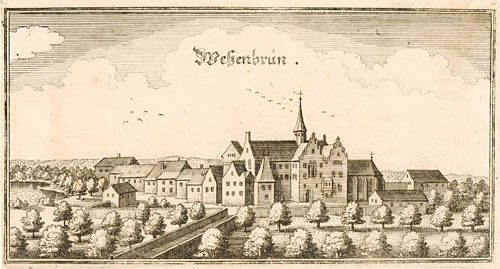
Wessobrunn Abbey: There have been a monastery at this place for a long time. Here a depiction of how it looked like in 1640, centuries after the ghosts started haunting the place.

The monastery of Wessobrunn, near Weilheim in Bavaria had been founded in the 8th century. From 1100 the community of male monks was joined by a sisterhood as well and it included both a community of nuns and monks. There are also legends about one of the nuns in the abbey haunting the place as a ghost. 

The Ghost of the Nun

According to this legend there was a nun in the 13th century who might have been a sister of Knight Joseph Diethalm von Wileyhin, the last Count of Weilheim. It is said she entered Wessobrunn Abbey after her brother’s death in 1211. 

But the way of the sisters is not for everyone and according to the stories, she broke one of her vows of the order. Nuns had to live by strict rules of Chastity, Poverty and Obedience. Exactly what type of vows she broke are unclear, but it scared her so that she ran off. She hid in an underground passage back at her family’s home in Göterlberg. 

Without seeing the sun ever again, she died shortly after and her remains were not found until many years had come and passed. From then on it is reported of sightseeings of a nun around the castle as well as her old abbey, crying in the hallways, still in her nuns’ habit. 

Up until the 1800s it was said that locals threw spruce cones into a hollow said to be the former corridor where the nun hid on her escape from the Wessobrunn Abbey to scare away the ghost. 

Today there are still a cluster of Benedictine nuns living after God’s words within the walls of the abbey, still seeing their long dead sister walking the halls. 

More like this

Newest Posts

References

Die spukende Nonne (Kloster… – Der Märchenonkel | Facebook

Haunting in Hardtkapelle Wielenbach

Advertisements

A haunted chapel known as Hardtkapelle Wielenbach can be found in the darkness of the Bavarian forest, surrounded by black hellhounds and a woman in white. This place is of the more unholy sorts. 

Forests in Germany are where the darkness creeps in and where stories about ghosts and ghouls take form. 

In this particular Bavarian forest in the city of Weilheim in Wielenbach, perhaps a mere hour away from Munich, there is a small but still frightening chapel according to the legends that is said to be particularly dark and where the devil himself appeared.

The Haunted Hardtkapelle Wielenbach

The building from the outside of the Hardtkapelle Wielenbach looks innocent enough as the white walls and church tower looks like any other little chapel in these parts. 

Still, there are many young and hopeful visitors who visit each year to get a taste of the haunted place, not necessarily of the godly kind, but perhaps many of them get a little more than they bargained for. Because according to those visiting, they report about being nauseous and being dizzy, some even suffering a panic attack after spending enough time in that place.  

It is said that the Hardtkapelle Wielenbach is surrounded by huge black hellhounds as the dark forces have been plentiful around these parts for centuries. One can wonder if the chapel is really what keeps the evil inside, or if it attracts it all together. You can hear the hellhounds growling in the background between the trees. 

The Haunted Hardtkapelle Wielenbach: The chapel look cozy and innocent at day among the green trees, but when the sun goes down and the trees grows darker, the ghosts come out to play. Gras-Ober/wikimedia

At night a light is always burning at the small chapel when no one is there to light it up. Sometimes a woman in white is suddenly appearing at night close to the chapel. Who she is, friend or foe, is difficult to say. 

The chapel we see today was built as a pilgrimage church in 1865 with the Patroness being Saint Anne, the mother of Mary. It was built on the grounds of a chapel that used to be there but was demolished back in 1250. 

The Devil’s Kick

There have been many reports about this strange place and one of the legends dates back to the time before there ever was a Hardtkapelle Wielenbach there. When this was is unclear as not much of Germany’s history dates back in written form before the 1200s.  

But according to this legend there was a huge fight among the neighboring villagers. Citizens of the town of Weilheim and Haunshofen fought about grazing rights for their animals in the surrounding area and the arguments were getting heated with harsh words being thrown back and forth. 

A man stepped out from the crowd and they say he was the devil in the form of a shepherd who had come to join them. He put a big stone on the ground and yelled out 

“When I kick this stone, this belongs to Haunshofen”

Then he kicked his foot into the ground, creating a hoof-like hole that he disappeared into. 

This stopped the argument and the Hardtkapelle Wielenbach was built around the stone with the hoofprint to protect the evil from it to come out again.

If they really were successful remains to be seen. 

The Devil’s Hole: At the altar at the Hardtkapelle Wielenbach in Bavaria, Germany, you can see the hole the chapel was built around. // Source: Henning Schlottmann//wikimedia

More like this

Newest Posts

References

Hardtkapelle Weilheim

https://www.atlasobscura.com/places/hardtkapelle-wielenbach