Unhappy is he to whom the memories of childhood bring only fear and sadness. Wretched is he who looks back upon lone hours in vast and dismal chambers with brown hangings and maddening rows of antique books, or upon awed watches in twilight groves of grotesque, gigantic, and vine-encumbered trees that silently wave twisted branches far aloft. Such a lot the gods gave to me—to me, the dazed, the disappointed; the barren, the broken. And yet I am strangely content and cling desperately to those sere memories, when my mind momentarily threatens to reach beyond to the other.
I know not where I was born, save that the castle was infinitely old and infinitely horrible, full of dark passages and having high ceilings where the eye could find only cobwebs and shadows. The stones in the crumbling corridors seemed always hideously damp, and there was an accursed smell everywhere, as of the piled-up corpses of dead generations. It was never light, so that I used sometimes to light candles and gaze steadily at them for relief, nor was there any sun outdoors, since the terrible trees grew high above the topmost accessible tower. There was one black tower which reached above the trees into the unknown outer sky, but that was partly ruined and could not be ascended save by a well-nigh impossible climb up the sheer wall, stone by stone.
I must have lived years in this place, but I cannot measure the time. Beings must have cared for my needs, yet I cannot recall any person except myself, or anything alive but the noiseless rats and bats and spiders. I think that whoever nursed me must have been shockingly aged, since my first conception of a living person was that of somebody mockingly like myself, yet distorted, shrivelled, and decaying like the castle. To me there was nothing grotesque in the bones and skeletons that strewed some of the stone crypts deep down among the foundations. I fantastically associated these things with everyday events, and thought them more natural than the coloured pictures of living beings which I found in many of the mouldy books. From such books I learned all that I know. No teacher urged or guided me, and I do not recall hearing any human voice in all those years—not even my own; for although I had read of speech, I had never thought to try to speak aloud. My aspect was a matter equally unthought of, for there were no mirrors in the castle, and I merely regarded myself by instinct as akin to the youthful figures I saw drawn and painted in the books. I felt conscious of youth because I remembered so little.
Advertisements
Outside, across the putrid moat and under the dark mute trees, I would often lie and dream for hours about what I read in the books; and would longingly picture myself amidst gay crowds in the sunny world beyond the endless forests. Once I tried to escape from the forest, but as I went farther from the castle the shade grew denser and the air more filled with brooding fear; so that I ran frantically back lest I lose my way in a labyrinth of nighted silence.
So through endless twilights I dreamed and waited, though I knew not what I waited for. Then in the shadowy solitude my longing for light grew so frantic that I could rest no more, and I lifted entreating hands to the single black ruined tower that reached above the forest into the unknown outer sky. And at last I resolved to scale that tower, fall though I might; since it were better to glimpse the sky and perish, than to live without ever beholding day.
In the dank twilight I climbed the worn and aged stone stairs till I reached the level where they ceased, and thereafter clung perilously to small footholds leading upward. Ghastly and terrible was that dead, stairless cylinder of rock; black, ruined, and deserted, and sinister with startled bats whose wings made no noise. But more ghastly and terrible still was the slowness of my progress; for climb as I might, the darkness overhead grew no thinner, and a new chill as of haunted and venerable mould assailed me. I shivered as I wondered why I did not reach the light, and would have looked down had I dared. I fancied that night had come suddenly upon me, and vainly groped with one free hand for a window embrasure, that I might peer out and above, and try to judge the height I had once attained.
All at once, after an infinity of awesome, sightless, crawling up that concave and desperate precipice, I felt my head touch a solid thing, and I knew I must have gained the roof, or at least some kind of floor. In the darkness I raised my free hand and tested the barrier, finding it stone and immovable. Then came a deadly circuit of the tower, clinging to whatever holds the slimy wall could give; till finally my testing hand found the barrier yielding, and I turned upward again, pushing the slab or door with my head as I used both hands in my fearful ascent. There was no light revealed above, and as my hands went higher I knew that my climb was for the nonce ended; since the slab was the trapdoor of an aperture leading to a level stone surface of greater circumference than the lower tower, no doubt the floor of some lofty and capacious observation chamber. I crawled through carefully, and tried to prevent the heavy slab from falling back into place, but failed in the latter attempt. As I lay exhausted on the stone floor I heard the eerie echoes of its fall, hoped when necessary to pry it up again.
Advertisements
Believing I was now at prodigious height, far above the accursed branches of the wood, I dragged myself up from the floor and fumbled about for windows, that I might look for the first time upon the sky, and the moon and stars of which I had read. But on every hand I was disappointed; since all that I found were vast shelves of marble, bearing odious oblong boxes of disturbing size. More and more I reflected, and wondered what hoary secrets might abide in this high apartment so many aeons cut off from the castle below. Then unexpectedly my hands came upon a doorway, where hung a portal of stone, rough with strange chiselling. Trying it, I found it locked; but with a supreme burst of strength I overcame all obstacles and dragged it open inward. As I did so there came to me the purest ecstasy I have ever known; for shining tranquilly through an ornate grating of iron, and down a short stone passageway of steps that ascended from the newly found doorway, was the radiant full moon, which I had never before seen save in dreams and in vague visions I dared not call memories.
Fancying now that I had attained the very pinnacle of the castle, I commenced to rush up the few steps beyond the door; but the sudden veiling of the moon by a cloud caused me to stumble, and I felt my way more slowly in the dark. It was still very dark when I reached the grating—which I tried carefully and found unlocked, but which I did not open for fear of falling from the amazing height to which I had climbed. Then the moon came out.
Most demoniacal of all shocks is that of the abysmally unexpected and grotesquely unbelievable. Nothing I had before undergone could compare in terror with what I now saw; with the bizarre marvels that sight implied. The sight itself was as simple as it was stupefying, for it was merely this: instead of a dizzying prospect of treetops seen from a lofty eminence, there stretched around me on the level through the grating nothing less than the solid ground, decked and diversified by marble slabs and columns, and overshadowed by an ancient stone church, whose ruined spire gleamed spectrally in the moonlight.
Half unconscious, I opened the grating and staggered out upon the white gravel path that stretched away in two directions. My mind, stunned and chaotic as it was, still held the frantic craving for light; and not even the fantastic wonder which had happened could stay my course. I neither knew nor cared whether my experience was insanity, dreaming, or magic; but was determined to gaze on brilliance and gaiety at any cost. I knew not who I was or what I was, or what my surroundings might be; though as I continued to stumble along I became conscious of a kind of fearsome latent memory that made my progress not wholly fortuitous. I passed under an arch out of that region of slabs and columns, and wandered through the open country; sometimes following the visible road, but sometimes leaving it curiously to tread across meadows where only occasional ruins bespoke the ancient presence of a forgotten road. Once I swam across a swift river where crumbling, mossy masonry told of a bridge long vanished.
Advertisements
Over two hours must have passed before I reached what seemed to be my goal, a venerable ivied castle in a thickly wooded park, maddeningly familiar, yet full of perplexing strangeness to me. I saw that the moat was filled in, and that some of the well-known towers were demolished, whilst new wings existed to confuse the beholder. But what I observed with chief interest and delight were the open windows—gorgeously ablaze with light and sending forth sound of the gayest revelry. Advancing to one of these I looked in and saw an oddly dressed company indeed; making merry, and speaking brightly to one another. I had never, seemingly, heard human speech before and could guess only vaguely what was said. Some of the faces seemed to hold expressions that brought up incredibly remote recollections, others were utterly alien.
I now stepped through the low window into the brilliantly lighted room, stepping as I did so from my single bright moment of hope to my blackest convulsion of despair and realization. The nightmare was quick to come, for as I entered, there occurred immediately one of the most terrifying demonstrations I had ever conceived. Scarcely had I crossed the sill when there descended upon the whole company a sudden and unheralded fear of hideous intensity, distorting every face and evoking the most horrible screams from nearly every throat. Flight was universal, and in the clamour and panic several fell in a swoon and were dragged away by their madly fleeing companions. Many covered their eyes with their hands, and plunged blindly and awkwardly in their race to escape, overturning furniture and stumbling against the walls before they managed to reach one of the many doors.
The cries were shocking; and as I stood in the brilliant apartment alone and dazed, listening to their vanishing echoes, I trembled at the thought of what might be lurking near me unseen. At a casual inspection the room seemed deserted, but when I moved towards one of the alcoves I thought I detected a presence there—a hint of motion beyond the golden-arched doorway leading to another and somewhat similar room. As I approached the arch I began to perceive the presence more clearly; and then, with the first and last sound I ever uttered—a ghastly ululation that revolted me almost as poignantly as its noxious cause—I beheld in full, frightful vividness the inconceivable, indescribable, and unmentionable monstrosity which had by its simple appearance changed a merry company to a herd of delirious fugitives.
I cannot even hint what it was like, for it was a compound of all that is unclean, uncanny, unwelcome, abnormal, and detestable. It was the ghoulish shade of decay, antiquity, and dissolution; the putrid, dripping eidolon of unwholesome revelation, the awful baring of that which the merciful earth should always hide. God knows it was not of this world—or no longer of this world—yet to my horror I saw in its eaten-away and bone-revealing outlines a leering, abhorrent travesty on the human shape; and in its mouldy, disintegrating apparel an unspeakable quality that chilled me even more.
Advertisements
I was almost paralysed, but not too much so to make a feeble effort towards flight; a backward stumble which failed to break the spell in which the nameless, voiceless monster held me. My eyes bewitched by the glassy orbs which stared loathsomely into them, refused to close; though they were mercifully blurred, and showed the terrible object but indistinctly after the first shock. I tried to raise my hand to shut out the sight, yet so stunned were my nerves that my arm could not fully obey my will. The attempt, however, was enough to disturb my balance; so that I had to stagger forward several steps to avoid falling. As I did so I became suddenly and agonizingly aware of the nearness of the carrion thing, whose hideous hollow breathing I half fancied I could hear. Nearly mad, I found myself yet able to throw out a hand to ward off the foetid apparition which pressed so close; when in one cataclysmic second of cosmic nightmarishness and hellish accident my fingers touched the rotting outstretched paw of the monster beneath the golden arch.
I did not shriek, but all the fiendish ghouls that ride the nightwind shrieked for me as in that same second there crashed down upon my mind a single fleeting avalanche of soul-annihilating memory. I knew in that second all that had been; I remembered beyond the frightful castle and the trees, and recognized the altered edifice in which I now stood; I recognized, most terrible of all, the unholy abomination that stood leering before me as I withdrew my sullied fingers from its own.
But in the cosmos there is balm as well as bitterness, and that balm is nepenthe. In the supreme horror of that second I forgot what had horrified me, and the burst of black memory vanished in a chaos of echoing images. In a dream I fled from that haunted and accursed pile, and ran swiftly and silently in the moonlight. When I returned to the churchyard place of marble and went down the steps I found the stone trap-door immovable; but I was not sorry, for I had hated the antique castle and the trees. Now I ride with the mocking and friendly ghouls on the night-wind, and play by day amongst the catacombs of Nephren-Ka in the sealed and unknown valley of Hadoth by the Nile. I know that light is not for me, save that of the moon over the rock tombs of Neb, nor any gaiety save the unnamed feasts of Nitokris beneath the Great Pyramid; yet in my new wildness and freedom I almost welcome the bitterness of alienage.
For although nepenthe has calmed me, I know always that I am an outsider; a stranger in this century and among those who are still men. This I have known ever since I stretched out my fingers to the abomination within that great gilded frame; stretched out my fingers and touched a cold and unyielding surface of polished glass.
. . . .and in the fearsome instant of deeper darkness, the watchers saw wriggling at that treetop height, a thousand tiny points of faint and unhallowed radiance, tipping each bough like the fire of St. Elmo. . . . and all the while the shaft of phosphorescence from the well was getting brighter and brighter and bringing to the minds of the huddled men, a sense of doom and abnormality. . . It was no longer shining out; it was pouring out; and as the shapeless stream of unplaceable colour left the well, it seemed to flow directly into the sky.
WEST of Arkham the hills rise wild, and there are valleys with deep woods that no axe has ever cut. There are dark narrow glens where the trees slope fantastically, and where thin brooklets trickle without ever having caught the glint of sunlight. On the gentler slopes there are farms, ancient and rocky, with squat, moss-coated cottages brooding eternally over old New England secrets in the lee of great ledges; but these are all vacant now, the wide chimneys crumbling and the shingled sides bulging perilously beneath low gambrel roofs.
Paul Flanders’ artwork based on H. P. Lovecraft’s short story “The Colour out of Space”. Source
The old folk have gone away, and foreigners do not like to live there. French-Canadians have tried it, Italians have tried it, and the Poles have come and departed. It is not because of anything that can be seen or heard or handled, but because of something that is imagined. The place is not good for imagination, and does not bring restful dreams at night. It must be this which keeps the foreigners away, for old Ammi Pierce has never told them of anything he recalls from the strange days. Ammi, whose head has been a little queer for years, is the only one who still remains, or who ever talks of the strange days; and he dares to do this because his house is so near the open fields and the travelled roads around Arkham.
There was once a road over the hills and through the valleys, that ran straight where the blasted heath is now; but people ceased to use it and a new road was laid curving far toward the south. Traces of the old one can still be found amidst the weeds of a returning wilderness, and some of them will doubtless linger even when half the hollows are flooded for the new reservoir. Then the dark woods will be cut down and the blasted heath will slumber far below blue waters whose surface will mirror the sky and ripple in the sun. And the secrets of the strange days will be one with the deep’s secrets; one with the hidden lore of old ocean, and all the mystery of primal earth.
When I went into the hills and vales to survey for the new reservoir they told me the place was evil. They told me this in Arkham, and because that is a very old town full of witch legends I thought the evil must be something which grandmas had whispered to children through centuries. The name “blasted heath” seemed to me very odd and theatrical, and I wondered how it had come into the folklore of a Puritan people. Then I saw that dark westward tangle of glens and slopes for myself, and ceased to wonder at anything besides its own elder mystery. It was morning when I saw it, but shadow lurked always there. The trees grew too thickly, and their trunks were too big for any healthy New England wood. There was too much silence in the dim alleys between them, and the floor was too soft with the dank moss and mattings of infinite years of decay.
In the open spaces, mostly along the line of the old road, there were little hillside farms; sometimes with all the buildings standing, sometimes with only one or two, and sometimes with only a lone chimney or fast-filling cellar. Weeds and briers reigned, and furtive wild things rustled in the undergrowth. Upon everything was a haze of restlessness and oppression; a touch of the unreal and the grotesque, as if some vital element of perspective or chiaroscuro were awry. I did not wonder that the foreigners would not stay, for this was no region to sleep in. It was too much like a landscape of Salvator Rosa; too much like some forbidden woodcut in a tale of terror.
But even all this was not so bad as the blasted heath. I knew it the moment I came upon it at the bottom of a spacious valley; for no other name could fit such thing, or any other thing fit such a name. It was as if the poet had coined the phrase from having seen this one particular region. It must, I thought as I viewed it, be the outcome of a fire; but why had nothing new ever grown over those five acres of grey desolation that sprawled open to the sky like a great spot eaten by acid in the woods and fields? It lay largely to the north of the ancient road line, but encroached a little on the other side. I felt an odd reluctance about approaching, and did so at last only because my business took me through and past it. There was no vegetation of any kind on that broad expanse, but only a fine grey dust or ash which no wind seemed ever to blow about. The trees near it were sickly and stunted, and many dead trunks stood or lay rotting at the rim. As I walked hurriedly by I saw the tumbled bricks and stones of an old chimney and cellar, on my right, and the yawning black maw of an abandoned well whose stagnant vapours played strange tricks with the hues of the sunlight. Even the long, dark woodland climb beyond seemed welcome in contrast, and I marvelled no more at the frightened whispers of Arkham people. There had been no house or ruin near; even in the old days the place must have been lonely and remote. And at twilight, dreading to repass that ominous spot, I walked circuitously back to the town by the curving road on the south. I vaguely wished some clouds would gather, for an odd timidity about the deep skyey voids above had crept into my soul.
Advertisements
In the evening I asked old people in Arkham about the blasted heath, and what was meant by that phrase “strange days” which so many evasively muttered. I could not, however, get any good answers, except that all the mystery was much more recent than I had dreamed. It was not a matter of old legendry at all, but something within the lifetime of those who spoke. It had happened in the ’eighties, and a family had disappeared or was killed. Speakers would not be exact; and because they all told me to pay no attention to old Ammi Pierce’s crazy tales, I sought him out the next morning, having heard that he lived alone in the ancient tottering cottage where the trees first begin to get very thick. It was a fearsomely ancient place, and had begun to exude the faint miasmal odour which clings about houses that have stood too long. Only with persistent knocking could I rouse the aged man, and when he shuffled timidly to the door I could tell he was not glad to see me. He was not so feeble as I had expected; but his eyes drooped in a curious way, and his unkempt clothing and white beard made him seem very worn and dismal.
Not knowing just how he could best be launched on his tales, I feigned a matter of business; told him of my surveying, and asked vague questions about the district. He was far brighter and more educated than I had been led to think, and before I knew it had grasped quite as much of the subject as any man I had talked with in Arkham. He was not like other rustics I had known in the sections where reservoirs were to be. From him there were no protests at the miles of old wood and farmland to be blotted out, though perhaps there would have been had not his home lain outside the bounds of the future lake. Relief was all that he showed; relief at the doom of the dark ancient valleys through which he had roamed all his life. They were better under water now—better under water since the strange days. And with this opening his husky voice sank low, while his body leaned forward and his right forefinger began to point shakily and impressively.
IT was then that I heard the story, and as the rambling voice scraped and whispered on I shivered again and again despite the summer day. Often I had to recall the speaker from ramblings, piece out scientific points which he knew only by a fading parrot memory of professors’ talk, or bridge over gaps, where his sense of logic and continuity broke down. When he was done I did not wonder that his mind had snapped a trifle, or that the folk of Arkham would not speak much of the blasted heath. I hurried back before sunset to my hotel, unwilling to have the stars come out above me in the open; and the next day returned to Boston to give up my position. I could not go into that dim chaos of old forest and slope again, or face another time that grey blasted heath where the black well yawned deep beside the tumbled bricks and stones. The reservoir will soon be built now, and all those elder secrets will lie safe forever under watery fathoms. But even then I do not believe I would like to visit that country by night—at least not when the sinister stars are out; and nothing could bribe me to drink the new city water of Arkham.
It all began, old Ammi said, with the meteorite. Before that time there had been no wild legends at all since the witch trials, and even then these western woods were not feared half so much as the small island in the Miskatonic where the devil held court beside a curious stone altar older than the Indians. These were not haunted woods, and their fantastic dusk was never terrible till the strange days. Then there had come that white noontide cloud, that string of explosions in the air, and that pillar of smoke from the valley far in the wood. And by night all Arkham had heard of the great rock that fell out of the sky and bedded itself in the ground beside the well at the Nahum Gardner place. That was the house which had stood where the blasted heath was to come—the trim white Nahum Gardner house amidst its fertile gardens and orchards.
Advertisements
Nahum had come to town to tell people about the stone, and had dropped in at Ammi Pierce’s on the way. Ammi was forty then, and all the queer things were fixed very strongly in his mind. He and his wife had gone with the three professors from Miskatonic University who hastened out the next morning to see the weird visitor from unknown stellar space, and had wondered why Nahum had called it so large the day before. It had shrunk, Nahum said as he pointed out the big brownish mound above the ripped earth and charred grass near the archaic well-sweep in his front yard; but the wise men answered that stones do not shrink. Its heat lingered persistently, and Nahum declared it had glowed faintly in the night. The professors tried it with a geologist’s hammer and found it was oddly soft. It was, in truth, so soft as to be almost plastic; and they gouged rather than chipped a specimen to take back to the college for testing. They took it in an old pail borrowed from Nahum’s kitchen, for even the small piece refused to grow cool. On the trip back they stopped at Ammi’s to rest, and seemed thoughtful when Mrs. Pierce remarked that the fragment was growing smaller and burning the bottom of the pail. Truly, it was not large, but perhaps they had taken less than they thought.
The day after that—all this was in June of ’82—the professors had trooped out again in a great excitement. As they passed Ammi’s they told him what queer things the specimen had done, and how it had faded wholly away when they put it in a glass beaker. The beaker had gone, too, and the wise men talked of the strange stone’s affinity for silicon. It had acted quite unbelievably in that well-ordered laboratory; doing nothing at all and showing no occluded gases when heated on charcoal, being wholly negative in the borax bead, and soon proving itself absolutely non-volatile at any producible temperature, including that of the oxy-hydrogen blowpipe. On an anvil it appeared highly malleable, and in the dark its luminosity was very marked. Stubbornly refusing to grow cool, it soon had the college in a state of real excitement; and when upon heating before the spectroscope it displayed shining bands unlike any known colours of the normal spectrum there was much breathless talk of new elements, bizarre optical properties, and other things which puzzled men of science are wont to say when faced by the unknown.
Hot as it was, they tested it in a crucible with all the proper reagents. Water did nothing. Hydrochloric acid was the same. Nitric acid and even aqua regia merely hissed and spattered against its torrid invulnerability. Ammi had difficulty in recalling all these things, but recognized some solvents as I mentioned them in the usual order of use. There were ammonia and caustic soda, alcohol and ether, nauseous carbon disulphide and a dozen others; but although the weight grew steadily less as time passed, and the fragment seemed to be slightly cooling, there was no change in the solvents to show that they had attacked the substance at all. It was a metal, though, beyond a doubt. It was magnetic, for one thing; and after its immersion in the acid solvents there seemed to be faint traces of the Widmänstätten figures found on meteoric iron. When the cooling had grown very considerable, the testing was carried on in glass; and it was in a glass beaker that they left all the chips made of the original fragment during the work. The next morning both chips and beaker were gone without trace, and only a charred spot marked the place on the wooden shelf where they had been.
Advertisements
All this the professors told Ammi as they paused at his door, and once more he went with them to see the stony messenger from the stars, though this time his wife did not accompany him. It had now most certainly shrunk, and even the sober professors could not doubt the truth of what they saw. All around the dwindling brown lump near the well was a vacant space, except where the earth had caved in; and whereas it had been a good seven feet across the day before, it was now scarcely five. It was still hot, and the sages studied its surface curiously as they detached another and larger piece with hammer and chisel. They gouged deeply this time, and as they pried away the smaller mass they saw that the core of the thing was not quite homogeneous.
THEY had uncovered what seemed to be the side of a large coloured globule embedded in the substance. The colour, which resembled some of the bands in the meteor’s strange spectrum, was almost impossible to describe; and it was only by analogy that they called it colour at all. Its texture was glossy, and upon tapping it appeared to promise both brittleness and hollowness. One of the professors gave it a smart blow with a hammer, and it burst with a nervous little pop. Nothing was emitted, and all trace of the thing vanished with the puncturing. It left behind a hollow spherical space about three inches across, and all thought it probable that others would be discovered as the enclosing substance wasted away.
Conjecture was vain; so after a futile attempt to find additional globules by drilling, the seekers left again with their new specimen—which proved, however, as baffling in the laboratory as its predecessor. Aside from being almost plastic, having heat, magnetism, and slight luminosity, cooling slightly in powerful acids, possessing an unknown spectrum, wasting away in air, and attacking silicon compounds with mutual destruction as a result, it presented no indentifying features whatsoever; and at the end of the tests the college scientists were forced to own that they could not place it. It was nothing of this earth, but a piece of the great outside; and as such dowered with outside properties and obedient to outside laws.
That night there was a thunderstorm, and when the professors went out to Nahum’s the next day they met with a bitter disappointment. The stone, magnetic as it had been, must have had some peculiar electrical property; for it had “drawn the lightning,” as Nahum said, with a singular persistence. Six times within an hour the farmer saw the lightning strike the furrow in the front yard, and when the storm was over nothing remained but a ragged pit by the ancient wellsweep, half-chocked with caved-in earth. Digging had borne no fruit, and the scientists verified the fact of the utter vanishment. The failure was total; so that nothing was left to do but go back to the laboratory and test again the disappearing fragment left carefully cased in lead. That fragment lasted a week, at the end of which nothing of value had been learned of it. When it had gone, no residue was left behind, and in time the professors felt scarcely sure they had indeed seen with waking eyes that cryptic vestige of the fathomless gulfs outside; that lone, weird message from other universes and other realms of matter, force, and entity.
Advertisements
As was natural, the Arkham papers made much of the incident with its collegiate sponsoring, and sent reporters to talk with Nahum Gardner and his family. At least one Boston daily also sent a scribe, and Nahum quickly became a kind of local celebrity. He was a lean, genial person of about fifty, living with his wife and three sons on the pleasant farmstead in the valley. He and Ammi exchanged visits frequently, as did their wives; and Ammi had nothing but praise for him after all these years. He seemed slightly proud of the notice his place had attracted, and talked often of the meteorite in the succeeding weeks. That July and August were hot; and Nahum worked hard at his haying in the ten-acre pasture across Chapman’s Brook; his rattling wain wearing deep ruts in the shadowy lanes between. The labour tired him more than it had in other years, and he felt that age was beginning to tell on him.
Then fell the time of fruit and harvest. The pears and apples slowly ripened, and Nahum vowed that his orchards were prospering as never before. The fruit was growing to phenomenal size and unwonted gloss, and in such abundance that extra barrels were ordered to handle the future crop. But with the ripening came sore disappointment, for of all that gorgeous array of specious lusciousness not one single jot was fit to eat. Into the fine flavour of the pears and apples had crept a stealthy bitterness and sickishness, so that even the smallest of bites induced a lasting disgust. It was the same with the melons and tomatoes, and Nahum sadly saw that his entire crop was lost. Quick to connect events, he declared that the meteorite had poisoned the soil, and thanked Heaven that most of the other crops were in the upland lot along the road.
WINTER came early, and was very cold. Ammi saw Nahum less often than usual, and observed that he had begun to look worried. The rest of his family too, seemed to have grown taciturn; and were far from steady in their churchgoing or their attendance at the various social events of the countryside. For this reserve or melancholy no cause could be found, though all the household confessed now and then to poorer health and a feeling of vague disquiet. Nahum himself gave the most definite statement of anyone when he said he was disturbed about certain footprints in the snow. They were the usual winter prints of red squirrels, white rabbits, and foxes, but the brooding farmer professed to see something not quite right about their nature and arrangement. He was never specific, but appeared to think that they were not as characteristic of the anatomy and habits of squirrels and rabbits and foxes as they ought to be. Ammi listened without interest to this talk until one night when he drove past Nahum’s house in his sleigh on the way back from Clark’s Corners. There had been a moon, and a rabbit had run across the road; and the leaps of that rabbit were longer than either Ammi or his horse liked. The latter, indeed, had almost run away when brought up by a firm rein. Thereafter Ammi gave Nahum’s tales more respect, and wondered why the Gardner dogs seemed so cowed and quivering every morning. They had, it developed, nearly lost the spirit to bark.
In February the McGregor boys from Meadow Hill were out shooting woodchucks, and not far from the Gardner place bagged a very peculiar specimen. The proportions of its body seemed slightly altered in a queer way impossible to describe, while its face had taken on an expression which no one ever saw in a woodchuck before. The boys were genuinely frightened, and threw the thing away at once, so that only their grotesque tales of it ever reached the people of the countryside. But the shying of horses near Nahum’s house had now become an acknowledged thing, and all the basis for a cycle of whispered legend was fast taking form.
Advertisements
People vowed that the snow melted faster around Nahum’s than it did anywhere else, and early in March there was an awed discussion in Potter’s general store at Clark’s Corners. Stephen Rice had driven past Gardner’s in the morning, and had noticed the skunk-cabbages coming up through the mud by the woods across the road. Never were things of such size seen before, and they held strange colours that could not be put into any words. Their shapes were monstrous, and the horse had snorted at an odour which struck Stephen as wholly unprecedented. That afternoon several persons drove past to see the abnormal growth, and all agreed that plants of that kind ought never to sprout in a healthy world. The bad fruit of the fall before was freely mentioned, and it went from mouth to mouth that there was poison in Nahum’s ground. Of course it was the meteorite; and remembering how strange the men from the college had found that stone to be, several farmers spoke about the matter to them.
One day they paid Nahum a visit; but having no love of wild tales and folklore were very conservative in what they inferred. The plants were certainly odd, but all skunk-cabbags are more or less odd in shape and hue. Perhaps some mineral element from the stone had entered the soil, but it would soon be washed away. And as for the footprints and frightened horses—of course this was mere country talk which such a phenomenon as the aerolite would be certain to start. There was really nothing for serious men to do in cases of wild gossip, for superstitious rustics will say and believe anything. And so all through the strange days the professors stayed away in contempt. Only one of them, when given two phials of dust for analysis in a police job over a year and a half later, recalled that the queer colour of that skunk-cabbage had been very like one of the anomalous bands of light shown by the meteor fragment in the college spectroscope, and like the brittle globule found imbedded in the stone from the abyss. The samples in this analysis case gave the same odd bands at first, though later they lost the property.
The trees budded prematurely around Nahum’s, and at night they swayed ominously in the wind. Nahum’s second son Thaddeus, a lad of fifteen, swore that they swayed also when there was no wind; but even the gossips would not credit this. Certainly, however, restlessness was in the air. The entire Gardner family developed the habit of stealthy listening, though not for any sound which they could consciously name. The listening was, indeed, rather a product of moments when consciousness seemed half to slip away. Unfortunately such moments increased week by week, till it became common speech that “something was wrong with all Nahum’s folks.” When the early saxifrage came out it had another strange colour; not quite like that of the skunk-cabbage, but plainly related and equally unknown to anyone who saw it. Nahum took some blossoms to Arkham and showed them to the editor of the Gazette, but that dignitary did no more than write a humorous article about them, in which the dark fears of rustics were held up to polite ridicule. It was a mistake of Nahum’s to tell a stolid city man about the way the great, overgrown mourning-cloak butterflies behaved in connection with these saxifrages.
April brought a kind of madness to the country folk, and began that disuse of the road past Nahum’s which led to its ultimate abandonment. It was next the vegetation. All the orchard trees blossomed forth in strange colours, and through the stony soil of the yard and adjacent pasturage there sprang up a bizarre growth which only a botanist could connect with the proper flora of the region. No sane wholesome colours were anywhere to be seen except in the green grass and leafage; but everywhere were those hectic and prismatic variants of some diseased, underlying primary tone without a place among the known tints of earth. The “Dutchman’s breeches” became a thing of sinister menace, and the bloodroots grew insolent in their chromatic perversion. Ammi and the Gardners thought that most of the colours had a sort of haunting familiarity, and decided that they reminded one of the brittle globule in the meteor. Nahum ploughed and sowed the ten-acre pasture and the upland lot, but did nothing with the land around the house. He knew it would be of no use, and hoped that the summer’s strange growths would draw all the poison from the soil. He was prepared for almost anything now, and had grown used to the sense of something near him waiting to be heard. The shunning of his house by neighbours told on him, of course; but it told on his wife more. The boys were better off, being at school each day; but they could not help being frightened by the gossip. Thaddeus, an especially sensitive youth, suffered the most.
IN May the insects came, and Nahum’s place became a nightmare of buzzing and crawling. Most of the creatures seemed not quite usual in their aspects and motions, and their nocturnal habits contradicted all former experience. The Gardners took to watching at night—watching in all directions at random for something they could not tell what. It was then that they all owned that Thaddeus had been right about the trees. Mrs. Gardner was the next to see it from the window as she watched the swollen boughs of a maple against a moonlit sky. The boughs surely moved, and there was no wind. It must be the sap. Strangeness had come into everything growing now. Yet it was none of Nahum’s family at all who made the next discovery. Familiarity had dulled them, and what they could not see was glimpsed by a timid windmill salesman from Bolton who drove by one night in ignorance of the country legends. What he told in Arkham was given a short paragraph in the Gazette and it was there that all the farmers, Nahum included, saw it first. The night had been dark and the buggy-lamps faint, but around a farm in the valley which everyone knew from the account must be Nahum’s, the darkness had been less thick. A dim though distinct luminosity seemed to inhere in all the vegetation, grass, leaves, and blossoms alike, while at one moment a detached piece of the phosphorescence appeared to stir furtively in the yard near the barn.
The grass had so far seemed untouched, and the cows were freely pastured in the lot near the house, but toward the end of May the milk began to be bad. Then Nahum had the cows driven to the uplands, after which this trouble ceased. Not long after this the change in grass and leaves became apparent to the eye. All the verdure was going grey, and was developing a highly singular quality of brittleness. Ammi was now the only person who ever visited the place, and his visits were becoming fewer and fewer. When school closed the Gardners were virtually cut off from the world, and sometimes let Ammi do their errands in town. They were failing curiously both physically and mentally, and no one was surprised when the news of Mrs. Gardner’s madness stole around.
Advertisements
It happened in June, about the anniversary of the meteor’s fall, and the poor woman screamed about things in the air which she could not describe. In her raving there was not a single specific noun, but only verbs and pronouns. Things moved and changed and fluttered, and ears tingled to impulses which were not wholly sounds. Something was taken away—she was being drained of something—something was fastening itself on her that ought not to be—someone must make it keep off—nothing was ever still in the night—the walls and windows shifted. Nahum did not send her to the county asylum, but let her wander about the house as long as she was harmless to herself and others. Even when her expression changed he did nothing. But when the boys grew afraid of her, and Thaddeus nearly fainted at the way she made faces at him, he decided to keep her locked in the attic. By July she had ceased to speak and crawled on all fours, and before that month was over Nahum got the mad notion that she was slightly luminous in the dark, as he now clearly saw was the case with the nearby vegetation.
It was a little before this that the horses had stampeded. Something had aroused them in the night, and their neighing and kicking in their stalls had been terrible. There seemed virtually nothing to do to calm them, and when Nahum opened the stable door they all bolted out like frightened woodland deer. It took a week to track all four, and when found they were seen to be quite useless and unmanageable. Something had snapped in their brains, and each one had to be shot for its own good. Nahum borrowed a horse from Ammi for his haying, but found it would not approach the barn. It shied, balked, and whinnied, and in the end he could do nothing but drive it into the yard while the men used their own strength to get the heavy wagon near enough the hayloft for convenient pitching. And all the while the vegetation was turning grey and brittle. Even the flowers whose hues had been so strange were graying now, and the fruit was coming out grey and dwarfed and tasteless. The asters and goldenrod bloomed grey and distorted, and the roses and zinneas and hollyhocks in the front yard were such blasphemous-looking things that Nahum’s oldest boy Zenas cut them down. The strangely puffed insects died about that time, even the bees that had left their hives and taken to the woods.
An illustration for H.P. Lovecraft’s The Colour out of Space from Amazing Stories
By September all the vegetation was fast crumbling to a greyish powder, and Nahum feared that the trees would die before the poison was out of the soil. His wife now had spells of terrific screaming, and he and the boys were in a constant state of nervous tension. They shunned people now, and when school opened the boys did not go. But it was Ammi, on one of his rare visits, who first realized that the well water was no longer good. It had an evil taste that was not exactly fetid nor exactly salty, and Ammi advised his friend to dig another well on higher ground to use till the soil was good again. Nahum, however, ignored the warning, for he had by that time become calloused to strange and unpleasant things. He and the boys continued to use the tainted supply, drinking it as listlessly and mechanically as they ate their meagre and ill-cooked meals and did their thankless and monotonous chores through the aimless days. There was something of stolid resignation about them all, as if they walked half in another world between lines of nameless guards to a certain and familiar doom.
Thaddeus went mad in September after a visit to the well. He had gone with a pail and had come back empty-handed, shrieking and waving his arms, and sometimes lapsing into an inane titter or a whisper about “the moving colours down there.” Two in one family was pretty bad, but Nahum was very brave about it. He let the boy run about for a week until he began stumbling and hurting himself , and then he shut him in an attic room across the hall from his mother’s. The way they screamed at each other from behind their locked doors was very terrible, especially to little Merwin, who fancied they talked in some terrible language that was not of earth. Merwin was getting frightfully imaginative, and his restlessness was worse after the shutting away of the brother who had been his greatest playmate.
Almost at the same time the mortality among the livestock commenced. Poultry turned greyish and died very quickly, their meat being found dry and noisome upon cutting. Hogs grew inordinately fat, then suddenly began to undergo loathsome changes which no one could explain. Their meat was of course useless, and Nahum was at his wit’s end. No rural veterinary would approach his place, and the city veterinary from Arkham was openly baffled. The swine began growing grey and brittle and falling to pieces before they died, and their eyes and muzzles developed singular alterations. It was very inexplicable, for they had never been fed from the tainted vegetation. Then something struck the cows. Certain areas or sometimes the whole body would be uncannily shrivelled or compressed, and atrocious collapses or disintegrations were common. In the last stages—and death was always the result—there would be a greying and turning brittle like that which beset the hogs. There could be no question of poison, for all the cases occurred in a locked and undisturbed barn. No bites of prowling things could have brought the virus, for what live beast of earth can pass through solid obstacles? It must be only natural disease—yet what disease could wreak such results was beyond any mind’s guessing. When the harvest came there was not an animal surviving on the place, for the stock and poultry were dead and the dogs had run away. These dogs, three in number, had all vanished one night and were never heard of again. The five cats had left some time before, but their going was scarcely noticed since there now seemed to be no mice, and only Mrs. Gardner had made pets of the graceful felines.
ON the nineteenth of October Nahum staggered into Ammi’s house with hideous news. The death had come to poor Thaddeus in his attic room, and it had come in a way which could not be told. Nahum had dug a grave in the railed family plot behind the farm, and had put therein what he found. There could have been nothing from outside, for the small barred window and locked door were intact; but it was much as it had been in the barn. Ammi and his wife consoled the stricken man as best they could, but shuddered as they did so. Stark terror seemed to cling round the Gardners and all they touched, and the very presence of one in the house was a breath from regions unnamed and unnamable. Ammi accompanied Nahum home with the greatest reluctance, and did what he might to calm the hysterical sobbing of little Merwin. Zenas needed no calming. He had come of late to do nothing but stare into space and obey what his father told him; and Ammi thought that his fate was very merciful. Now and then Merwin’s screams were answered faintly from the attic, and in response to an inquiring look Nahum said that his wife was getting very feeble. When night approached, Ammi managed to get away; for not even friendship could make him stay in that spot when the glow of the vegetation began and the trees may or may not have swayed without wind. It was really lucky for Ammi that he was not more imaginative. Even as things were, his mind was bent ever so slightly; but had he been able to connect and reflect upon all the portents around him he must inevitably have turned a total maniac. In the twilight he hastened home, the screams of the mad woman and the nervous faint child ringing horrible in his ears.
Three days later Nahum burst into Ammi’s kitchen in the early morning, and in the absence of his host stammered out a desperate tale once more, while Mrs. Pierce listened in a clutching fright. It was little Merwin this time. He was gone. He had gone out late at night with a lantern and pail for water, and had never come back. He’d been going to pieces for days, and hardly knew what he was about. Screamed at everything. There had been a frantic shriek from the yard then, but before the father could get to the door the boy was gone. There was no glow from the lantern he had taken, and of the child himself no trace. At the time Nahum thought the lantern and pail were gone too; but when dawn came, and the man had plodded back from his all-night search of the woods and fields, he had found some very curious things near the well. There was a crushed and apparently somewhat melted mass of iron which had certainly been the lantern; while a bent pail and twisted iron hoops beside it, both half-fused, seemed to hint at the remnants of the pail. That was all. Nahum was past imagining, Mrs. Pierce was blank, and Ammi, when he had reached home and heard the tale, could give no guess. Merwin was gone, and there would be no use in telling the people around, who shunned all Gardners now. No use, either, in telling the city people at Arkham who laughed at everything. Thad was gone, and now Merwin was gone. Something was creeping and creeping and waiting to be seen and heard. Nahum would go soon, and he wanted Ammi to look after his wife and Zenas if they survived him. It must all be a judgment of some sort; though he could not fancy what for, since he had always walked uprightly in the Lord’s ways so far as he knew.
Advertisements
For over two weeks Ammi saw nothing of Nahum; and then, worried about what might have happened, he overcame his fears and paid the Gardner place a visit. There was no smoke from the great chimney, and for a moment the visitor was apprehensive of the worst. The aspect of the whole farm was shocking—greyish withered grass and leaves on the ground, vines falling in brittle wreckage from archaic walls and gables, and great bare trees clawing up at the grey November sky with a studied malevolence which Ammi could not but feel had come from some subtle change in the tilt of the branches. But Nahum was alive, after all. He was weak, and lying in a couch in the low-ceiled kitchen, but perfectly conscious and able to give simple orders to Zenas. The room was deadly cold; and as Ammi visibly shivered, the host shouted huskily to Zenas for more wood. Wood, indeed, was sorely needed; since the cavernous fireplace was unlit and empty, with a cloud of soot blowing about in the chill wind that came down the chimney. Presently Nahum asked him if the extra wood had made him any more confortable, and then Ammi saw what had happened. The stoutest cord had broken at last, and the hapless farmer’s mind was proof against more sorrow.
Questioning tactfully, Ammi could get no clear data at all about the missing Zenas. “In the well—he lives in the well—” was all that the clouded father would say. Then there flashed across the visitor’s mind a sudden thought of the mad wife, and he changed his line of inquiry. “Nabby? Why, here she is!” was the surprised response of poor Nahum, and Ammi soon saw that he must search for himself. Leaving the harmless babbler on the couch, he took the keys from their nail beside the door and climbed the creaking stairs to the attic. It was very close and noisome up there, and no sound could be heard from any direction. Of the four doors in sight, only one was locked, and on this he tried various keys on the ring he had taken. The third key proved the right one, and after some fumbling Ammi threw open the low white door.
It was quite dark inside, for the window was small and half-obscured by the crude wooden bars; and Ammi could see nothing at all on the wide-planked floor. The stench was beyond enduring, and before proceeding further he had to retreat to another room and return with his lungs filled with breathable air. When he did enter he saw something dark in the corner, and upon seeing it more clearly he screamed outright. While he screamed he thought a momentary cloud eclipsed the window, and a second later he felt himself brushed as if by some hateful current of vapour. Strange colours danced before his eyes; and had not a present horror numbed him he would have thought of the globule in the meteor that the geologist’s hammer had shattered, and of the morbid vegetation that had sprouted in the spring. As it was he thought only of the blasphemous monstrosity which confronted him, and which all too clearly had shared the nameless fate of young Thaddeus and the livestock. But the terrible thing about the horror was that it very slowly and perceptibly moved as it continued to crumble.
AMMI would give me no added particulars of this scene, but the shape in the corners does not reappear in his tale as a moving object. There are things which cannot be mentioned, and what is done in common humanity is sometimes cruelly judged by the law. I gathered that no moving thing was left in that attic room, and that to leave anything capable of motion there would have been a deed so monstrous as to damn any accountable being to eternal torment. Anyone but a stolid farmer would have fainted or gone mad, but Ammi walked conscious through that low doorway and locked the accursed secret behind him. There would be Nahum to deal with now; he must be fed and tended, and removed to some place where he could be cared for.
Commencing his descent of the dark stairs, Ammi heard a thud below him. He even thought a scream had been suddenly choked off, and recalled nervously the clammy vapour which had brushed by him in that frightful room above. What presence had his cry and entry started up? Halted by some vague fear, he heard still further sounds below. Indubitably there was a sort of heavy dragging, and a most detestably sticky noise as of some fiendish and unclean species of suction. With an associative sense goaded to feverish heights, he thought unaccountably of what he had seen upstairs. Good God! What eldritch dream-world was this into which he had blundered? He dared move neither backward nor forward, but stood there trembling at the black curve of the boxed-in staircase. Every trifle of the scene burned itself into his brain. The sounds, the sense of dread expectancy, the darkness, the steepness of the narrow steps—and merciful Heaven!—the faint but unmistakable luminosity of all the woodwork in sight; steps, sides, exposed laths, and beams alike.
Then there burst forth a frantic whinny from Ammi’s horse outside, followed at once by a clatter which told of a frenzied runaway. In another moment horse and buggy had gone beyond earshot, leaving the frightened man on the dark stairs to guess what had sent them. But that was not all. There had been another sound out there. A sort of liquid splash—water—it must have been the well. He had left Hero untied near it, and a buggy-wheel must have brushed the coping and knocked in a stone. And still the pale phosphorescense glowed in that detestably ancient woodwork. God! how old the house was! Most of it built before 1700.
Advertisements
A feeble scratching on the floor downstairs now sounded distinctly, and Ammi’s grip tightened on a heavy stick he had picked up in the attic for some purpose. Slowly nerving himself, he finished his descent and walked boldly toward the kitchen. But he did not complete the walk, because what he sought was no longer there. It had come to meet him, and it was still alive after a fashion. Whether it had crawled or whether it had been dragged by any external forces, Ammi could not say; but the death had been at it. Everything had happened in the last half-hour, but collapse, greying, and disintegration were already far advanced. There was a horrible brittleness, and dry fragments were scaling off. Ammi could not touch it, but looked horrifiedly into the distorted parody that had been a face. “What was it, Nahum—what was it?” He whispered, and the cleft, bulging lips were just able to crackle out a final answer.
“Nothin’ . . . . . nothin’ . . . . . the colour . . . . . it burns . . . . . cold an’ wet, but it burns . . . . . it lived in the well . . . . . I seen it . . . . . a kind o’ smoke . . . . . jest like the flowers last spring . . . . . the well shone at night . . . . . Thad an’ Merwin an’ Zenas . . . . . everything alive . . . . . suckin’ the life out of everything . . . . . in that stone . . . . . it must o’ come in that stone . . . . . pizened the whole place . . . . . dun’t know what it wants . . . . . that round thing them men from the college dug outen the stone . . . . . they smashed it . . . . . it was that same colour . . . . . jest the same, like the flowers an’ plants . . . . . must a’ ben more of ’em . . . . . seeds . . . . . seeds . . . . . they growed . . . . . I seen it the fust time this week . . . . . must a’ got strong on Zenas . . . . . he was a big boy, full o’life . . . . . it beats down your mind an’ then gits ye . . . . . burns ye up . . . . . in the well water . . . . . you was right about that . . . . . evil water . . . . . Zenas never come back from the well . . . . . can’t git away . . . . . draws ye . . . . . ye know summ’at’s comin’, but ’tain’t no use . . . . . I seen it time an’ agin Zenas was took . . . . . whar’s Nabby, Ammi? . . . . . my head’s no good . . . . . dun’t know how long sence I fed her . . . . . it’ll git her ef we ain’t keerful . . . . . jest a colour . . . . . her face is gittin’ to hev that colour sometimes towards night . . . . . an’ it burns an’ sucks . . . . . it come from some place whar things ain’t as they is here . . . . . one o’ them professors said so . . . . . he was right . . . . . look out, Ammi, it’ll do suthin’ more . . . . . sucks the life out . . . . . ”
But that was all. That which spoke could speak no more because it had completely caved in. Ammi laid a red checked tablecloth over what was left and reeled out the back door into the fields. He climbed the slope to the ten-acre pasture and stumbled home by the north road and the woods. He could not pass that well from which his horses had run away. He had looked at it through the window, and had seen that no stone was missing from the rim. Then the lurching buggy had not dislodged anything after all—the splash had been something else—something which went into the well after it had done with poor Nahum . . . . .
When Ammi reached his house the horses and buggy had arrived before him and thrown his wife into fits of anxiety. Reassuring her without explanations, he set out at once for Arkham and notified the authorities that the Gardner family was no more. He indulged in no details, but merely told of the deaths of Nahum and Nabby, that of Thaddeus being already known, and mentioned that the cause seemed to be the same strange ailment which had killed the livestock. He also stated that Merwin and Zenas had dissappeared. There was considerable questioning at the police station, and in the end Ammi was compelled to take three officers to the Gardner farm, together with the coroner, the medical examiner, and the veterinary who had treated the diseased animals. He went much against his will, for the afternoon was advancing and he feared the fall of night over that accursed place, but it was some comfort to have so many people with him.
Advertisements
The six men drove out in a democrat-wagon, following Ammi’s buggy, and arrived at the pest-ridden farmhouse about four o’clock. Used as the officers were to gruesome experiences, not one remained unmoved at what was found in the attic and under the red checked tablecloth on the floor below. The whole aspect of the farm with its grey desolation was terrible enough, but those two crumbling objects were beyond all bounds. No one could look long at them, and even the medical examiner admitted that there was very little to examine. Specimens could be analysed, of course, so he busied himself in obtaining them—and here it develops that a very puzzling aftermath occurred at the college laboratory where the two phials of dust were finally taken. Under the spectroscope both samples gave off an unknown spectrum, in which many of the baffling bands were precisely like those which the strange meteor had yielded in the previous year. The property of emitting this spectrum vanished in a month, the dust and thereafter consisting mainly of alkaline phosphates carbonates.
AMMI would not have told the men about the well if he had thought they meant to do anything then and there. It was getting toward sunset, and he was anxious to be away. But he could not help glancing nervously at the stony curb by the great sweep, and when a detective questioned him he admitted that Nahum had feared something down there—so much so that he had never even thought of searching it for Merwin or Zenas. After that nothing would do but that they empty and explore the well immediately, so Ammi had to wait trembling while pail after pail of rank water was hauled up and splashed on the soaking ground outside. The men sniffed in disgust at the fluid, and toward the last held their noses against the foetor they were uncovering. It was not so long a job as they had feared it would be, since the water was phenomenally low. There is no need to speak too exactly of what they found. Merwin and Zenas were both there, in part, though the vestiges were mainly skeletal. There were also a small deer and a large dog in about the same state, and a number of bones of smaller animals. The ooze and slime at the bottom seemed inexplicably porous and bubbling, and a man who descended on hand-holds with a long pole found that he could sink the wooden shaft to any depth in the mud of the floor without meeting any solid obstruction.
Twilight had now fallen, and lanterns were brought from the house. Then, when it was seen that nothing further could be gained from the well, everyone went indoors and conferred in the ancient sitting-room while the intermittent light of a spectral half-moon played wanly on the grey desolation outside. The men were frankly nonplussed by the entire case, and could find no convincing common element to link the strange vegetable conditions, the unknown disease of livestock and humans, and the unaccountable deaths of Merwin and Zenas in the tainted well. They had heard the common country talk, it is true; but could not believe that anything contrary to natural law had occurred. No doubt the meteor had poisoned the soil, but the illness of person and animals who had eaten nothing grown in that soil was another matter. Was it the well water? Very possibly. It might be a good idea to analyse it. But what peculiar madness could have made both boys jump into the well? Their deeds were so similar—and the fragments showed that they had both suffered from the grey brittle death. Why was everything so grey and brittle?
It was the coroner, seated near a window overlooking the yard, who first noticed the glow about the well. Night had fully set in, and all the abhorrent grounds seemed faintly luminous with more than the fitful moonbeams; but this new glow was something definite and distinct, and appeared to shoot up from the black pit like a softened ray from a searchlight, giving dull reflections in the little ground pools where the water had been emptied. It had a very queer colour, and as all the men clustered round the window Ammi gave a violent start. For this strange beam of ghastly miasma was to him of no unfamiliar hue. He had seen that colour before, and feared to think what it might mean. He had seen it in the nasty brittle globule in that aerolite two summers ago, had seen it in the crazy vegetation of the springtime, and had thought he had seen it for an instant that very morning against the small barred window of that terrible attic room where nameless things had happened. It had flashed there a second, and a clammy and hateful current of vapour had brushed past him—and then poor Nahum had been taken by something of that colour. He had said so at the last—said it was like the globule and the plants. After that had come the runaway in the yard and the splash in the well—and now that well was belching forth to the night a pale insidious beam of the same demoniac tint.
Advertisements
It does credit to the alertness of Ammi’s mind that he puzzled even at that tense moment over a point which was essentially scientific. He could not but wonder at his gleaning of the same impression from a vapour glimpsed in the daytime, against a window opening in the morning sky, and from a nocturnal exhalation seen as a phosphorescent mist against the black and blasted landscape. It wasn’t right—it was against Nature—and he thought of those terrible last words of his stricken friend, “It come from some place whar things ain’t as they is here . . . . . one o’ them professors said so . . . . . ”
All three horses outside, tied to a pair of shrivelled saplings by the road, were now neighing and pawing frantically. The wagon driver started for the door to do something, but Ammi laid a shaky hand on his shoulder. “Dun’t go out thar,” he whispered. “They’s more to this nor what we know. Nahum said somethin’ lived in the well that sucks your life out. He said it must be some’at growed from a round ball like one we all seen in the meteor stone that fell a year ago June. Sucks an’ burns, he said, an’ is jest a cloud of colour like that light out thar now, that ye can hardly see an’ can’t tell what it is. Nahum thought it feeds on everything livin’ an’ gits stronger all the time. He said he seen it this last week. It must be somethin’ from away off in the sky like the men from the college last year says the meteor stone was. The way it’s made an’ the way it works ain’t like no way o’ God’s world. It’s some’at from beyond.”
So the men paused indecisively as the light from the well grew stronger and the hitched horses pawed and whinnied in increasing frenzy. It was truly an awful moment; with terror in that ancient and accursed house itself, four monstrous sets of fragments—two from the house and two from the well—in the woodshed behind, and that shaft of unknown and unholy iridescence from the slimy depths in front. Ammi had restrained the driver on impulse, forgetting how uninjured he himself was after the clammy brushing of that coloured vapour in the attic room, but perhaps it is just as well that he acted as he did. No one will ever know what was abroad that night; and though the blasphemy from beyond had not so far hurt any human of unweakened mind, there is no telling what it might not have done at that last moment, and with its seemingly increased strength and the special signs of purpose it was soon to display beneath the half-clouded moonlit sky.
ALL at once one of the detectives at the window gave a short, sharp gasp. The others looked at him, and then quickly followed his own gaze upward to the point at which its idle straying had been suddenly arrested. There was no need for words. What had been disputed in country gossip was disputable no longer, and it is because of the thing which every man of that party agreed in whispering later on, that strange days are never talked about in Arkham. It is necessary to premise that there was no wind at that hour of the evening. One did arise not long afterward, but there was absolutely none then. Even the dry tips of the lingering hedge-mustard, grey and blighted, and the fringe on the roof of the standing democrat-wagon were unstirred. And yet amid that tense, godless calm the high bare boughs of all the trees in the yard were moving. They were twitching morbidly and spasmodically, clawing in convulsive and epileptic madness at the moonlit clouds; scratching impotently in the noxious air as if jerked by some allied and bodiless line of linkage with subterrene horrors writhing and struggling below the black roots.
Not a man breathed for several seconds. Then a cloud of darker depth passed over the moon, and the silhouette of clutching branches faded out momentarily. At this there was a general cry; muffled with awe, but husky and almost identical from every throat. For the terror had not faded with the silhouette, and in a fearsome instant of deeper darkness the watchers saw wriggling at the treetop height a thousand tiny points of faint and unhalloed radiance, tipping each bough like the fire of St. Elmo or the flames that come down on the apostles’ heads at Pentecost. It was a monstrous constellation of unnatural light, like a glutted swarm of corpse-fed fireflies dancing hellish sarabands over an accursed marsh; and its colour was that same nameless intrusion which Ammi had come to recognise and dread. All the while the shaft of phosphorescence from the well was getting brighter and brighter, bringing to the minds of the huddled men, a sense of doom and abnormality which far outraced any image their conscious minds could form. It was no longer shining out; it was pouring out; and as the shapeless stream of unplaceable colour left the well it seemed to flow’ directly into the sky.
Advertisements
The veterinary shivered, and walked to the front door to drop the heavy extra bar across it. Ammi shook no less, and had to tug and point for lack of a controllable voice when he wished to draw notice to the growing luminosity of the trees. The neighing and stamping of the horses had become utterly frightful, but not a soul of that group in the old house would have ventured forth for any earthly reward. With the moments the shining of the trees increased, while their restless branches seemed to strain more and more toward verticality. The wood of the well-sweep was shining now, and presently a policeman dumbly pointed to some wooden sheds and beehives near the stone wall on the west. They were commencing to shine, too, though the tethered vehicles of the visitors seemed so far unaffected. Then there was a wild commotion and clopping in the road, and as Ammi quenched the lamp for better seeing they realized that the span of frantic grays had broken their sapling and run off with the democrat-wagon.
The shock served to loosen several tongues, and embarrassed whispers were exchanged. “It spreads on everything organic that’s been around here.” muttered the medical examiner. No one replied, but the man who had been in the well gave a hint that his long pole must have stirred up something intangible. “It was awful,” he added. “There was no bottom at all. Just ooze and bubbles and the feeling of something lurking under there.” Ammi’s horse still pawed and screamed deafeningly in the road outside, and nearly drowned its owner’s faint quaver as he mumbled his formless reflections. “It come from that stone—it growed down thar—it got everything livin’—it fed itself on ’em, mind and body—Thad an’ Merwin, Zenas an’ Nabby—Nahum was the last—they all drunk the water—it got strong on ’em—it come from beyond, whar things ain’t like they be here—now it’s goin’ home—”
At this point, as the column of unknown colour flared suddenly stronger and began to weave itself into fantastic suggestions of shape which each spectator later described differently, there came from poor tethered Hero such a sound as no man before or since ever heard from a horse. Every person in that low-pitched sitting room stopped his ears, and Ammi turned away from the window in horror and nausea. Words could not convey it—when Ammi looked out again the hapless beast lay huddled inert on the moonlit ground between the splintered shafts of the buggy. That was the last of Hero till they buried him next day. But the present was no time to mourn, for almost at this instant a detective silently called attention to something terrible in the very room with them. In the absence of the lamplight it was clear that a faint phosphorescence had begun to pervade the entire apartment. It glowed on the broad-planked floor where the rag carpet left it bare, and shimmered over the sashes of the small-paned windows. It ran up and down the exposed corner-posts, coruscated about the shelf and mantel, and infected the very doors and furniture. Each minute saw it strengthen, and at last it was very plain that healthy living things must leave that house.
Ammi showed them the back door and the path up through the fields to the ten-acre pasture. They walked and stumbled as in a dream, and did not dare look back till they were far away on the high ground. They were glad of the path, for they could not have gone the front way, by that well. It was bad enough passing the glowing barn and sheds, and those shining orchard trees with their gnarled, fiendish contours; but thank Heaven the branches did their worst twisting high up. The moon went under some very black clouds as they crossed the rustic bridge over Chapman’s Brook, and it was blind groping from there to the open meadows.
WHEN they looked back toward the valley and the distant Gardner place at the bottom they saw a fearsome sight. All the farm was shining with the hideous unknown blend of colour; trees, buildings, and even such grass and herbage as had not been wholly changed to lethal grey brittleness. The boughs were all straining skyward, tipped with tongues of foul flame, and lambent tricklings of the same monstrous fire were creeping about the ridgepoles of the house, barn and sheds. It was a scene from a vision of Fuseli, and over all the rest reigned that riot of luminous amorphousness, that alien and undimensioned rainbow of cryptic poison from the well—seething, feeling, lapping, reaching, scintillating, straining, and malignly bubbling in its cosmic and unrecognizable chromaticism.
Then without warning the hideous thing shot vertically up toward the sky like a rocket or meteor, leaving behind no trail and disappearing through a round and curiously regular hole in the clouds before any man could gasp or cry out. No watcher can ever forget that sight, and Ammi stared blankly at the stars of Cyngus, Deneb twinkling above the others, where the unknown colour had melted into the Milky Way. But his gaze was the next moment called swiftly to earth by the crackling in the valley. It was just that. Only a wooden ripping and crackling, and not an explosion, as so many others of the party vowed. Yet the outcome was the same, for in one feverish kaleidoscopic instant there burst up from that doomed and accursed farm a gleamingly eruptive cataclysm of unnatural sparks and substance; blurring the glance of the few who saw it, and sending forth to the zenith a bombarding cloudburst of such coloured and fantastic fragments as our universe must needs disown. Through quickly re-closing vapours they followed the great morbidity that had vanished, and in another second they had vanished too. Behind and below was only a darkness to which the men dared not return, and all about was a mounting wind which seemed to sweep down in black, frore gusts from interstellar space. It shrieked and howled, and lashed the fields and distorted woods in a mad cosmic frenzy, till soon the trembling party realized it would be no use waiting for the moon to show what was left down there at Nahum’s.
Too awed even to hint theories, the seven shaking men trudged back toward Arkham by the north road. Ammi was worse than his fellows, and begged them to see him inside his own kitchen, instead of keeping straight on to town. He did not wish to cross the blighted, wind-whipped woods alone to his home on the main road. For he had had an added shock that the others were spared, and was crushed for ever with a brooding fear he dared not even mention for many years to come. As the rest of the watchers on that tempestuous hill had stolidly set their faces toward the road, Ammi had looked back an instant at the shadowed valley of desolation so lately sheltering his ill-starred friend. And from that stricken, far-away spot he had seen something feebly rise, only to sink down again upon the place from which the great shapeless horror had shot into the sky. It was just a colour—but not any colour of our earth or heavens. And because Ammi recognized that colour, and knew that this last faint remnant must still lurk down there in the well, he has never been quite right since.
Advertisements
Ammi would never go near the place again. It is forty-four years now since the horror happened, but he has never bean there, and will he glad when the new reservoir blots it out. I shall be glad, too, for I do not like the way the sunlight changed colour around the mouth of that abandoned well I passed. I hope the water will always be very deep—but even so, I shall never drink it. I do not think I shall visit the Arkham country hereafter. Three of the men who had been with Ammi returned the next morning to see the ruins by daylight, but there were not any real ruins. Only the bricks of the chimney, the stones of the cellar, some mineral and metallic litter here and there, and the rim of that nefandous well. Save for Ammi’s dead horse, which they towed away and buried, and the buggy which they shortly returned to him, everything that had ever been living had gone. Five eldritch acres of dusty grey desert remained, nor has anything ever grown there since. To this day it sprawls open to the sky like a great spot eaten by acid in the woods and fields, and the few who have ever dared glimpse it in spite of the rural tales have named it “the blasted heath.”
THE rural tales are queer. They might be even queerer if city men and college chemists could be interested enough to analyze the water from that disused well, or the grey dust that no wind seems ever to disperse. Botanists, too, ought to study the stunted flora on the borders of that spot, for they might shed light on the country notion that the blight is spreading—little by little, perhaps an inch a year. People say the colour of the neighboring herbage is not quite right in the spring, and that wild things leave queer prints in the light winter snow. Snow never seems quite so heavy on the blasted heath as it is elsewhere. Horses—the few that are left in this motor age—grow skittish in the silent valley; and hunters cannot depend on their dogs too near the splotch of greyish dust.
They say the mental influences are very bad, too; numbers went queer in the years after Nahum’s taking, and always they lacked the power to get away. Then the stronger-minded folk all left the region, and only the foreigners tried to live in the crumbling old homesteads. They could not stay, though; and one sometimes wonders what insight beyond ours their wild, weird stories of whispered magic have given them. Their dreams at night, they protest, are very horrible in that grotesque country; and surely the very look of the dark realm is enough to stir a morbid fancy. No traveler has ever escaped a sense of strangeness in those deep ravines, and artists shiver as they paint thick woods whose mystery is as much of the spirits as of the eye. I myself am curious about the sensation I derived from my one lone walk before Ammi told me his tale. When twilight came I had vaguely wished some clouds would gather, for odd timidity about the deep skyey voids above had crept into my soul.
Do not ask me for my opinion. I do not know—that is all. There was no one but Ammi to question; for Arkham people will not talk about the strange days, and all three professors who saw the aerolite and its coloured globule are dead. There were other globules—depend upon that. One must have fed itself and escaped, and probably there was another which was too late. No doubt it is still down the well—I know there was something wrong with the sunlight I saw above that miasmal brink. The rustics say the blight creeps an inch a year, so perhaps there is a kind of growth or nourishment even now. But whatever demon hatchling is there, it must be tethered to something or else it would quickly spread. Is it fastened to the roots of those trees that claw the air? One of the current Arkham tales is about fat oaks that shine and move as they ought not to do at night.
Advertisements
What it is, only God knows. In terms of matter I suppose the thing Ammi described would be called a gas, but this gas obeyed laws that are not of our cosmos. This was no fruit of such worlds and suns as shine on the telescopes and photographic plates of our observatories. This was no breath from the skies whose motions and dimensions our astronomers measure or deem too vast to measure. It was just a colour out of space a frightful messenger from unformed realms of infinity beyond all Nature as we know it; from realms whose mere existence stuns the brain and numbs us with the black extra-cosmic gulfs it throws open before our frenzied eyes.
I doubt very much if Ammi consciously lied to me, and I do not think his tale was all a freak of madness as the townsfolk had forewarned. Something terrible came to the hills and valleys on that meteor, and something terrible though I know not in what proportion still remains. I shall be glad to see the water come. Meanwhile I hope nothing will happen to Ammi. He saw so much of the thing and its influence was so insiduous. Why has he never been able to move away? How clearly he recalled those dying words of Nahum’s—“can’t git away—draws ye—ye know summ’at’s comin’, but ’tain’t no use—” Ammi is such a good old man when the reservoir gang gets to work I must write the chief engineer to keep a sharp watch on him. I would hate to think of him as the grey, twisted, brittle monstrosity which persists more and more in troubling my sleep.
On 16 July 1923, I moved into Exham Priory after the last workman had finished his labours. The restoration had been a stupendous task, for little had remained of the deserted pile but a shell-like ruin; yet because it had been the seat of my ancestors, I let no expense deter me. The place had not been inhabited since the reign of James the First, when a tragedy of intensely hideous, though largely unexplained, nature had struck down the master, five of his children, and several servants; and driven forth under a cloud of suspicion and terror the third son, my lineal progenitor and the only survivor of the abhorred line.
With this sole heir denounced as a murderer, the estate had reverted to the crown, nor had the accused man made any attempt to exculpate himself or regain his property. Shaken by some horror greater than that of conscience or the law, and expressing only a frantic wish to exclude the ancient edifice from his sight and memory, Walter de la Poer, eleventh Baron Exham, fled to Virginia and there founded the family which by the next century had become known as Delapore.
Exham Priory had remained untenanted, though later allotted to the estates of the Norrys family and much studied because of its peculiarly composite architecture; an architecture involving Gothic towers resting on a Saxon or Romanesque substructure, whose foundation in turn was of a still earlier order or blend of orders—Roman, and even Druidic or native Cymric, if legends speak truly. This foundation was a very singular thing, being merged on one side with the solid limestone of the precipice from whose brink the priory overlooked a desolate valley three miles west of the village of Anchester.
Architects and antiquarians loved to examine this strange relic of forgotten centuries, but the country folk hated it. They had hated it hundreds of years before, when my ancestors lived there, and they hated it now, with the moss and mould of abandonment on it. I had not been a day in Anchester before I knew I came of an accursed house. And this week workmen have blown up Exham Priory, and are busy obliterating the traces of its foundations. The bare statistics of my ancestry I had always known, together with the fact that my first American forebear had come to the colonies under a strange cloud. Of details, however, I had been kept wholly ignorant through the policy of reticence always maintained by the Delapores. Unlike our planter neighbours, we seldom boasted of crusading ancestors or other mediaeval and Renaissance heroes; nor was any kind of tradition handed down except what may have been recorded in the sealed envelope left before the Civil War by every squire to his eldest son for posthumous opening. The glories we cherished were those achieved since the migration; the glories of a proud and honourable, if somewhat reserved and unsocial Virginia line.
Advertisements
During the war our fortunes were extinguished and our whole existence changed by the burning of Carfax, our home on the banks of the James. My grandfather, advanced in years, had perished in that incendiary outrage, and with him the envelope that had bound us all to the past. I can recall that fire today as I saw it then at the age of seven, with the federal soldiers shouting, the women screaming, and the black people howling and praying. My father was in the army, defending Richmond, and after many formalities my mother and I were passed through the lines to join him.
When the war ended we all moved north, whence my mother had come; and I grew to manhood, middle age, and ultimate wealth as a stolid Yankee. Neither my father nor I ever knew what our hereditary envelope had contained, and as I merged into the greyness of Massachusetts business life I lost all interest in the mysteries which evidently lurked far back in my family tree. Had I suspected their nature, how gladly I would have left Exham Priory to its moss, bats and cobwebs!
My father died in 1904, but without any message to leave to me, or to my only child, Alfred, a motherless boy of ten. It was this boy who reversed the order of family information, for although I could give him only jesting conjectures about the past, he wrote me of some very interesting ancestral legends when the late war took him to England in 1917 as an aviation officer. Apparently the Delapores had a colourful and perhaps sinister history, for a friend of my son’s, Capt. Edward Norrys of the Royal Flying Corps, dwelt near the family seat at Anchester and related some peasant superstitions which few novelists could equal for wildness and incredibility. Norrys himself, of course, did not take them so seriously; but they amused my son and made good material for his letters to me. It was this legendry which definitely turned my attention to my transatlantic heritage, and made me resolve to purchase and restore the family seat which Norrys showed to Alfred in its picturesque desertion, and offered to get for him at a surprisingly reasonable figure, since his own uncle was the present owner.
I bought Exham Priory in 1918, but was almost immediately distracted from my plans of restoration by the return of my son as a maimed invalid. During the two years that he lived I thought of nothing but his care, having even placed my business under the direction of partners.
In 1921, as I found myself bereaved and aimless, a retired manufacturer no longer young, I resolved to divert my remaining years with my new possession. Visiting Anchester in December, I was entertained by Capt. Norrys, a plump, amiable young man who had thought much of my son, and secured his assistance in gathering plans and anecdotes to guide in the coming restoration. Exham Priory itself I saw without emotion, a jumble of tottering mediaeval ruins covered with lichens and honeycombed with rooks’ nests, perched perilously upon a precipice, and denuded of floors or other interior features save the stone walls of the separate towers.
Advertisements
As I gradually recovered the image of the edifice as it had been when my ancestors left it over three centuries before, I began to hire workmen for the reconstruction. In every case I was forced to go outside the immediate locality, for the Anchester villagers had an almost unbelievable fear and hatred of the place. The sentiment was so great that it was sometimes communicated to the outside labourers, causing numerous desertions; whilst its scope appeared to include both the priory and its ancient family.
My son had told me that he was somewhat avoided during his visits because he was a de la Poer, and I now found myself subtly ostracized for a like reason until I convinced the peasants how little I knew of my heritage. Even then they sullenly disliked me, so that I had to collect most of the village traditions through the mediation of Norrys. What the people could not forgive, perhaps, was that I had come to restore a symbol so abhorrent to them; for, rationally or not, they viewed Exham Priory as nothing less than a haunt of fiends and werewolves.
Piecing together the tales which Norrys collected for me, and supplementing them with the accounts of several savants who had studied the ruins, I deduced that Exham Priory stood on the site of a prehistoric temple; a Druidical or ante-Druidical thing which must have been contemporary with Stonehenge. That indescribable rites had been celebrated there, few doubted, and there were unpleasant tales of the transference of these rites into the Cybele worship which the Romans had introduced.
Inscriptions still visible in the sub-cellar bore such unmistakable letters as “DIV . . . OPS . . . MAGNA. MAT . . .”, sign of the Magna Mater whose dark worship was once vainly forbidden to Roman citizens. Anchester had been the camp of the third Augustan legion, as many remains attest, and it was said that the temple of Cybele was splendid and thronged with worshippers who performed nameless ceremonies at the bidding of a Phrygian priest. Tales added that the fall of the old religion did not end the orgies at the temple, but that the priests lived on in the new faith without real change. Likewise was it said that the rites did not vanish with the Roman power, and that certain among the Saxons added to what remained of the temple, and gave it the essential outline it subsequently preserved, making it the centre of a cult feared through half the heptarchy. About 1000 A.D. the place is mentioned in a chronicle as being a substantial stone priory housing a strange and powerful monastic order and surrounded by extensive gardens which needed no walls to exclude a frightened populace. It was never destroyed by the Danes, though after the Norman Conquest it must have declined tremendously, since there was no impediment when Henry the Third granted the site to my ancestor, Gilbert de la Poer, First Baron Exham, in 1261.
Advertisements
Of my family before this date there is no evil report, but something strange must have happened then. In one chronicle there is a reference to a de la Poer as “cursed of God in 1307”, whilst village legendry had nothing but evil and frantic fear to tell of the castle that went up on the foundations of the old temple and priory. The fireside tales were of the most grisly description, all the ghastlier because of their frightened reticence and cloudy evasiveness. They represented my ancestors as a race of hereditary daemons beside whom Gilles de Retz and the Marquis de Sade would seem the veriest tyros, and hinted whisperingly at their responsibility for the occasional disappearances of villagers through several generations.
The worst characters, apparently, were the barons and their direct heirs; at least, most was whispered about these. If of healthier inclinations, it was said, an heir would early and mysteriously die to make way for another more typical scion. There seemed to be an inner cult in the family, presided over by the head of the house, and sometimes closed except to a few members. Temperament rather than ancestry was evidently the basis of this cult, for it was entered by several who married into the family. Lady Margaret Trevor from Cornwall, wife of Godfrey, the second son of the fifth baron, became a favourite bane of children all over the countryside, and the daemon heroine of a particularly horrible old ballad not yet extinct near the Welsh border. Preserved in balladry, too, though not illustrating the same point, is the hideous tale of Lady Mary de la Poer, who shortly after her marriage to the Earl of Shrewsfield was killed by him and his mother, both of the slayers being absolved and blessed by the priest to whom they confessed what they dared not repeat to the world.
These myths and ballads, typical as they were of crude superstition, repelled me greatly. Their persistence, and their application to so long a line of my ancestors, were especially annoying; whilst the imputations of monstrous habits proved unpleasantly reminiscent of the one known scandal of my immediate forebears—the case of my cousin, young Randolph Delapore of Carfax who went among the black people and became a voodoo priest after he returned from the Mexican War.
I was much less disturbed by the vaguer tales of wails and howlings in the barren, windswept valley beneath the limestone cliff; of the graveyard stenches after the spring rains; of the floundering, squealing white thing on which Sir John Clave’s horse had trod one night in a lonely field; and of the servant who had gone mad at what he saw in the priory in the full light of day. These things were hackneyed spectral lore, and I was at that time a pronounced sceptic. The accounts of vanished peasants were less to be dismissed, though not especially significant in view of mediaeval custom. Prying curiosity meant death, and more than one severed head had been publicly shown on the bastions—now effaced—around Exham Priory.
Advertisements
A few of the tales were exceedingly picturesque, and made me wish I had learnt more of the comparative mythology in my youth. There was, for instance, the belief that a legion of bat-winged devils kept witches’ sabbath each night at the priory—a legion whose sustenance might explain the disproportionate abundance of coarse vegetables harvested in the vast gardens. And, most vivid of all, there was the dramatic epic of the rats—the scampering army of obscene vermin which had burst forth from the castle three months after the tragedy that doomed it to desertion—the lean, filthy, ravenous army which had swept all before it and devoured fowl, cats, dogs, hogs, sheep, and even two hapless human beings before its fury was spent. Around that unforgettable rodent army a whole separate cycle of myths revolves, for it scattered among the village homes and brought curses and horrors in its train.
Such was the lore that assailed me as I pushed to completion, with an elderly obstinacy, the work of restoring my ancestral home. It must not be imagined for a moment that these tales formed my principal psychological environment. On the other hand, I was constantly praised and encouraged by Capt. Norrys and the antiquarians who surrounded and aided me. When the task was done, over two years after its commencement, I viewed the great rooms, wainscoted walls, vaulted ceilings, mullioned windows, and broad staircases with a pride which fully compensated for the prodigious expense of the restoration.
Every attribute of the Middle Ages was cunningly reproduced and the new parts blended perfectly with the original walls and foundations. The seat of my fathers was complete, and I looked forward to redeeming at last the local fame of the line which ended in me. I could reside here permanently, and prove that a de la Poer (for I had adopted again the original spelling of the name) need not be a fiend. My comfort was perhaps augmented by the fact that, although Exham Priory was mediaevally fitted, its interior was in truth wholly new and free from old vermin and old ghosts alike.
As I have said, I moved in on 16 July 1923. My household consisted of seven servants and nine cats, of which latter species I am particularly fond. My eldest cat, “Black Tom”, was seven years old and had come with me from my home in Bolton, Massachusetts; the others I had accumulated whilst living with Capt. Norrys’ family during the restoration of the priory.
Advertisements
For five days our routine proceeded with the utmost placidity, my time being spent mostly in the codification of old family data. I had now obtained some very circumstantial accounts of the final tragedy and flight of Walter de la Poer, which I conceived to be the probable contents of the hereditary paper lost in the fire at Carfax. It appeared that my ancestor was accused with much reason of having killed all the other members of his household, except four servant confederates, in their sleep, about two weeks after a shocking discovery which changed his whole demeanour, but which, except by implication, he disclosed to no one save perhaps the servants who assisted him and afterwards fled beyond reach.
This deliberate slaughter, which included a father, three brothers, and two sisters, was largely condoned by the villagers, and so slackly treated by the law that its perpetrator escaped honoured, unharmed, and undisguised to Virginia; the general whispered sentiment being that he had purged the land of an immemorial curse. What discovery had prompted an act so terrible, I could scarcely even conjecture. Walter de la Poer must have known for years the sinister tales about his family, so that this material could have given him no fresh impulse. Had he, then, witnessed some appalling ancient rite, or stumbled upon some frightful and revealing symbol in the priory or its vicinity? He was reputed to have been a shy, gentle youth in England. In Virginia he seemed not so much hard or bitter as harassed and apprehensive. He was spoken of in the diary of another gentleman adventurer, Francis Harley of Bellview, as a man of unexampled justice, honour, and delicacy.
On 22 July occurred the first incident which, though lightly dismissed at the time, takes on a preternatural significance in relation to later events. It was so simple as to be almost negligible, and could not possibly have been noticed under the circumstances; for it must be recalled that since I was in a building practically fresh and new except for the walls, and surrounded by a well-balanced staff of servitors, apprehension would have been absurd despite the locality.
What I afterward remembered is merely this—that my old black cat, whose moods I know so well, was undoubtedly alert and anxious to an extent wholly out of keeping with his natural character. He roved from room to room, restless and disturbed, and sniffed constantly about the walls which formed part of the Gothic structure. I realize how trite this sounds—like the inevitable dog in the ghost story, which always growls before his master sees the sheeted figure—yet I cannot consistently suppress it.
The following day a servant complained of restlessness among all the cats in the house. He came to me in my study, a lofty west room on the second storey, with groined arches, black oak panelling, and a triple Gothic window overlooking the limestone cliff and desolate valley; and even as he spoke I saw the jetty form of Black Tom creeping along the west wall and scratching at the new panels which overlaid the ancient stone.
Advertisements
I told the man that there must be a singular odour or emanation from the old stonework, imperceptible to human senses, but affecting the delicate organs of cats even through the new woodwork. This I truly believed, and when the fellow suggested the presence of mice or rats, I mentioned that there had been no rats there for three hundred years, and that even the field mice of the surrounding country could hardly be found in these high walls, where they had never been known to stray. That afternoon I called on Capt. Norrys, and he assured me that it would be quite incredible for field mice to infest the priory in such a sudden and unprecedented fashion.
That night, dispensing as usual with a valet, I retired in the west tower chamber which I had chosen as my own, reached from the study by a stone staircase and short gallery—the former partly ancient, the latter entirely restored. This room was circular, very high, and without wainscoting, being hung with arras which I had myself chosen in London.
Seeing that Black Tom was with me, I shut the heavy Gothic door and retired by the light of the electric bulbs which so cleverly counterfeited candles, finally switching off the light and sinking on the carved and canopied four-poster, with the venerable cat in his accustomed place across my feet. I did not draw the curtains, but gazed out at the narrow window which I faced. There was a suspicion of aurora in the sky, and the delicate traceries of the window were pleasantly silhouetted.
At some time I must have fallen quietly asleep, for I recall a distinct sense of leaving strange dreams, when the cat started violently from his placid position. I saw him in the faint auroral glow, head strained forward, fore feet on my ankles, and hind feet stretched behind. He was looking intensely at a point on the wall somewhat west of the window, a point which to my eye had nothing to mark it, but toward which all my attention was now directed.
And as I watched, I knew that Black Tom was not vainly excited. Whether the arras actually moved I cannot say. I think it did, very slightly. But what I can swear to is that behind it I heard a low, distinct scurrying as of rats or mice. In a moment the cat had jumped bodily on the screening tapestry, bringing the affected section to the floor with his weight, and exposing a damp, ancient wall of stone; patched here and there by the restorers, and devoid of any trace of rodent prowlers.
Black Tom raced up and down the floor by this part of the wall, clawing the fallen arras and seemingly trying at times to insert a paw between the wall and the oaken floor. He found nothing, and after a time returned wearily to his place across my feet. I had not moved, but I did not sleep again that night.
Advertisements
In the morning I questioned all the servants, and found that none of them had noticed anything unusual, save that the cook remembered the actions of a cat which had rested on her windowsill. This cat had howled at some unknown hour of the night, awaking the cook in time for her to see him dart purposefully out of the open door down the stairs. I drowsed away the noontime, and in the afternoon called again on Capt. Norrys, who became exceedingly interested in what I told him. The odd incidents—so slight yet so curious—appealed to his sense of the picturesque and elicited from him a number of reminiscenses of local ghostly lore. We were genuinely perplexed at the presence of rats, and Norrys lent me some traps and Paris green, which I had the servants place in strategic localities when I returned.
I retired early, being very sleepy, but was harassed by dreams of the most horrible sort. I seemed to be looking down from an immense height upon a twilit grotto, knee-deep with filth, where a white-bearded daemon swineherd drove about with his staff a flock of fungous, flabby beasts whose appearance filled me with unutterable loathing. Then, as the swineherd paused and nodded over his task, a mighty swarm of rats rained down on the stinking abyss and fell to devouring beasts and man alike.
From this terrific vision I was abruptly awakened by the motions of Black Tom, who had been sleeping as usual across my feet. This time I did not have to question the source of his snarls and hisses, and of the fear which made him sink his claws into my ankle, unconscious of their effect; for on every side of the chamber the walls were alive with nauseous sound—the verminous slithering of ravenous, gigantic rats. There was now no aurora to show the state of the arras—the fallen section of which had been replaced—but I was not too frightened to switch on the light.
As the bulbs leapt into radiance I saw a hideous shaking all over the tapestry, causing the somewhat peculiar designs to execute a singular dance of death. This motion disappeared almost at once, and the sound with it. Springing out of bed, I poked at the arras with the long handle of a warming-pan that rested near, and lifted one section to see what lay beneath. There was nothing but the patched stone wall, and even the cat had lost his tense realization of abnormal presences. When I examined the circular trap that had been placed in the room, I found all of the openings sprung, though no trace remained of what had been caught and had escaped.
Further sleep was out of the question, so lighting a candle, I opened the door and went out in the gallery towards the stairs to my study, Black Tom following at my heels. Before we had reached the stone steps, however, the cat darted ahead of me and vanished down the ancient flight. As I descended the stairs myself, I became suddenly aware of sounds in the great room below; sounds of a nature which could not be mistaken.
The oak-panelled walls were alive with rats, scampering and milling whilst Black Tom was racing about with the fury of a baffled hunter. Reaching the bottom, I switched on the light, which did not this time cause the noise to subside. The rats continued their riot, stampeding with such force and distinctness that I could finally assign to their motions a definite direction. These creatures, in numbers apparently inexhaustible, were engaged in one stupendous migration from inconceivable heights to some depth conceivably or inconceivably below.
Advertisements
I now heard steps in the corridor, and in another moment two servants pushed open the massive door. They were searching the house for some unknown source of disturbance which had thrown all the cats into a snarling panic and caused them to plunge precipitately down several flights of stairs and squat, yowling, before the closed door to the sub-cellar. I asked them if they had heard the rats, but they replied in the negative. And when I turned to call their attention to the sounds in the panels, I realized that the noise had ceased.
With the two men, I went down to the door of the sub-cellar, but found the cats already dispersed. Later I resolved to explore the crypt below, but for the present I merely made a round of the traps. All were sprung, yet all were tenantless. Satisfying myself that no one had heard the rats save the felines and me, I sat in my study till morning, thinking profoundly and recalling every scrap of legend I had unearthed concerning the building I inhabited. I slept some in the forenoon, leaning back in the one comfortable library chair which my mediaeval plan of furnishing could not banish. Later I telephoned to Capt. Norrys, who came over and helped me explore the sub-cellar.
Absolutely nothing untoward was found, although we could not repress a thrill at the knowledge that this vault was built by Roman hands. Every low arch and massive pillar was Roman—not the debased Romanesque of the bungling Saxons, but the severe and harmonious classicism of the age of the Caesars; indeed, the walls abounded with inscriptions familiar to the antiquarians who had repeatedly explored the place—things like “P. GETAE. PROP . . . TEMP . . . DONA . . .” and “L. PRAEG . . . VS . . . PONTIFI . . . ATYS . . .”
The reference to Atys made me shiver, for I had read Catullus and knew something of the hideous rites of the Eastern god, whose worship was so mixed with that of Cybele. Norrys and I, by the light of lanterns, tried to interpret the odd and nearly effaced designs on certain irregularly rectangular blocks of stone generally held to be altars, but could make nothing of them. We remembered that one pattern, a sort of rayed sun, was held by students to imply a non-Roman origin suggesting that these altars had merely been adopted by the Roman priests from some older and perhaps aboriginal temple on the same site. On one of these blocks were some brown stains which made me wonder. The largest, in the centre of the room, had certain features on the upper surface which indicated its connection with fire—probably burnt offerings.
Such were the sights in that crypt before whose door the cats howled, and where Norrys and I now determined to pass the night. Couches were brought down by the servants, who were told not to mind any nocturnal actions of the cats, and Black Tom was admitted as much for help as for companionship. We decided to keep the great oak door—a modern replica with slits for ventilation—tightly closed; and, with this attended to, we retired with lanterns still burning to await whatever might occur.
The vault was very deep in the foundations of the priory, and undoubtedly far down on the face of the beetling limestone cliff overlooking the waste valley. That it had been the goal of the scuffling and unexplainable rats I could not doubt, though why, I could not tell. As we lay there expectantly, I found my vigil occasionally mixed with half-formed dreams from which the uneasy motions of the cat across my feet would rouse me.
Advertisements
These dreams were not wholesome, but horribly like the one I had had the night before. I saw again the twilit grotto, and the swineherd with his unmentionable fungous beasts wallowing in filth, and as I looked at these things they seemed nearer and more distinct—so distinct that I could almost observe their features. Then I did observe the flabby features of one of them—and awakened with such a scream that Black Tom merciful way.
Norrys waked me when the phenomena began. Out of the same frightful dream I was called by his gentle shaking and his urging to listen to the cats. Indeed, there was much to listen to, for beyond the closed door at the head of the stone steps was a veritable nightmare of feline yelling and clawing, whilst Black Tom, unmindful of his kindred outside, was running excitedly round the bare stone walls, in which I heard the same babel of scurrying rats that had troubled me the night before.
An acute terror now rose within me, for here were anomalies which nothing normal could well explain. These rats, if not the creatures of a madness which I shared with the cats alone, must be burrowing and sliding in Roman walls I had thought to be solid limestone blocks . . . unless perhaps the action of water through more than seventeen centuries had eaten winding tunnels which rodent bodies had worn clear and ample . . . But even so, the spectral horror was no less; for if these were living vermin why did not Norrys hear their disgusting commotion? Why did he urge me to watch Black Tom and listen to the cats outside, and why did he guess wildly and vaguely at what could have aroused them?
By the time I had managed to tell him, as rationally as I could, what I thought I was hearing, my ears gave me the last fading impression of scurrying; which had retreated still downward, far underneath this deepest of sub-cellars till it seemed as if the whole cliff below were riddled with questing rats. Norrys was not as sceptical as I had anticipated, but instead seemed profoundly moved. He motioned to me to notice that the cats at the door had ceased their clamour, as if giving up the rats for lost; whilst Black Tom had a burst of renewed restlessness, and was clawing frantically around the bottom of the large stone altar in the centre of the room, which was nearer Norrys’ couch than mine.
My fear of the unknown was at this point very great. Something astounding had occurred, and I saw that Capt. Norrys, a younger, stouter, and presumably more naturally materialistic man, was affected fully as much as myself—perhaps because of his lifelong and intimate familiarity with local legend. We could for the moment do nothing but watch the old black cat as he pawed with decreasing fervour at the base of the altar, occasionally looking up and mewing to me in that persuasive manner which he used when he wished me to perform some favour for him.
Norrys now took a lantern close to the altar and examined the place where Black Tom was pawing; silently kneeling and scraping away the lichens of the centuries which joined the massive pre-Roman block to the tessellated floor. He did not find anything, and was about to abandon his efforts when I noticed a trivial circumstance which made me shudder, even though it implied nothing more than I had already imagined.
Advertisements
I told him of it, and we both looked at its almost imperceptible manifestation with the fixedness of fascinated discovery and acknowledgment. It was only this—that the flame of the lantern set down near the altar was slightly but certainly flickering from a draught of air which it had not before received, and which came indubitably from the crevice between floor and altar where Norrys was scraping away the lichens.
We spent the rest of the night in the brilliantly-lighted study, nervously discussing what we should do next. The discovery that some vault deeper than the deepest known masonry of the Romans underlay this accursed pile, some vault unsuspected by the curious antiquarians of three centuries, would have been sufficient to excite us without any background of the sinister. As it was, the fascination became two-fold; and we paused in doubt whether to abandon our search and quit the priory forever in superstitious caution, or to gratify our sense of adventure and brave whatever horrors might await us in the unknown depths.
By morning we had compromised, and decided to go to London to gather a group of archaeologists and scientific men fit to cope with the mystery. It should be mentioned that before leaving the sub-cellar we had vainly tried to move the central altar which we now recognized as the gate to a new pit of nameless fear. What secret would open the gate, wiser men than we would have to find.
During many days in London Capt. Norrys and I presented our facts, conjectures, and legendary anecdotes to five eminent authorities, all men who could be trusted to respect any family disclosures which future explorations might develop. We found most of them little disposed to scoff but, instead, intensely interested and sincerely sympathetic. It is hardly necessary to name them all, but I may say that they included Sir William Brinton, whose excavations in the Troad excited most of the world in their day. As we all took the train for Anchester I felt myself poised on the brink of frightful revelations, a sensation symbolized by the air of mourning among the many Americans at the unexpected death of the President on the other side of the world.
On the evening of 7 August we reached Exham Priory, where the servants assured me that nothing unusual had occurred. The cats, even old Black Tom, had been perfectly placid, and not a trap in the house had been sprung. We were to begin exploring on the following day, awaiting which I assigned well-appointed rooms to all my guests.
I myself retired in my own tower chamber, with Black Tom across my feet. Sleep came quickly, but hideous dreams assailed me. There was a vision of a Roman feast like that of Trimalchio, with a horror in a covered platter. Then came that damnable, recurrent thing about the swineherd and his filthy drove in the twilit grotto. Yet when I awoke it was full daylight, with normal sounds in the house below. The rats, living or spectral, had not troubled me; and Black Tom was still quietly asleep. On going down, I found that the same tranquillity had prevailed elsewhere; a condition which one of the assembled servants—a fellow named Thornton, devoted to the psychic—rather absurdly laid to the fact that I had now been shown the thing which certain forces had wished to show me.
All was now ready, and at 11 A.M. our entire group of seven men, bearing powerful electric searchlights and implements of excavation, went down to the sub-cellar and bolted the door behind us. Black Tom was with us, for the investigators found no occasion to despise his excitability, and were indeed anxious that he be present in case of obscure rodent manifestations. We noted the Roman inscriptions and unknown altar designs only briefly, for three of the savants had already seen them, and all knew their characteristics. Prime attention was paid to the momentous central altar, and within an hour Sir William Brinton had caused it to tilt backward, balanced by some unknown species of counterweight.
There now lay revealed such a horror as would have overwhelmed us had we not been prepared. Through a nearly square opening in the tiled floor, sprawling on a flight of stone steps so prodigiously worn that it was little more than an inclined plane at the centre, was a ghastly array of human or semi-human bones. Those which retained their collocation as skeletons showed attitudes of panic fear, and over all were the marks of rodent gnawing. The skulls denoted nothing short of utter idiocy, cretinism, or primitive semi-apedom.
Advertisements
Above the hellishly littered steps arched a descending passage seemingly chiselled from the solid rock, and conducting a current of air. This current was not a sudden and noxious rush as from a closed vault, but a cool breeze with something of freshness in it. We did not pause long, but shiveringly began to clear a passage down the steps. It was then that Sir William, examining the hewn walls, made the odd observation that the passage, according to the direction of the strokes, must have been chiselled from beneath.
I must be very deliberate now, and choose my words. After ploughing down a few steps amidst the gnawed bones we saw that there was light ahead; not any mystic phosphorescence, but a filtered daylight which could not come except from unknown fissures in the cliff that over-looked the waste valley. That such fissures had escaped notice from outside was hardly remarkable, for not only is the valley wholly uninhabited, but the cliff is so high and beetling that only an aeronaut could study its face in detail. A few steps more, and our breaths were literally snatched from us by what we saw; so literally that Thornton, the psychic investigator, actually fainted in the arms of the dazed men who stood behind him. Norrys, his plump face utterly white and flabby, simply cried out inarticulately; whilst I think that what I did was to gasp or hiss, and cover my eyes.
The man behind me—the only one of the party older than I—croaked the hackneyed “My God!” in the most cracked voice I ever heard. Of seven cultivated men, only Sir William Brinton retained his composure, a thing the more to his credit because he led the party and must have seen the sight first.
It was a twilit grotto of enormous height, stretching away farther than any eye could see; a subterraneous world of limitless mystery and horrible suggestion. There were buildings and other architectural remains—in one terrified glance I saw a weird pattern of tumuli, a savage circle of monoliths, a low-domed Roman ruin, a sprawling Saxon pile, and an early English edifice of wood—but all these were dwarfed by the ghoulish spectacle presented by the general surface of the ground. For yards about the steps extended an insane tangle of human bones, or bones at least as human as those on the steps. Like a foamy sea they stretched, some fallen apart, but others wholly or partly articulated as skeletons; these latter invariably in postures of daemoniac frenzy, either fighting off some menace or clutching other forms with cannibal intent.
When Dr Trask, the anthropologist, stopped to classify the skulls, he found a degraded mixture which utterly baffled him. They were mostly lower than the Piltdown man in the scale of evolution, but in every case definitely human. Many were of higher grade, and a very few were the skulls of supremely and sensitively developed types. All the bones were gnawed, mostly by rats, but somewhat by others of the half-human drove. Mixed with them were many tiny bones of rats—fallen members of the lethal army which closed the ancient epic.
I wonder that any man among us lived and kept his sanity through that hideous day of discovery. Not Hoffman nor Huysmans could conceive a scene more wildly incredible, more frenetically repellent, or more Gothically grotesque than the twilit grotto through which we seven staggered; each stumbling on revelation after revelation, and trying to keep for the nonce from thinking of the events which must have taken place there three hundred, or a thousand, or two thousand or ten thousand years ago. It was the antechamber of hell, and poor Thornton fainted again when Trask told him that some of the skeleton things must have descended as quadrupeds through the last twenty or more generations.
Advertisements
Horror piled on horror as we began to interpret the architectural remains. The quadruped things—with their occasional recruits from the biped class—had been kept in stone pens, out of which they must have broken in their last delirium of hunger or rat-fear. There had been great herds of them, evidently fattened on the coarse vegetables whose remains could be found as a sort of poisonous ensilage at the bottom of the huge stone bins older than Rome. I knew now why my ancestors had had such excessive gardens—would to heaven I could forget! The purpose of the herds I did not have to ask.
Sir William, standing with his searchlight in the Roman ruin, translated aloud the most shocking ritual I have ever known; and told of the diet of the antediluvian cult which the priests of Cybele found and mingled with their own. Norrys, used as he was to the trenches, could not walk straight when he came out of the English building. It was a butcher shop and kitchen—he had expected that—but it was too much to see familiar English implements in such a place, and to read familiar English graffiti there, some as recent as 1610. I could not go in that building—that building whose daemon activities were stopped only by the dagger of my ancestor Walter de la Poer.
What I did venture to enter was the low Saxon building whose oaken door had fallen, and there I found a terrible row of ten stone cells with rusty bars. Three had tenants, all skeletons of high grade, and on the bony forefinger of one I found a seal ring with my own coat-of-arms. Sir William found a vault with far older cells below the Roman chapel, but these cells were empty. Below them was a low crypt with cases of formally arranged bones, some of them bearing terrible parallel inscriptions carved in Latin, Greek, and the tongue of Phrygia.
Meanwhile, Dr Trask had opened one of the prehistoric tumuli, and brought to light skulls which were slightly more human than a gorilla’s, and which bore indescribably ideographic carvings. Through all this horror my cat stalked unperturbed. Once I saw him monstrously perched atop a mountain of bones, and wondered at the secrets that might lie behind his yellow eyes.
Having grasped to some slight degree the frightful revelations of this twilit area—an area so hideously foreshadowed by my recurrent dream—we turned to that apparently boundless depth of midnight cavern where no ray of light from the cliff could penetrate. We shall never know what sightless Stygian worlds yawn beyond the little distance we went, for it was decided that such secrets are not good for mankind. But there was plenty to engross us close at hand, for we had not gone far before the searchlights showed that accursed infinity of pits in which the rats had feasted, and whose sudden lack of replenishment had driven the ravenous rodent army first to turn on the living herds of starving things, and then to burst forth from the priory in that historic orgy of devastation which the peasants will never forget.
God! those carrion black pits of sawed, picked bones and opened skulls! Those nightmare chasms choked with the pithecanthropoid, Celtic, Roman, and English bones of countless unhallowed centuries! Some of them were full, and none can say how deep they had once been. Others were still bottomless to our searchlights, and peopled by unnamable fancies. What, I thought, of the hapless rats that stumbled into such traps amidst the blackness of their quests in this grisly Tartarus?
Advertisements
Once my foot slipped near a horribly yawning brink, and I had a moment of ecstatic fear. I must have been musing a long time, for I could not see any of the party but plump Capt. Norrys. Then there came a sound from that inky, boundless, farther distance that I thought I knew; and I saw my old black cat dart past me like a winged Egyptian god, straight into the illimitable gulf of the unknown. But I was not far behind, for there was no doubt after another second. It was the eldritch scurrying of those fiend-born rats, always questing for new horrors, and determined to lead me on even unto those grinning caverns of earth’s centre where Nyarlathotep, the mad faceless god, howls blindly in the darkness to the piping of two amorphous idiot flute-players.
My searchlight expired, but still I ran. I heard voices, and yowls, and echoes, but above all there gently rose that impious, insidious scurrying; gently rising, rising, as a stiff bloated corpse gently rises above an oily river that flows under the endless onyx bridges to a black, putrid sea.
Something bumped into me—something soft and plump. It must have been the rats; the viscous, gelatinous, ravenous army that feast on the dead and the living. . . . Why shouldn’t rats eat a de la Poer as a de la Poer eats forbidden things? . . . The war ate my boy, damn them all . . . and the Yanks ate Carfax with flames and burnt Grandsire Delapore and the secret. . . . No, no, I tell you, I am not that daemon swineherd in the twilit grotto! It was not Edward Norrys’ fat face on that flabby fungous thing! Who says I am a de la Poer? He lived, but my boy died! . . . Shall a Norrys hold the land of a de la Poer? . . . It’s voodoo, I tell you . . . that spotted snake . . . Curse you, Thornton, I’ll teach you to faint at what my family do! . . . ‘Sblood, thou stinkard, I’ll learn ye how to gust . . . wolde ye swynke me thilke wys? . . . Magna Mater! Magna Mater! . . . Atys . . . Dia ad aghaidh’s ad aodaun . . . agus bas dunarch ort! Dhonas ‘s dholas ort, agus leat-sa! . . . Ungl unl . . . rrlh . . . chchch . . .
This is what they say I said when they found me in the blackness after three hours; found me crouching in the blackness over the plump, half-eaten body of Capt. Norrys, with my own cat leaping and tearing at my throat. Now they have blown up Exham Priory, taken my Black Tom away from me, and shut me into this barred room at Hanwell with fearful whispers about my heredity and experience. Thornton is in the next room, but they prevent me from talking to him. They are trying, too, to suppress most of the facts concerning the priory. When I speak of poor Norrys they accuse me of this hideous thing, but they must know that I did not do it. They must know it was the rats; the slithering scurrying rats whose scampering will never let me sleep; the daemon rats that race behind the padding in this room and beckon me down to greater horrors than I have ever known; the rats they can never hear; the rats, the rats in the walls.
There is in the land of Mnar a vast still lake that is fed by no stream, and out of which no stream flows. Ten thousand years ago there stood by its shore the mighty city of Sarnath, but Sarnath stands there no more.
It is told that in the immemorial years when the world was young, before ever the men of Sarnath came to the land of Mnar, another city stood beside the lake; the gray stone city of Ib, which was old as the lake itself, and peopled with beings not pleasing to behold. Very odd and ugly were these beings, as indeed are most beings of a world yet inchoate and rudely fashioned. It is written on the brick cylinders of Kadatheron that the beings of Ib were in hue as green as the lake and the mists that rise above it; that they had bulging eyes, pouting, flabby lips, and curious ears, and were without voice. It is also written that they descended one night from the moon in a mist; they and the vast still lake and gray stone city Ib. However this may be, it is certain that they worshipped a sea-green stone idol chiseled in the likeness of Bokrug, the great water-lizard; before which they danced horribly when the moon was gibbous. And it is written in the papyrus of Ilarnek, that they one day discovered fire, and thereafter kindled flames on many ceremonial occasions. But not much is written of these beings, because they lived in very ancient times, and man is young, and knows but little of the very ancient living things.
After many eons men came to the land of Mnar, dark shepherd folk with their fleecy flocks, who built Thraa, Ilarnek, and Kadatheron on the winding river Ai. And certain tribes, more hardy than the rest, pushed on to the border of the lake and built Sarnath at a spot where precious metals were found in the earth.
Advertisements
Not far from the gray city of Ib did the wandering tribes lay the first stones of Sarnath, and at the beings of Ib they marveled greatly. But with their marveling was mixed hate, for they thought it not meet that beings of such aspect should walk about the world of men at dusk. Nor did they like the strange sculptures upon the gray monoliths of Ib, for why those sculptures lingered so late in the world, even until the coming men, none can tell; unless it was because the land of Mnar is very still, and remote from most other lands, both of waking and of dream.
As the men of Sarnath beheld more of the beings of Ib their hate grew, and it was not less because they found the beings weak, and soft as jelly to the touch of stones and arrows. So one day the young warriors, the slingers and the spearmen and the bowmen, marched against Ib and slew all the inhabitants thereof, pushing the queer bodies into the lake with long spears, because they did not wish to touch them. And because they did not like the gray sculptured monoliths of Ib they cast these also into the lake; wondering from the greatness of the labor how ever the stones were brought from afar, as they must have been, since there is naught like them in the land of Mnar or in the lands adjacent.
Thus of the very ancient city of Ib was nothing spared, save the sea-green stone idol chiseled in the likeness of Bokrug, the water-lizard. This the young warriors took back with them as a symbol of conquest over the old gods and beings of Ib, and as a sign of leadership in Mnar. But on the night after it was set up in the temple, a terrible thing must have happened, for weird lights were seen over the lake, and in the morning the people found the idol gone and the high-priest Taran-Ish lying dead, as from some fear unspeakable. And before he died, Taran-Ish had scrawled upon the altar of chrysolite with coarse shaky strokes the sign of DOOM.
After Taran-Ish there were many high-priests in Sarnath but never was the sea-green stone idol found. And many centuries came and went, wherein Sarnath prospered exceedingly, so that only priests and old women remembered what Taran-Ish had scrawled upon the altar of chrysolite. Betwixt Sarnath and the city of Ilarnek arose a caravan route, and the precious metals from the earth were exchanged for other metals and rare cloths and jewels and books and tools for artificers and all things of luxury that are known to the people who dwell along the winding river Ai and beyond. So Sarnath waxed mighty and learned and beautiful, and sent forth conquering armies to subdue the neighboring cities; and in time there sat upon a throne in Sarnath the kings of all the land of Mnar and of many lands adjacent.
The wonder of the world and the pride of all mankind was Sarnath the magnificent. Of polished desert-quarried marble were its walls, in height three hundred cubits and in breadth seventy-five, so that chariots might pass each other as men drove them along the top. For full five hundred stadia did they run, being open only on the side toward the lake where a green stone sea-wall kept back the waves that rose oddly once a year at the festival of the destroying of Ib. In Sarnath were fifty streets from the lake to the gates of the caravans, and fifty more intersecting them. With onyx were they paved, save those whereon the horses and camels and elephants trod, which were paved with granite. And the gates of Sarnath were as many as the landward ends of the streets, each of bronze, and flanked by the figures of lions and elephants carven from some stone no longer known among men. The houses of Sarnath were of glazed brick and chalcedony, each having its walled garden and crystal lakelet. With strange art were they builded, for no other city had houses like them; and travelers from Thraa and Ilarnek and Kadatheron marveled at the shining domes wherewith they were surmounted.
But more marvelous still were the palaces and the temples, and the gardens made by Zokkar the olden king. There were many palaces, the last of which were mightier than any in Thraa or Ilarnek or Kadatheron. So high were they that one within might sometimes fancy himself beneath only the sky; yet when lighted with torches dipt in the oil of Dother their walls showed vast paintings of kings and armies, of a splendor at once inspiring and stupefying to the beholder. Many were the pillars of the palaces, all of tinted marble, and carven into designs of surpassing beauty. And in most of the palaces the floors were mosaics of beryl and lapis lazuli and sardonyx and carbuncle and other choice materials, so disposed that the beholder might fancy himself walking over beds of the rarest flowers. And there were likewise fountains, which cast scented waters about in pleasing jets arranged with cunning art. Outshining all others was the palace of the kings of Mnar and of the lands adjacent. On a pair of golden crouching lions rested the throne, many steps above the gleaming floor. And it was wrought of one piece of ivory, though no man lives who knows whence so vast a piece could have come. In that palace there were also many galleries, and many amphitheaters where lions and men and elephants battled at the pleasure of the kings. Sometimes the amphitheaters were flooded with water conveyed from the lake in mighty aqueducts, and then were enacted stirring sea-fights, or combats betwixt swimmers and deadly marine things.
Advertisements
Lofty and amazing were the seventeen tower-like temples of Sarnath, fashioned of a bright multi-colored stone not known elsewhere. A full thousand cubits high stood the greatest among them, wherein the high-priests dwelt with a magnificence scarce less than that of the kings. On the ground were halls as vast and splendid as those of the palaces; where gathered throngs in worship of Zo-Kalar and Tamash and Lobon, the chief gods of Sarnath, whose incense-enveloped shrines were as the thrones of monarchs. Not like the eikons of other gods were those of Zo-Kalar and Tamash and Lobon. For so close to life were they that one might swear the graceful bearded gods themselves sate on the ivory thrones. And up unending steps of zircon was the tower-chamber, wherefrom the high-priests looked out over the city and the plains and the lake by day; and at the cryptic moon and significant stars and planets, and their reflections in the lake, at night. Here was done the very secret and ancient rite in detestation of Bokrug, the water-lizard, and here rested the altar of chrysolite which bore the Doom-scrawl of Taran-Ish.
Wonderful likewise were the gardens made by Zokkar the olden king. In the center of Sarnath they lay, covering a great space and encircled by a high wall. And they were surmounted by a mighty dome of glass, through which shone the sun and moon and planets when it was clear, and from which were hung fulgent images of the sun and moon and stars and planets when it was not clear. In summer the gardens were cooled with fresh odorous breezes skilfully wafted by fans, and in winter they were heated with concealed fires, so that in those gardens it was always spring. There ran little streams over bright pebbles, dividing meads of green and gardens of many hues, and spanned by a multitude of bridges. Many were the waterfalls in their courses, and many were the hued lakelets into which they expanded. Over the streams and lakelets rode white swans, whilst the music of rare birds chimed in with the melody of the waters. In ordered terraces rose the green banks, adorned here and there with bowers of vines and sweet blossoms, and seats and benches of marble and porphyry. And there were many small shrines and temples where one might rest or pray to small gods.
Each year there was celebrated in Sarnath the feast of the destroying of Ib, at which time wine, song, dancing, and merriment of every kind abounded. Great honors were then paid to the shades of those who had annihilated the odd ancient beings, and the memory of those beings and of their elder gods was derided by dancers and lutanists crowned with roses from the gardens of Zokkar. And the kings would look out over the lake and curse the bones of the dead that lay beneath it.
Advertisements
At first the high-priests liked not these festivals, for there had descended amongst them queer tales of how the sea-green eikon had vanished, and how Taran-Ish had died from fear and left a warning. And they said that from their high tower they sometimes saw lights beneath the waters of the lake. But as many years passed without calamity even the priests laughed and cursed and joined in the orgies of the feasters. Indeed, had they not themselves, in their high tower, often performed the very ancient and secret rite in detestation of Bokrug, the water-lizard? And a thousand years of riches and delight passed over Sarnath, wonder of the world.
Gorgeous beyond thought was the feast of the thousandth year of the destroying of Ib. For a decade had it been talked of in the land of Mnar, and as it drew nigh there came to Sarnath on horses and camels and elephants men from Thraa, Ilarnek, and Kadetheron, and all the cities of Mnar and the lands beyond. Before the marble walls on the appointed night were pitched the pavilions of princes and the tents of travelers. Within his banquet-hall reclined Nargis-Hei, the king, drunken with ancient wine from the vaults of conquered Pnoth, and surrounded by feasting nobles and hurrying slaves. There were eaten many strange delicacies at that feast; peacocks from the distant hills of Linplan, heels of camels from the Bnazic desert, nuts and spices from Sydathrian groves, and pearls from wave-washed Mtal dissolved in the vinegar of Thraa. Of sauces there were an untold number, prepared by the subtlest cooks in all Mnar, and suited to the palate of every feaster. But most prized of all the viands were the great fishes from the lake, each of vast size, and served upon golden platters set with rubies and diamonds.
Whilst the king and his nobles feasted within the palace, and viewed the crowning dish as it awaited them on golden platters, others feasted elsewhere. In the tower of the great temple the priests held revels, and in pavilions without the walls the princes of neighboring lands made merry. And it was the high-priest Gnai-Kah who first saw the shadows that descended from the gibbous moon into the lake, and the damnable green mists that arose from the lake to meet the moon and to shroud in a sinister haze the towers and the domes of fated Sarnath. Thereafter those in the towers and without the walls beheld strange lights on the water, and saw that the gray rock Akurion, which was wont to rear high above it near the shore, was almost submerged. And fear grew vaguely yet swiftly, so that the princes of Ilarnek and of far Rokol took down and folded their tents and pavilions and departed, though they scarce knew the reason for their departing.
Advertisements
Then, close to the hour of midnight, all the bronze gates of Sarnath burst open and emptied forth a frenzied throng that blackened the plain, so that all the visiting princes and travelers fled away in fright. For on the faces of this throng was writ a madness born of horror unendurable, and on their tongues were words so terrible that no hearer paused for proof. Men whose eyes were wild with fear shrieked aloud of the sight within the king’s banquet-hall, where through the windows were seen no longer the forms of Nargis-Hei and his nobles and slaves, but a horde of indescribable green voiceless things with bulging eyes, pouting, flabby lips, and curious ears; things which danced horribly, bearing in their paws golden platters set with rubies and diamonds and containing uncouth flames. And the princes and travelers, as they fled from the doomed city of Sarnath on horses and camels and elephants, looked again upon the mist-begetting lake and saw the gray rock Akurion was quite submerged. Through all the land of Mnar and the land adjacent spread the tales of those who had fled from Sarnath, and caravans sought that accursed city and its precious metals no more. It was long ere any travelers went thither, and even then only the brave and adventurous young men of yellow hair and blue eyes, who are no kin to the men of Mnar. These men indeed went to the lake to view Sarnath; but though they found the vast still lake itself, and the gray rock Akurion which rears high above it near the shore, they beheld not the wonder of the world and pride of all mankind. Where once had risen walls of three hundred cubits and towers yet higher, now stretched only the marshy shore, and where once had dwelt fifty million of men now crawled the detestable water-lizard. Not even the mines of precious metal remained. DOOM had come to Sarnath.
But half buried in the rushes was spied a curious green idol; an exceedingly ancient idol chiseled in the likeness of Bokrug, the great water-lizard. That idol, enshrined in the high temple at Ilarnek, was subsequently worshipped beneath the gibbous moon throughout the land of Mnar.
“Of such great powers or beings there may be conceivably a survival . . . a survival of a hugely remote period when . . . consciousness was manifested, perhaps, in shapes and forms long since withdrawn before the tide of advancing humanity . . . forms of which poetry and legend alone have caught a flying memory and called them gods, monsters, mythical beings of all sorts and kinds . . .”
—Algernon Blackwood.Found among the papers of the late Francis Wayland Thurston, of Boston.
1. The Horror in Clay.
THE most merciful thing in the world, I think, is the inability of the human mind to correlate all its contents. We live on a placid island of ignorance in the midst of black seas of infinity, and it was not meant that we should voyage far. The sciences, each straining in its own direction, have hitherto harmed us little; but some day the piecing together of dissociated knowledge will open up such terrifying vistas of reality, and of our frightful position therein, that we shall either go mad from the revelation or flee from the deadly light into the peace and safety of a new dark age.
Theosophists have guessed at the awesome grandeur of the cosmic cycle wherein our world and human race form transient incidents. They have hinted at strange survivals in terms which would freeze the blood if not masked by a bland optimism. But it is not from them that there came the single glimpse of forbidden eons which chills me when I think of it and maddens me when I dream of it. That glimpse, like all dread glimpses of truth, flashed out from an accidental piecing together of separated things—in this case an old newspaper item and the notes of a dead professor. I hope that no one else will accomplish this piecing out; certainly, if I live, I shall never knowingly supply a link in so hideous a chain. I think that the professor, too, intended to keep silent regarding the part he knew, and that he would have destroyed his notes had not sudden death seized him.
My knowledge of the thing began in the winter of 1926-27 with the death of my grand-uncle, George Gammell Angell, Professor Emeritus of Semitic languages in Brown University, Providence, Rhode Island. Professor Angell was widely known as an authority on ancient inscriptions, and had frequently been resorted to by the heads of prominent museums; so that his passing at the age of ninety-two may be recalled by many. Locally, interest was intensified by the obscurity of the cause of death. The professor had been stricken whilst returning from the Newport boat; falling suddenly, as witnesses said, after having been jostled by a nautical-looking negro who had come from one of the queer dark courts on the precipitous hillside which formed a short cut from the waterfront to the deceased’s home in Williams Street. Physicians were unable to find any visible disorder, but concluded after perplexed debate that some obscure lesion of the heart, induced by the brisk ascent of so steep a hill by so elderly a man, was responsible for the end. At the time I saw no reason to dissent from this dictum, but latterly I am inclined to wonder—and more than wonder.
Advertisements
As my granduncle’s heir and executor, for he died a childless widower, I was expected to go over his papers with some thoroughness; and for that purpose moved his entire set of files and boxes to my quarters in Boston. Much of the material which I correlated will be later published by the American Archeological Society, but there was one box which I found exceedingly puzzling, and which I felt much averse from showing to other eyes. It had been locked, and I did not find the key till it occurred to me to examine the personal ring which the professor carried always in his pocket. Then, indeed, I succeeded in opening it, but when I did so seemed only to be confronted by a greater and more closely locked barrier. For what could be the meaning of the queer clay bas-relief and the disjointed jottings, ramblings, and cuttings which I found? Had my uncle, in his latter years, become credulous of the most superficial impostures? I resolved to search out the eccentric sculptor responsible for this apparent disturbance of an old man’s peace of mind.
The bas-relief was a rough rectangle less than an inch thick and about five by six inches in area; obviously of modern origin. Its designs, however, were far from modern in atmosphere and suggestion; for, although the vagaries of cubism and futurism are many and wild, they do not often reproduce that cryptic regularity which lurks in prehistoric writing. And writing of some kind the bulk of these designs seemed certainly to be; though my memory, despite much familiarity with the papers and collections of my uncle, failed in any way to identify this particular species, or even hint at its remotest affiliations.
Above these apparent hieroglyphics was a figure of evidently pictorial intent, though its impressionistic execution forbade a very clear idea of its nature. It seemed to be a sort of monster, or symbol representing a monster, of a form which only a diseased fancy could conceive. If I say that my somewhat extravagant imagination yielded simultaneous pictures of an octopus, a dragon, and a human caricature, I shall not be unfaithful to the spirit of the thing. A pulpy, tentacled head surmounted a grotesque and scaly body with rudimentary wings; but it was the general outline of the whole which made it most shockingly frightful. Behind the figure was a vague suggestion of a Cyclopean architectural background.
The writing accompanying this oddity was, aside from a stack of press cuttings, in Professor Angell’s most recent hand; and made no pretense to literary style. What seemed to be the main document was headed “CTHULHU CULT” in characters painstakingly printed to avoid the erroneous reading of a word so unheard-of. This manuscript was divided into two sections, the first of which was headed “1925—Dream and Dream Work of H. A. Wilcox, 7 Thomas St., Providence, R. I.,” and the second, “Narrative of Inspector John R. Legrasse, 121 Bienville St., New Orleans, La., at 1908 A. A. S. Mtg.—Notes on Same, & Prof. Webb’s Acct.” The other manuscript papers were all brief notes, some of them accounts of the queer dreams of different persons, some of them citations from theosophical books and magazines (notably W. Scott-Eliott’s Atlantis and the Lost Lemuria), and the rest comments on long-surviving secret societies and hidden cults, with references to passages in such mythological and anthropological source-books as Frazer’s Golden Bough and Miss Murray’s Witch-Cult in Western Europe. The cuttings largely alluded to outré mental illnesses and outbreaks of group folly or mania in the spring of 1925.
Advertisements
The first half of the principal manuscript told a very peculiar tale. It appears that on March 1st, 1925, a thin, dark young man of neurotic and excited aspect had called upon Professor Angell bearing the singular clay bas-relief, which was then exceedingly damp and fresh. His card bore the name of Henry Anthony Wilcox, and my uncle had recognized him as the youngest son of an excellent family slightly known to him, who had latterly been studying sculpture at the Rhode Island School of Design and living alone at the Fleur-de-Lys Building near that institution. Wilcox was a precocious youth of known genius but great eccentricity, and had from childhood excited attention through the strange stories and odd dreams he was in the habit of relating. He called himself “psychically hypersensitive”, but the staid folk of the ancient commercial city dismissed him as merely “queer”. Never mingling much with his bind, he had dropped gradually from social visibility, and was now known only to a small group of esthetes from other towns. Even the Providence Art Club, anxious to preserve its conservatism, had found him quite hopeless.
On the occasion of the visit, ran the professor’s manuscript, the sculptor abruptly asked for the benefit of his host’s archeological knowledge in identifying the hieroglyphics on the bas-relief. He spoke in a dreamy, stilted manner which suggested pose and alienated sympathy; and my uncle showed some sharpness in replying, for the conspicuous freshness of the tablet implied kinship with anything but archeology. Young Wilcox’s rejoinder, which impressed my uncle enough to make him recall and record it verbatim, was of a fantastically poetic cast which must have typified his whole conversation, and which I have since found highly characteristic of him. He said, “It is new, indeed, for I made it last night in a dream of strange cities; and dreams are older than brooding Tyre, or the contemplative Sphinx, or garden-girdled Babylon.”
It was then that he began that rambling tale which suddenly played upon a sleeping memory and won the fevered interest of my uncle. There had been a slight earthquake tremor the night before, the most considerable felt in New England for some years; and Wilcox’s imagination had been keenly affected. Upon retiring, he had had an unprecedented dream of great Cyclopean cities of Titan blocks and sky-flung monoliths, all dripping with green ooze and sinister with latent horror. Hieroglyphics had covered the walls and pillars, and from some undetermined point below had come a voice that was not a voice; a chaotic sensation which only fancy could transmute into sound, but which he attempted to render by the almost unpronounceable jumble of letters, “Cthulhu fhtagn”.
This verbal jumble was the key to the recollection which excited and disturbed Professor Angell. He questioned the sculptor with scientific minuteness; and studied with almost frantic intensity the bas-relief on which the youth had found himself working, chilled and clad only in his nightclothes, when waking had stolen bewilderingly over him. My uncle blamed his old age, Wilcox afterward said, for his slowness in recognizing both hieroglyphics and pictorial design. Many of his questions seemed highly out of place to his visitor, especially those which tried to connect the latter with strange cults or societies; and Wilcox could not understand the repeated promises of silence which he was offered in exchange for an admission of membership in some widespread mystical or paganly religious body. When Professor Angell became convinced that the sculptor was indeed ignorant of any cult or system of cryptic lore, he besieged his visitor with demands for future reports of dreams. This bore regular fruit, for after the first interview the manuscript records daily calls of the young man, during which he related startling fragments of nocturnal imagery whose burden was always some terrible Cyclopean vista of dark and dripping stone, with a subterrene voice or intelligence shouting monotonously in enigmatical sense-impacts uninscribable save as gibberish. The two sounds most frequently repeated are those rendered by the letters “Cthulhu” and “R’lyeh”.
On March 23rd, the manuscript continued, Wilcox failed to appear; and inquiries at his quarters revealed that he had been stricken with an obscure sort of fever and taken to the home of his family in Waterman Street. He had cried out in the night, arousing several other artists in the building, and had manifested since then only alternations of unconsciousness and delirium. My uncle at once telephoned the family, and from that time forward kept close watch of the case; calling often at the Thayer Street office of Dr. Tobey, whom he learned to be in charge. The youth’s febrile mind, apparently, was dwelling on strange things; and the doctor shuddered now and then as he spoke of them. They included not only a repetition of what he had formerly dreamed, but touched wildly on a gigantic thing “miles high” which walked or lumbered about. He at no time fully described this object, but occasional frantic words, as repeated by Dr. Tobey, convinced the professor that it must be identical with the nameless monstrosity he had sought to depict in his dream-sculpture. Reference to this object, the doctor added, was invariably a prelude to the young man’s subsidence into lethargy. His temperature, oddly enough, was not greatly above normal; but the whole condition was otherwise such as to suggest true fever rather than mental disorder.
Advertisements
On April 2nd at about 3 p. m. every trace of Wilcox’s malady suddenly ceased. He sat upright in bed, astonished to find himself at home and completely ignorant of what had happened in dream or reality since the night of March 22nd. Pronounced well by his physician, he returned to his quarters in three days; but to Professor Angell he was of no further assistance. All traces of strange dreaming had vanished with his recovery, and my uncle kept no record of his night-thoughts after a week of pointless and irrelevant accounts of thoroughly usual visions.
Here the first part of the manuscript ended, but references to certain of the scattered notes gave me much material for thought—so much, in fact, that only the ingrained skepticism then forming my philosophy can account for my continued distrust of the artist. The notes in question were those descriptive of the dreams of various persons covering the same period as that in which young Wilcox had had his strange visitations. My uncle, it seems, had quickly instituted a prodigiously far-flung body of inquiries amongst nearly all the friends whom he could question without impertinence, asking for nightly reports of their dreams, and the dates of any notable visions for some time past. The reception of his request seems to have been varied; but he must, at the very least, have received more responses than any ordinary man could have handled without a secretary. This original correspondence was not preserved, but his notes formed a thorough and really significant digest. Average people in society and business—New England’s traditional “salt of the earth”—gave an almost completely negative result, though scattered cases of uneasy but formless nocturnal impressions appear here and there, always between March 23rd and April 2nd—the period of young Wilcox’s delirium. Scientific men were little more affected, though four cases of vague description suggest fugitive glimpses of strange landscapes, and in one case there is mentioned a dread of something abnormal.
It was from the artists and poets that the pertinent answers came, and I know that panic would have broken loose had they been able to compare notes. As it was, lacking their original letters, I half suspected the compiler of having asked leading questions, or of having edited the correspondence in corroboration of what he had latently resolved to see. That is why I continued to feel that Wilcox, somehow cognizant of the old data which my uncle had possessed, had been imposing on the veteran scientist. These responses from esthetes told a disturbing tale. From February 28th to April 2nd a large proportion of them had dreamed very bizarre things, the intensity of the dreams being immeasurably the stronger during the period of the sculptor’s delirium. Over a fourth of those who reported anything, reported scenes and half-sounds not unlike those which Wilcox had described; and some of the dreamers confessed acute fear of the gigantic nameless thing visible toward the last. One case, which the note describes with emphasis, was very sad. The subject, a widely known architect with leanings toward theosophy and occultism, went violently insane on the date of young Wilcox’s seizure, and expired several months later after incessant screamings to be saved from some escaped denizen of hell. Had my uncle referred to these eases by name instead of merely by number, I should have attempted some corroboration and personal investigation; but as it was, I succeeded in tracing down only a few. All of these, however, bore out the notes in full. I have often wondered if all the objects of the professor’s questioning felt as puzzled as did this fraction. It is well that no explanation shall ever reach them.
The press cuttings, as I have intimated, touched on eases of panic, mania, and eccentricity during the given period. Professor Angell must have employed a cutting bureau, for the number of extracts was tremendous, and the sources scattered throughout the globe. Here was a nocturnal suicide in London, where a lone sleeper had leaped from a window after a shocking cry. Here likewise a rambling letter to the editor of a paper in South America, where a fanatic deduces a dire future from visions he has seen. A dispatch from California describes a theosophist colony as donning white robes en masse for some “glorious fulfilment” which never arrives, whilst items from India speak guardedly of serious native unrest toward the end of March. Voodoo orgies multiply in Haiti, and African outposts report ominous mutterings. American officers in the Philippines find certain tribes bothersome about this time, and New York policemen are mobbed by hysterical Levantines on the night of March 22-23. The west of Ireland, too, is full of wild rumor and legendry, and a fantastic painter named Ardois-Bonnot hangs a blasphemous Dream Landscape in the Paris spring salon of 1926. And so numerous are the recorded troubles in insane asylums that only a miracle can have stopped the medical fraternity from noting strange parallelisms, and drawing mystified conclusions. A weird bunch of cuttings, all told; and I can at this date scarcely envisage the callous rationalism with which I set them aside. But I was then convinced that young Wilcox had known of the older matters mentioned by the professor.
2. The Tale of Inspector Legrasse.
The older matters which had made the sculptor’s dream and bas-relief so significant to my uncle formed the subject of the second half of his long manuscript. Once before, it appears, Professor Angell had seen the hellish outlines of the nameless monstrosity, puzzled over the unknown hieroglyphics, and heard the ominous syllables which can be rendered only as “Cthulhu”; and all this in so stirring and horrible a connection that it is small wonder he pursued young Wilcox with queries and demands for data.
This earlier experience had come in 1908, seventeen years before, when the American Archeological Society held its annual meeting in St. Louis. Professor Angell, as befitted one of his authority and attainments, had had a prominent part in all the deliberations; and was one of the first to be approached by the several outsiders who took advantage of the convocation to offer questions for correct answering and problems for expert solution.
The chief of these outsiders, and in a short time the focus of interest for the entire meeting, was a commonplace-looking middle-aged man who had traveled all the way from New Orleans for certain special information unobtainable from any local source. His name was John Raymond Legrasse, and he was by profession an inspector of police. With him he bore the subject of his visit, a grotesque, repulsive, and apparently very ancient stone statuette whose origin he was at a loss to determine.
It must not be fancied that Inspector Legrasse had the least interest in archeology. On the contrary, his wish for enlightenment was prompted by purely professional considerations. The statuette, idol, fetish, or whatever it was, had been captured some months before in the wooded swamps south of New Orleans during a raid on a supposed voodoo meeting; and so singular and hideous were the rites connected with it, that the police could not but realize that they had stumbled on a dark cult totally unknown to them, and infinitely more diabolic than even the blackest of the African voodoo circles. Of its origin, apart from the erratic and unbelievable tales extorted from the captured members, absolutely nothing was to be discovered; hence the anxiety of the police for any antiquarian lore which might help them to place the frightful symbol, and through it track down the cult to its fountain-head.
Inspector Legrasse was scarcely prepared for the sensation which his offering created. One sight of the thing had been enough to throw the assembled men of science into a state of tense excitement, and they lost no time in crowding around him to gaze at the diminutive figure whose utter strangeness and air of genuinely abysmal antiquity hinted so potently at unopened and archaic vistas. No recognized school of sculpture had animated this terrible object, yet centuries and even thousands of years seemed recorded in its dim and greenish surface of unplaceable stone.
The figure, which was finally passed slowly from man to man for close and careful study, was between seven and eight inches in height, and of exquisitely artistic workmanship. It represented a monster of vaguely anthropoid outline, but with an octopus-like head whose face was a mass of feelers, a scaly, rubbery-looking body, prodigious claws on hind and fore feet, and long, narrow wings behind. This thing, which seemed instinct with a fearsome and unnatural malignancy, was of a somewhat bloated corpulence, and squatted evilly on a rectangular block or pedestal covered with undecipherable characters. The tips of the wings touched the back edge of the block, the seat occupied the center, whilst the long, curved claws of the doubled-up, crouching hind legs gripped the front edge and extended a quarter of the way down toward the bottom of the pedestal. The cephalopod head was bent forward, so that the ends of the facial feelers brushed the backs of huge forepaws which clasped the croucher’s elevated knees. The aspect of the whole was abnormally lifelike, and the more subtly fearful because its source was so totally unknown. Its vast, awesome, and incalculable age was unmistakable; yet not one link did it show with any known type of art belonging to civilization’s youth—or indeed to any other time.
Advertisements
Totally separate and apart, its very material was a mystery; for the soapy, greenish-black stone with its golden or iridescent flecks and striations resembled nothing familiar to geology or mineralogy. The characters along the base were equally baffling; and no member present, despite a representation of half the world’s expert learning in this field, could form the least notion of even their remotest linguistic kinship. They, like the subject and material, belonged to something horribly remote and distinct from mankind as we know it; something frightfully suggestive of old and unhallowed cycles of life in which our world and our conceptions have no part.
And yet, as the members severally shook their heads and confessed defeat at the inspector’s problem, there was one man in that gathering who suspected a touch of bizarre familiarity in the monstrous shape and writing, and who presently told with some diffidence of the odd trifle he knew. This person was the late William Channing Webb, professor of anthropology in Princeton University, and an explorer of no slight note.
Professor Webb had been engaged, forty-eight years before, in a tour of Greenland and Iceland in search of some Runic inscriptions which he failed to unearth; and whilst high up on the West Greenland coast had encountered a singular tribe or cult of degenerate Eskimos whose religion, a curious form of devil-worship, chilled him with its deliberate bloodthirstiness and repulsiveness. It was a faith of which other Eskimos knew little, and which they mentioned only with shudders, saying that it had come down from horribly ancient eons before ever the world was made. Besides nameless rites and human sacrifices there were certain queer hereditary rituals addressed to a supreme elder devil or tornasuk; and of this Professor Webb had taken a careful phonetic copy from an aged angekok or wizard-priest, expressing the sounds in Roman letters as best he knew how. But just now of prime significance was the fetish which this cult had cherished, and around which they danced when the aurora leaped high over the ice cliffs. It was, the professor stated, a very crude bas-relief of stone, comprising a hideous picture and some cryptic writing. And as far as he could tell, it was a rough parallel in all essential features of the bestial thing now lying before the meeting.
These data, received with suspense and astonishment by the assembled members, proved doubly exciting to Inspector Legrasse; and he began at once to ply his informant with questions. Having noted and copied an oral ritual among the swamp cult-worshipers his men had arrested, he besought the professor to remember as best he might the syllables taken down amongst the diabolist Eskimos. There then followed an exhaustive comparison of details, and a moment of really awed silence when both detective and scientist agreed on the virtual identity of the phrase common to two hellish rituals so many worlds of distance apart. What, in substance, both the Eskimo wizards and the Louisiana swamp-priests had chanted to their kindred idols was something very like this—the word-divisions being guessed at from traditional breaks in the phrase as chanted aloud:
Legrasse had one point in advance of Professor Webb, for several among his mongrel prisoners had repeated to him what older celebrants had told them the words meant. This text, as given, ran something like this:
“In his house at R’lyeh dead Cthulhu waits dreaming.”
And now, in response to a general urgent demand, Inspector Legrasse related as fully as possible his experience with the swamp worshipers; telling a story to which I could see my uncle attached profound significance. It savored of the wildest dreams of myth-maker and theosophist, and disclosed an astonishing degree of cosmic imagination among such half-castes and pariahs as might be least expected to possess it.
On November 1st, 1907, there had come to New Orleans police a frantic summons from the swamp and lagoon country to the south. The squatters there, mostly primitive but good-natured descendants of Lafitte’s men, were in the grip of stark terror from an unknown thing which had stolen upon them in the night. It was voodoo, apparently, but voodoo of a more terrible sort than they had ever known; and some of their women and children had disappeared since the malevolent tom-tom had begun its incessant beating far within the black haunted woods where no dweller ventured. There were insane shouts and harrowing screams, soul-chilling chants and dancing devil-flames; and, the frightened messenger added, the people could stand it no more.
So a body of twenty police, filling two carriages and an automobile, had set out in the late afternoon with the shivering squatter as a guide. At the end of the passable road they alighted, and for miles splashed on in silence through the terrible cypress woods where day never came. Ugly roots and malignant hanging nooses of Spanish moss beset them, and now and then a pile of dank stones or fragments of a rotting wall intensified by its hint of morbid habitation a depression which every malformed tree and every fungous islet combined to create. At length the squatter settlement, a miserable huddle of huts, hove in sight; and hysterical dwellers ran out to cluster around the group of bobbing lanterns. The muffled beat of tom-toms was now faintly audible far, far ahead; and a curdling shriek came at infrequent intervals when the wind shifted. A reddish glare, too, seemed to filter through the pale undergrowth beyond endless avenues of forest night. Reluctant even to be left alone again, each one of the cowed squatters refused point-blank to advance another inch toward the scene of unholy worship, so Inspector Legrasse and his nineteen colleagues plunged on unguided into black arcades of horror that none of them had ever trod before.
The region now entered by the police was one of traditionally evil repute, substantially unknown and untraversed by white men. There were legends of a hidden lake unglimpsed by mortal sight, in which dwelt a huge, formless white polypous thing with luminous eyes; and squatters whispered that bat-winged devils flew up out of caverns in inner earth to worship it at midnight They said it had been there before D’Iberville, before La Salle, before the Indians, and before even the wholesome beasts and birds of the woods. It was nightmare itself, and to see it was to die. But it made men dream, and so they knew enough to keep away. The present voodoo orgy was, indeed, on the merest fringe of this abhorred area, but that location was bad enough; hence perhaps the very place of the worship had terrified the squatters more than the shocking sounds and incidents.
Only poetry or madness could do justice to the noises heard by Legrasse’s men as they plowed on through the black morass toward the red glare and the muffled tom-toms. There are vocal qualities peculiar to men, and vocal qualities peculiar to beasts; and it is terrible to hear the one when the source should yield the other. Animal fury and orgiastic license here whipped themselves to demoniac heights by howls and squawking ecstasies that tore and reverberated through those nighted woods like pestilential tempests from the gulfs of hell. Now and then the less organized ululations would cease, and from what seemed a well-drilled chorus of hoarse voices would rise in singsong chant that hideous phrase or ritual:
Then the men, having reached a spot where the trees were thinner, came suddenly in sight of the spectacle itself. Four of them reeled, one fainted, and two were shaken into a frantic cry which the mad cacophony of the orgy fortunately deadened. Legrasse dashed swamp water on the face of the fainting man, and all stood trembling and nearly hypnotized with horror.
In a natural glade of the swamp stood a grassy island of perhaps an acre’s extent, clear of trees and tolerably dry. On this now leaped and twisted a more indescribable horde of human abnormality than any but a Sime or an Angarola could paint. Void of clothing, this hybrid spawn were braying, bellowing and writhing about a monstrous ring-shaped bonfire; in the center of which, revealed by occasional rifts in the curtain of flame, stood a great granite monolith some eight feet in height; on top of which, incongruous in its diminutiveness, rested the noxious carven statuette. From a wide circle of ten scaffolds set up at regular intervals with the flame-girt monolith as a center hung, head downward, the oddly marred bodies of the helpless squatters who had disappeared. It was inside this circle that the ring of worshipers jumped and roared, the general direction of the mass motion being from left to right in endless bacchanals between the ring of bodies and the ring of fire.
It may have been only imagination and it may have been only echoes which induced one of the men, an excitable Spaniard, to fancy he heard antiphonal responses to the ritual from some far and unillumined spot deeper within the wood of ancient legendry and horror. This man, Joseph D. Galvez, I later met and questioned; and he proved distractingly imaginative. He indeed went so far as to hint of the faint beating of great wings, and of a glimpse of shining eyes and a mountainous white bulk beyond the remotest trees—but I suppose he had been hearing too much native superstition.
Actually, the horrified pause of the men was of comparatively brief duration. Duty came first; and although there must have been nearly a hundred mongrel celebrants in the throng, the police relied on their firearms and plunged determinedly into the nauseous rout. For five minutes the resultant din and chaos were beyond description. Wild blows were struck, shots were fired, and escapes were made; but in the end Legrasse was able to count some forty-seven sullen prisoners, whom he forced to dress in haste and fall into line between two rows of policemen. Five of the worshipers lay dead, and two severely wounded ones were carried away on improvised stretchers by their fellow-prisoners. The image on the monolith, of course, was carefully removed and carried back by Legrasse.
Examined at headquarters after a trip of intense strain and weariness, the prisoners all proved to be men of a very low, mixed-blooded, and mentally aberrant type. Most were seamen, and a sprinkling of negroes and mulattoes, largely West Indians or Brava Portuguese from the Cape Verde Islands, gave a coloring of voodooism to the heterogeneous cult. But before many questions were asked, it became manifest that something far deeper and older than negro fetishism was involved. Degraded and ignorant as they were, the creatures held with surprizing consistency to the central idea of their loathsome faith.
They worshiped, so they said, the Great Old Ones who lived ages before there were any men, and who came to the young world out of the sky. Those Old Ones were gone now, inside the earth and under the sea; but their dead bodies had told their secrets in dreams to the first man, who formed a cult which had never died. This was that cult, and the prisoners said it had always existed and always would exist, hidden in distant wastes and dark places all over the world until the time when the great priest Cthulhu, from his dark house in the mighty city of R’lyeh under the waters, should rise and bring the earth again beneath his sway. Some day he would call, when the stars were ready, and the secret cult would always be waiting to liberate him.
Meanwhile no more must be told. There was a secret which even torture could not extract. Mankind was not absolutely alone among the conscious things of earth, for shapes came out of the dark to visit the faithful few. But these were not the Great Old Ones. No man had ever seen the Old Ones. The carven idol was great Cthulhu, but none might say whether or not the others were precisely like him. No one could read the old writing now, but things were told by word of mouth. The chanted ritual was not the secret—that was never spoken aloud, only whispered. The chant meant only this: “In his house at R’lyeh dead Cthulhu waits dreaming.”
Only two of the prisoners were found sane enough to be hanged, and the rest were committed to various institutions. All denied a part in the ritual murders, and averred that the killing had been done by Black-winged Ones which had come to them from their immemorial meeting-place in the haunted wood. But of those mysterious allies no coherent account could ever be gained. What the police did extract came mainly from an immensely aged mestizo named Castro, who claimed to have sailed to strange ports and talked with undying leaders of the cult in the mountains of China.
Old Castro remembered bits of hideous legend that paled the speculations of theosophists and made man and the world seem recent and transient indeed. There had been eons when other Things ruled on the earth, and They had had great cities. Remains of Them, he said the deathless Chinamen had told him, were still to be found as Cyclopean stones on islands in the Pacific. They all died vast epochs of time before man came, but there were arts which could revive Them when the stars had come round again to the right positions in the cycle of eternity. They had, indeed, come themselves from the stars, and brought Their images with Them.
These Great Old Ones, Castro continued, were not composed altogether of flesh and blood. They had shape—for did not this star-fashioned image prove it?—but that shape was not made of matter. When the stars were right, They could plunge from world to world through the sky; but when the stars were wrong, They could not live. But although They no longer lived, They would never really die. They all lay in stone houses in Their great city of R’lyeh, preserved by the spells of mighty Cthulhu for a glorious resurrection when the stars and the earth might once more be ready for Them. But at that time some force from outside must serve to liberate Their bodies. The spells that preserved Them intact likewise prevented Them from making an initial move, and They could only lie awake in the dark and think whilst uncounted millions of years rolled by. They knew all that was occurring in the universe, for Their mode of speech was transmitted thought. Even now They talked in Their tombs. When, after infinities of chaos, the first men came, the Great Old Ones spoke to the sensitive among them by molding their dreams; for only thus could Their language reach the fleshly minds of mammals.
Then, whispered Castro, those first men formed the cult around small idols which the Great Ones showed them; idols brought in dim eras from dark stars. That cult would never die till the stars came right again, and the secret priests would take great Cthulhu from His tomb to revive His subjects and resume His rule of earth. The time would be easy to know, for then mankind would have become as the Great Old Ones; free and wild and beyond good and evil, with laws and morals thrown aside and all men shouting and killing and reveling in joy. Then the liberated Old Ones would teach them new ways to shout and kill and revel and enjoy themselves, and all the earth would flame with a holocaust of ecstasy and freedom. Meanwhile the cult, by appropriate rites, must keep alive the memory of those ancient ways and shadow forth the prophecy of their return.
Advertisements
In the elder time chosen men had talked with the entombed Old Ones in dreams, but then something had happened. The great stone city R’lyeh, with its monoliths and sepulchers, had sunk beneath the waves; and the deep waters, full of the one primal mystery through which not even thought can pass, had cut off the spectral intercourse. But memory never died, and high priests said that the city would rise again when the stars were right. Then came out of the earth the black spirits of earth, moldy and shadowy, and full of dim rumors picked up in caverns beneath forgotten sea-bottoms. But of them old Castro dared not speak much. He cut himself off hurriedly, and no amount of persuasion or subtlety could elicit more in this direction. The size of the Old Ones, too, he curiously declined to mention. Of the cult, he said that he thought the center lay amid the pathless deserts of Arabia, where Irem, the City of Pillars, dreams hidden and untouched. It was not allied to the European witch-cult, and was virtually unknown beyond its members. No book had ever really hinted of it, though the deathless Chinamen said that there were double meanings in the Necronomicon of the mad Arab Abdul Alhazred which the initiated might read as they chose, especially the much-discussed couplet:
“That is not dead which can eternal lie, And with strange eons even death may die.”
Legrasse, deeply impressed and not a little bewildered, had inquired in vain concerning the historic affiliations of the cult. Castro, apparently, had told the truth when he said that it was wholly secret. The authorities at Tulane University could shed no light upon either cult or image, and now the detective had come to the highest authorities in the country and met with no more than the Greenland tale of Professor Webb.
The feverish interest aroused at the meeting by Legrasse’s tale, corroborated as it was by the statuette, is echoed in the subsequent correspondence of those who attended; although scant mention occurs in the formal publication of the society. Caution is the first care of those accustomed to face occasional charlatanry and imposture. Legrasse for some time lent the image to Professor Webb, but at the latter’s death it was returned to him and remains in his possession, where I viewed it not long ago. It is truly a terrible thing, and unmistakably akin to the dream-sculpture of young Wilcox.
That my uncle was excited by the tale of the sculptor I did not wonder, for what thoughts must arise upon hearing, after a knowledge of what Legrasse had learned of the cult, of a sensitive young man who had dreamed not only the the figure and exact hieroglyphics of the swamp-found image and the Greenland devil tablet, but had come in his dreams upon at least three of the precise words of the formula uttered alike by Eskimo diabolists and mongrel Louisianans? Professor Angell’s instant start on an investigation of the utmost thoroughness was eminently natural; though privately I suspected young Wilcox of having heard of the cult in some indirect way, and of having invented a series of dreams to heighten and continue the mystery at my uncle’s expense. The dream-narratives and cuttings collected by the professor were, of course, strong corroboration; but the rationalism of my mind and the extravagance of the whole subject led me to adopt what I thought the most sensible conclusions. So, after thoroughly studying the manuscript again and correlating the theosophical and anthropological notes with the cult narrative of Legrasse, I made a trip to Providence to see the sculptor and give him the rebuke I thought proper for so boldly imposing upon a learned and aged man.
Wilcox still lived alone in the Fleur-de-Lys Building in Thomas Street, a hideous Victorian imitation of Seventeenth Century Breton architecture which flaunts its stuccoed front amidst the lovely Colonial houses on the ancient hill, and under the very shadow of the finest Georgian steeple in America. I found him at work in his rooms, and at once conceded from the specimens scattered about that his genius is indeed profound and authentic. He will, I believe, be heard from sometime as one of the great decadents; for he has crystallized in clay and will one day mirror in marble those nightmares and fantasies which Arthur Machen evokes in prose, and Clark Ashton Smith makes visible in verse and in painting.
Dark, frail, and somewhat unkempt in aspect, he turned languidly at my knock and asked me my business without rising. When I told him who I was, he displayed some interest; for my uncle had excited his curiosity in probing his strange dreams, yet had never explained the reason for the study. I did not enlarge his knowledge in this regard, but sought with some subtlety to draw him out.
In a short time I became convinced of his absolute sincerity, for he spoke of the dreams in a manner none could mistake. They and their subconscious residuum had influenced his art profoundly, and he showed me a morbid statue whose contours almost made me shake with the potency of its black suggestion. He could not recall having seen the original of this thing except in his own dream bas-relief, but the outlines had formed themselves insensibly under his hands. It was, no doubt, the giant shape he had raved of in delirium. That he really knew nothing of the hidden cult, save from what my uncle’s relentless catechism had let fall, he soon made clear; and again I strove to think of some way in which he could possibly have received the weird impressions.
He talked of his dreams in a strangely poetic fashion; making me see with terrible vividness the damp Cyclopean city of slimy green stone—whose geometry, he oddly said, was all wrong—and hear with frightened expectancy the ceaseless, half-mental calling from underground: “Cthulhu fhtagn,” “Cthuthu fhtagn.”
These words had formed part of that dread ritual which told of dead Cthulhu’s dream-vigil in his stone vault at R’lyeh, and I felt deeply moved despite my rational beliefs. Wilcox, I was sure, had heard of the cult in some casual way, and had soon forgotten it amidst the mass of his equally weird reading and imagining. Later, by virtue of its sheer impressiveness, it had found subconscious expression in dreams, in the bas-relief, and in the terrible statue I now beheld; so that his imposture upon my uncle had been a very innocent one. The youth was of a type, at once slightly affected and slightly ill-mannered, which I could never like; but I was willing enough now to admit both his genius and his honesty. I took leave of him amicably, and wish him all the success his talent promises.
The matter of the cult still remained to fascinate me, and at times I had visions of personal fame from researches into its origin and connections. I visited New Orleans, talked with Legrasse and others of that old-time raiding-party, saw the frightful image, and even questioned such of the mongrel prisoners as still survived. Old Castro, unfortunately, had been dead for some years. What I now heard so graphically at first hand, though it was really no more than a detailed confirmation of what my uncle had written, excited me afresh; for I felt sure that I was on the track of a very real, very secret, and very ancient religion whose discovery would make me an anthropologist of note. My attitude was still one of absolute materialism, as I wish it still were, and I discounted with almost inexplicable perversity the coincidence of the dream notes and odd cuttings collected by Professor Angell.
One thing which I began to suspect, and which I now fear I know, is that my uncle’s death was far from natural. He fell on a narrow hill street leading up from an ancient waterfront swarming with foreign mongrels, after a careless push from a negro sailor. I did not forget the mixed blood and marine pursuits of the cult-members in Louisiana, and would not be surprized to learn of secret methods and poison needles as ruthless and as anciently known as the cryptic rites and beliefs. Legrasse and his men, it is true, have been let alone; but in Norway a certain seaman who saw things is dead. Might not the deeper inquiries of my uncle after encountering the sculptor’s data have come to sinister ears? I thing Professor Angell died because he knew too much, or because he was likely to learn too much. Whether I shall go as he did remains to be seen, for I have learned much now.
3. The Madness from the Sea.
If heaven ever wishes to grant me a boon, it will be a total effacing of the results of a mere chance which fixed my eye on a certain stray piece of shelf-paper. It was nothing on which I would naturally have stumbled in the course of my daily round, for it was an old number of an Australian journal, Sydney Bulletin for April 18, 1925. It had escaped even the cutting bureau which had at the time of its issuance been avidly collecting material for my uncle’s research.
I had largely given over my inquiries into what Professor Angell called the “Cthulhu Cult,” and was visiting a learned friend of Paterson, New Jersey; the curator of a local museum and a mineralogist of note. Examining one day the reserve specimens roughly set on the storage shelves in a rear room of the museum, my eye was caught by an odd picture in one of the old papers spread beneath the stones. It was the Sydney Bulletin I have mentioned, for my friend has wide affiliations in all conceivable foreign parts; and the picture was a halftone cut of a hideous stone image almost identical with that which Legrasse had found in the swamp.
Eagerly clearing the sheet of its precious contents, I scanned the item in detail; and was disappointed to find it of only moderate length. What it suggested, however, was of portentous significance to my flagging quest; and I carefully tore it out for immediate action. It read as follows:
MYSTERY DERELICT FOUND AT SEA
Vigilant Arrives With Helpless Armed New Zealand Yacht in Tow. One Survivor and Dead Man Found Aboard. Tale of Desperate Battle and Deaths at Sea. Rescued Seaman Refuses Particulars of Strange Experience. Odd Idol Found in His Possession. Inquiry to Follow.
The Morrison Co.’s freighter Vigilant, bound from Valparaiso, arrived this morning at its wharf in Darling Harbour, having in tow the battled and disabled but heavily armed steam yacht Alert of Dunedin, N. Z., which was sighted April 12th in S. Latitude 34° 21′, W. Longitude 152° 17′, with one living and one dead man aboard.
The Vigilant left Valparaiso March 25th, and on April 2d was driven considerably south of her course by exceptionally heavy storms and monster waves. On April 12th the derelict was sighted; and though apparently deserted, was found upon boarding to contain one survivor in a half-delirious condition and one man who had evidently been dead for more than a week.
The living man was clutching a horrible stone idol of unknown origin, about a foot in height, regarding whose nature authorities at Sydney University, the Royal Society, and the Museum in College Street all profess complete bafflement, and which the survivor says he found in the cabin of the yacht, in a small carved shrine of common pattern.
This man, after recovering his senses, told an exceedingly strange story of piracy and slaughter. He is Gustaf Johansen, a Norwegian of some intelligence, and had been second mate of the two-masted schooner Emma of Auckland, which sailed for Callao February 20th, with a complement of eleven men.
The Emma, he says, was delayed and thrown widely south of her course by the great storm of March 1st, and on March 2nd, in S. Latitude 49° 51′, W. Longitude 128° 34′, encountered the Alert, manned by a queer and evil-looking crew of Kanakas and half-castes. Being ordered peremptorily to turn back, Capt. Collins refused; whereupon the strange crew began to fire savagely and without warning upon the schooner with a peculiarly heavy batter of brass cannon forming part of the yacht’s equipment.
The Emma’s men showed fight, says the survivor, and though the schooner began to sink from shots beneath the waterline they managed to heave alongside their enemy and board her, grappling with the savage crew on the yacht’s deck, and being forced to kill them all, the number being slightly superior, because of their particularly abhorrent and desperate though rather clumsy mode of fighting.
Three of the Emma’s men, including Capt. Collins and First Mate Green, were killed: and the remaining eight under Second Mate Johansen proceeded to navigate the captured yacht, going ahead in their original direction to see if any reason for their ordering back had existed.
The next day, it appears, they raised and landed on a small island, although none is known to exist in that part of the ocean; and six of the men somehow died ashore, though Johansen is queerly reticent about this part of his story and speaks only of their falling into a rock chasm.
Advertisements
Later, it seems, he and one companion boarded the yacht and tried to manage her, but were beaten about by the storm of April 2nd.
From that time till his rescue on the 12th, the man remembers little, and he does not even recall when William Briden, his companion, died. Briden’s death reveals no apparent cause, and was probably due to excitement or exposure.
Cable advices from Dunedin report that the Alert was well known there as an island trader, and bore an evil reputation along the waterfront. It was owned by a curious group of half-castes whose frequent meetings and night trips to the woods attracted no little curiosity; and it had set sail in great haste just after the storm and earth tremors of of March 1st.
Our Auckland correspondent gives the Emma and her crew an excellent reputation, and Johansen is described as a sober and worthy man.
The admiralty will institute an inquiry on the whole matter beginning tomorrow, at which every effort will be made to induce Johansen to speak more freely than he has has done hitherto.
This was all, together with the picture of the hellish image; but what a train of ideas it started in my mind! Here were new treasuries of data on the Cthulhu Cult, and evidence that it had strange interests at sea as well as on land. What motive prompted the hybrid crew to order back the Emma as they sailed about with their hideous idol? What was the unknown island on which six of the Emma’s crew had died, and about which the mate Johansen was so secretive? What had the vice-admiralty’s investigation brought out, and what was known of the noxious cult in Dunedin? And most marvelous of all, what deep and more than natural linkage of dates was this which gave a malign and now undeniable significance to the various turns of events so carefully noted by my uncle.
March 1st—our February 28th according to the International Date Line—the earthquake and storm had come. From Dunedin the Alert and her noisome crew had darted eagerly forth as if imperiously summoned, and on the other side of the earth poets and artists had begun to dream of a strange, dank Cyclopean city whilst a young sculptor had molded in his sleep the form of the dreaded Cthulhu. March 23rd the crew of the Emma landed on an unknown island and left six men dead; and on that date the dreams of sensitive men assumed a heightened vividness and darkened with dread of a giant monster’s malign pursuit, whilst an architect had gone mad and a sculptor had lapsed suddenly into delirium! And what of this storm of April 2nd—the date on which all dreams of the dank city ceased, and Wilcox emerged unharmed from the bondage of strange fever? What of all this—and of those hints of old Castro about the sunken, star-born Old Ones and their coming reign; their faithful cult and their mastery of dreams? Was I tottering on the brink of cosmic horrors beyond man’s power to bear? If so, they must be horrors of the mind alone, for in some way the second of April had put a stop to whatever monstrous menace had begun its siege of mankind’s soul.
That evening, after a day of hurried cabling and arranging, I bade my host adieu and took a train for San Francisco. In less than a month I was in Dunedin; where, however, I found that little was known of the strange cult-members who had lingered in the old sea taverns. Waterfront scum was far too common for special mention; though there was vague talk about one inland trip these mongrels had made, during which faint drumming and red flame were noted on the distant hills.
In Auckland I learned that Johansen had returned with yellow hair turned white after a perfunctory and inconclusive questioning at Sydney, and had thereafter sold his cottage in West Street and sailed with his wife to his old home in Oslo. Of his stirring experience he would tell his friends no more than he had told the admiralty officials, and all they could do was to give me his Oslo address.
After that I went to Sydney and talked profitlessly with seamen and members of the vice-admiralty court. I saw the Alert, now sold and in commercial use, at Circular Quay in Sydney Cove, but gained nothing from its non-committal bulk. The crouching image with its cuttlefish head, dragon body, scaly wings, and hieroglyphed pedestal, was preserved in the Museum at Hyde Park; and I studied it long and well, finding it a thing of balefully exquisite workmanship, and with the same utter mystery, terrible antiquity, and unearthly strangeness of material which I had noted in Legrasse’s smaller specimen. Geologists, the curator told me, had found it a monstrous puzzle; for they vowed that the world held no rock like it. Then I thought with a shudder of what old Castro had told Legrasse about the primal Great Ones: “They had come from the stars, and had brought Their images with Them.”
Shaken with such a mental revolution as I had never before known, I now resolved to visit Mate Johansen in Oslo. Sailing for London, I re-embarked at once for the Norwegian capital; and one autumn day landed at the trim wharves in the shadow of the Egeberg.
Johansen’s address, I discovered, lay in the Old Town of King Harold Haardrada, which kept alive the name of Oslo during all the centuries that the greater city masqueraded as “Christiania.” I made the brief trip by taxicab, and knocked with palpitant heart at the door of a neat and ancient building with plastered front. A sad-faced woman in black answered my summons, and I was stung with disappointment when she told me in halting English that Gustaf Johansen was no more.
He had not long survived his return, said his wife, for the doings at sea in 1925 had broken him. He had told her no more than he had told the public, but had left a long manuscript—of “technical matters” as he said—written in English, evidently in order to safeguard her from the peril of casual perusal. During a walk through a narrow lane near the Gothenburg dock, a bundle of papers falling from an attic window had knocked him down. Two Lascar sailors at once helped him to his feet, but before the ambulance could reach him he was dead. Physicians found no adequate cause for the end, and laid it to heart trouble and a weakened constitution.
I now felt gnawing at my vitals that dark terror which will never leave me till I, too, am at rest; “accidentally” or otherwise. Persuading the widow that my connection with her husband’s “technical matters” was sufficient to entitle me to his manuscript, I bore the document away and began to read it on the London boat.
It was a simple, rambling thing—a naive sailor’s effort at a post-facto diary—and strove to recall day by day that last awful voyage. I can not attempt to transcribe it verbatim in all its cloudiness and redundance, but I will tell its gist enough to show why the sound of the water against the vessel’s sides became so unendurable to me that I stopped my ears with cotton.
Johansen, thank God, did not know quite all, even though he saw the city and the Thing, but I shall never sleep calmly again when I think of the horrors that lurk ceaselessly behind life in time and in space, and of those unhallowed blasphemies from elder stars which dream beneath the sea, known and favored by a nightmare cult ready and eager to loose them on the world whenever another earthquake shall heave their monstrous stone city again to the sun and air.
Johansen’s voyage had begun just as he told it to the vice-admiralty. The Emma, in ballast, had cleared Auckland on February 20th, and had felt the full force of that earthquake-born tempest which must have heaved up from the sea-bottom the horrors that filled men’s dreams. Once more under control, the ship was making good progress when held up by the Alert on March 22nd, and I could feel the mate’s regret as he wrote of her bombardment and sinking. Of the swarthy cult-fiends on the Alert he speaks with significant horror. There was some peculiarly abominable quality about them which made their destruction seem almost a duty, and Johansen shows ingenuous wonder at the charge of ruthlessness brought against his party during the proceedings of the court of inquiry. Then, driven ahead by curiosity in their captured yacht under Johansen’s command, the men sight a great stone pillar sticking out of the sea, and in S. Latitude 47° 9′, W. Longitude 126° 43′ come upon a coastline of mingled mud, ooze, and weedy Cyclopean masonry which can be nothing less than the tangible substance of earth’s supreme terror—the nightmare corpse-city of R’lyeh, that was built in measureless eons behind history by the vast, loathsome shapes that seeped down from the dark stars. There lay great Cthulhu and his hordes, hidden in green slimy vaults and sending out at last, after cycles incalculable, the thoughts that spread fear to the dreams of the sensitive and called imperiously to the faithful to come on a pilgrimage of liberation and restoration. All this Johansen did not suspect, but God knows he soon saw enough!
I suppose that only a single mountain-top, the hideous monolith-crowned citadel whereon great Cthulhu was buried, actually emerged from the waters. When I think of the extent of all that may be brooding down there I almost wish to kill myself forthwith. Johansen and his men were awed by the cosmic majesty of this dripping Babylon of elder demons, and must have guessed without guidance that it was nothing of this or of any sane planet. Awe at the unbelievable size of the greenish stone blocks, at the dizzying height of the great carven monolith, and at the stupefying identity of the colossal statues and bas-reliefs with the queer image found in the shrine on the Alert, is poignantly visible in every line of die mate’s frightened description.
Without knowing what futurism is like, Johansen achieved something very close to it when he spoke of the city; for instead of describing any definite structure or building, he dwells only on the broad impressions of vast angles and stone surfaces—surfaces too great to belong to anything right or proper for this earth, and impious with horrible images and hieroglyphs. I mention his talk about angles because it suggests something Wilcox had told me of his awful dreams. He had said that the geometry of the dream-place he saw was abnormal, non-Euclidean, and loathsomely redolent of spheres and dimensions apart from ours. Now an unlettered seaman felt the same thing whilst gazing at the terrible reality.
Johansen and his men landed at a sloping mud-bank on this monstrous Acropolis, and clambered slipperily up over titan oozy blocks which could have been no mortal staircase. The very sun of heaven seemed distorted when viewed through the polarizing miasma welling out from this sea-soaked perversion, and twisted menace and suspense lurked leeringly in those crazily elusive angles of carven rock where a second glance showed concavity after the first showed convexity.
Advertisements
Something very like fright had come over all the explorers before anything more definite than rock and ooze and weed was seen. Each would have fled had he not feared the scorn of the others, and it was only half-heartedly that they searched—vainly, as it proved—for some portable souvenir to bear away.
It was Bodriguez the Portuguese who climbed up the foot of the monolith and shouted of what he had found. The rest followed him, and looked curiously at the immense carved door with the now familiar squid-dragon bas-relief. It was, Johansen said, like a great barn-door; and they all felt that it was a door because of the ornate lintel, threshold, and jambs around it, though they could not decide whether it lay flat like a trap-door or slantwise like an outside cellar-door. As Wilcox would have said, the geometry of the place was all wrong. One could not be sure that the sea and the ground were horizontal, hence the relative position of everything else seemed fantasmally variable.
Briden pushed at the stone in several places without result. Then Donovan felt over it delicately around the edge, pressing each point separately as he went. He climbed interminably along the grotesque stone molding—that is, one would call it climbing if the thing was not after all horizontal—and the men wondered how any door in the universe could be so vast. Then, very softly and slowly, the acre-great panel began to give inward at the top; and they saw that it was balanced.
Donovan slid or somehow propelled himself down or along the jamb and rejoined his fellows, and everyone watched the queer recession of the monstrously carven portal. In this fantasy of prismatic distortion it moved anomalously in a diagonal way, so that all the rules of matter and perspective seemed upset.
The aperture was black with a darkness almost material. That tenebrousness was indeed a positive quality; for it obscured such parts of the inner walls as ought to have been revealed, and actually burst forth like smoke from its eon-long imprisonment, visibly darkening the sun as it slunk away into the shrunken and gibbous sky on flapping membranous wings. The odor arising from the newly opened depths was intolerable, and at length the quickeared Hawkins thought he heard a nasty, slopping sound down there. Everyone listened, and everyone was listening still when It lumbered slobberingly into sight and gropingly squeezed Its gelatinous green immensity through the black doorway into the tainted outside air of that poison city of madness.
The Madness from the Sea: Artist: Sofyan Syarief /source
Poor Johansen’s handwriting almost gave out when he wrote of this. Of die six men who never reached the ship, he thinks two perished of pure fright in that accursed instant. The Thing can not be described—there is no language for such abysms of shrieking and immemorial lunacy, such eldritch contradictions of all matter, force, and cosmic order. A mountain walked or stumbled. God! What wonder that across the earth a great architect went mad, and poor Wilcox raved with fever in that telepathic instant? The Thing of the idols, the green, sticky spawn of the stars, had awaked to claim his own. The stars were right again, and what an age-old cult had failed to do by design, a band of innocent sailors had done by accident. After vigintillions of years great Cthulhu was loose again, and ravening for delight.
Three men were swept up by the flabby claws before anybody turned. God rest them, if there be any rest in the universe. They were Donovan, Guerrera and Angstrom. Parker slipped as the other three were plunging frenziedly over endless vistas of green-crusted rock to the boat, and Johansen swears he was swallowed up by an angle of masonry which shouldn’t have been there; an angle which was acute, but behaved as if it were obtuse. So only Briden and Johansen reached the boat, and pulled desperately for the Alert as the mountainous monstrosity flopped down the slimy stones and hesitated floundering at the edge of the water.
Steam had not been suffered to go down entirely, despite the departure of all hands for the shore; and it was the work of only a few moments of feverish rushing up and down between wheels and engines to get the Alert under way. Slowly, amidst the distorted horrors of that indescribable scene, she began to churn the lethal waters; whilst on the masonry of that charnel shore that was not of earth the titan Thing from the stars slavered and gibbered like Polypheme cursing the fleeing ship of Odysseus. Then, bolder than the storied Cyclops, great Cthulhu slid greasily into the water and began to pursue with vast wave-raising strokes of cosmic potency. Briden looked back and went mad, laughing shrilly as he kept on laughing at intervals till death found him one night in the cabin whilst Johansen was wandering deliriously.
But Johansen had not given out yet. Knowing that the Thing could surely overtake the Alert until steam was fully up, he resolved on a desperate chance; and, setting the engine for full speed, ran lightning-like on deck and reversed the wheel. There was a mighty eddying and foaming in the noisome brine, and as the steam mounted higher and higher the brave Norwegian drove his vessel head on against the pursuing jelly which rose above the unclean froth like the stem of a demon galleon. The awful squid-head with writhing feelers came nearly up to the bowsprit of the sturdy yacht, but Johansen drove on relentlessly.
There was a bursting as of an exploding bladder, a slushy nastiness as of a cloven sunfish, a stench as of a thousand opened graves, and a sound that the chronicler would not put on paper.
For an instant the ship was befouled by an acrid and blinding green cloud, and then there was only a venomous seething astern; where—God in heaven!—the scattered plasticity of that nameless sky-spawn was nebulously recombining in its hateful original form, whilst its distance widened every second as the Alert gained impetus from its mounting steam.
That was all. After that Johansen only brooded over the idol in the cabin and attended to a few matters of food for himself and the laughing maniac by his side. He did not try to navigate after the first bold flight, for the reaction had taken something out of his soul. Then came the storm of April 2nd, and a gathering of the clouds about his consciousness. There is a sense of spectral whirling through liquid gulfs of infinity, of dizzying rides through reeling universes on a comet’s tail, and of hysterical plunges from the pit to the moon and from the moon back again to the pit, all livened by a cachinnating chorus of the distorted, hilarious elder gods and the green, bat-winged mocking imps of Tartarus.
Out of that dream came rescue—the Vigilant, the vice-admiralty court, the streets of Dunedin, and the long voyage back home to the old house by the Egeberg. He could not tell—they would think him mad. He would write of what he knew before death came, but his wife must not guess. Death would be a boon if only it could blot out the memories.
That was the document I read, and now I have placed it in the tin box beside the bas-relief and the papers of Professor Angell. With it shall go this record of mine—this test of my own sanity, wherein is pieced together that which I hope may never be pieced together again. I have looked upon all that the universe has to hold of horror, and even the skies of spring and the flowers of summer must ever afterward be poison to me. But I do not think my life will be long. As my uncle went, as poor Johansen went, so I shall go. I know too much, and the cult still lives.
Cthulhu still lives, too, I suppose, again in that chasm of stone which has shielded him since the sun was young. His accursed city is sunken once more, for the Vigilant sailed over the spot after the April storm; but his ministers on earth still bellow and prance and slay around idol-capped monoliths in lonely places. He must have been trapped by the sinking whilst within his black abyss, or else the world would by now be screaming with fright and frenzy. Who knows the end? What has risen may sink, and what has sunk may rise. Loathsomeness waits and dreams in the deep, and decay spreads over the tottering cities of men. A time will come—but I must not and can not think! Let me pray that, if I do not survive this manuscript, my executors may put caution before audacity and see that it meets no other eye.
I am writing this under an appreciable mental strain, since by tonight I shall be no more. Penniless, and at the end of my supply of the drug which alone makes life endurable, I can bear the torture no longer; and shall cast myself from this garret window into the squalid street below. Do not think from my slavery to morphine that I am a weakling or a degenerate. When you have read these hastily scrawled pages you may guess, though never fully realise, why it is that I must have forgetfulness or death.
It was in one of the most open and least frequented parts of the broad Pacific that the packet of which I was supercargo fell a victim to the German sea-raider. The Great War was then at its very beginning, and the ocean forces of the Hun had not completely sunk to their later degradation; so that our vessel was made legitimate prize, whilst we of her crew were treated with all the fairness and consideration due us as naval prisoners. So liberal, indeed, was the discipline of our captors, that five days after we were taken I managed to escape alone in a small boat with water and provisions for a good length of time.
When I finally found myself adrift and free, I had but little idea of my surroundings. Never a competent navigator, I could only guess vaguely by the sun and stars that I was somewhat south of the equator. Of the longitude I knew nothing, and no island or coast-line was in sight. The weather kept fair, and for uncounted days I drifted aimlessly beneath the scorching sun; waiting either for some passing ship, or to be cast on the shores of some habitable land. But neither ship nor land appeared, and I began to despair in my solitude upon the heaving vastnesses of unbroken blue.
The change happened whilst I slept. Its details I shall never know; for my slumber, though troubled and dream-infested, was continuous. When at last I awaked, it was to discover myself half sucked into a slimy expanse of hellish black mire which extended about me in monotonous undulations as far as I could see, and in which my boat lay grounded some distance away.
Though one might well imagine that my first sensation would be of wonder at so prodigious and unexpected a transformation of scenery, I was in reality more horrified than astonished; for there was in the air and in the rotting soil a sinister quality which chilled me to the very core. The region was putrid with the carcasses of decaying fish, and of other less describable things which I saw protruding from the nasty mud of the unending plain. Perhaps I should not hope to convey in mere words the unutterable hideousness that can dwell in absolute silence and barren immensity. There was nothing within hearing, and nothing in sight save a vast reach of black slime; yet the very completeness of the stillness and homogeneity of the landscape oppressed me with a nauseating fear.
The sun was blazing down from a sky which seemed to me almost black in its cloudless cruelty; as though reflecting the inky marsh beneath my feet. As I crawled into the stranded boat I realised that only one theory could explain my position. Through some unprecedented volcanic upheaval, a portion of the ocean floor must have been thrown to the surface, exposing regions which for innumerable millions of years had lain hidden under unfathomable watery depths. So great was the extent of the new land which had risen beneath me, that I could not detect the faintest noise of the surging ocean, strain my ears as I might. Nor were there any sea-fowl to prey upon the dead things.
For several hours I sat thinking or brooding in the boat, which lay upon its side and afforded a slight shade as the sun moved across the heavens. As the day progressed, the ground lost some of its stickiness, and seemed likely to dry sufficiently for travelling purposes in a short time. That night I slept but little, and the next day I made for myself a pack containing food and water, preparatory to an overland journey in search of the vanished sea and possible rescue.
On the third morning I found the soil dry enough to walk upon with ease. The odour of the fish was maddening; but I was too much concerned with graver things to mind so slight an evil, and set out boldly for an unknown goal. All day I forged steadily westward, guided by a far-away hummock which rose higher than any other elevation on the rolling desert. That night I encamped, and on the following day still travelled toward the hummock, though that object seemed scarcely nearer than when I had first espied it. By the fourth evening I attained the base of the mound which turned out to be much higher than it had appeared from a distance, an intervening valley setting it out in sharper relief from the general surface. Too weary to ascend, I slept in the shadow of the hill.
I know not why my dreams were so wild that night; but ere the waning and fantastically gibbous moon had risen far above the eastern plain, I was awake in a cold perspiration, determined to sleep no more. Such visions as I had experienced were too much for me to endure again. And in the glow of the moon I saw how unwise I had been to travel by day. Without the glare of the parching sun, my journey would have cost me less energy; indeed, I now felt quite able to perform the ascent which had deterred me at sunset. Picking up my pack, I started for the crest of the eminence.
I have said that the unbroken monotony of the rolling plain was a source of vague horror to me; but I think my horror was greater when I gained the summit of the mound and looked down the other side into an immeasurable pit or canyon, whose black recesses the moon had not yet soard high enough to illuminate. I felt myself on the edge of the world; peering over the rim into a fathomless chaos of eternal night. Through my terror ran curious reminiscences of Paradise Lost, and of Satan’s hideous climb through the unfashioned realms of darkness.
As the moon climbed higher in the sky, I began to see that the slopes of the valley were not quite so perpendicular as I had imagined. Ledges and outcroppings of rock afforded fairly easy foot-holds for a descent, whilst after a drop of a few hundred feet, the declivity became very gradual. Urged on by an impulse which I cannot definitely analyse, I scrambled with difficulty down the rocks and stood on the gentler slope beneath, gazing into the Stygian deeps where no light had yet penetrated.
All at once my attention was captured by a vast and singular object on the opposite slope, which rose steeply about an hundred yards ahead of me; an object that gleamed whitely in the newly bestowed rays of the ascending moon. That it was merely a gigantic piece of stone, I soon assured myself; but I was conscious of a distinct impression that its contour and position were not altogether the work of Nature. A closer scrutiny filled me with sensations I cannot express; for despite its enormous magnitude, and its position in an abyss which had yawned at the bottom of the sea since the world was young, I perceived beyond a doubt that the strange object was a well-shaped monolith whose massive bulk had known the workmanship and perhaps the worship of living and thinking creatures.
Dazed and frightened, yet not without a certain thrill of the scientist’s or archaeologist’s delight, I examined my surroundings more closely. The moon, now near the zenith, shone weirdly and vividly above the towering steeps that hemmed in the chasm, and revealed the fact that a far-flung body of water flowed at the bottom, winding out of sight in both directions, and almost lapping my feet as I stood on the slope. Across the chasm, the wavelets washed the base of the Cyclopean monolith; on whose surface I could now trace both inscriptions and crude sculptures. The writing was in a system of hieroglyphics unknown to me, and unlike anything I had ever seen in books; consisting for the most part of conventionalised aquatic symbols such as fishes, eels, octopi, crustaceans, molluscs, whales, and the like. Several characters obviously represented marine things which are unknown to the modern world, but whose decomposing forms I had observed on the ocean-risen plain.
It was the pictorial carving, however, that did most to hold me spellbound. Plainly visible across the intervening water on account of their enormous size, were an array of bas-reliefs whose subjects would have excited the envy of Doré. I think that these things were supposed to depict men—at least, a certain sort of men; though the creatures were shewn disporting like fishes in waters of some marine grotto, or paying homage at some monolithic shrine which appeared to be under the waves as well. Of their faces and forms I dare not speak in detail; for the mere remembrance makes me grow faint. Grotesque beyond the imagination of a Poe or a Bulwer, they were damnably human in general outline despite webbed hands and feet, shockingly wide and flabby lips, glassy, bulging eyes, and other features less pleasant to recall. Curiously enough, they seemed to have been chiselled badly out of proportion with their scenic background; for one of the creatures was shewn in the act of killing a whale represented as but little larger than himself. I remarked, as I say, their grotesqueness and strange size, but in a moment decided that they were merely the imaginary gods of some primitive fishing or seafaring tribe; some tribe whose last descendant had perished eras before the first ancestor of the Piltdown or Neanderthal Man was born. Awestruck at this unexpected glimpse into a past beyond the conception of the most daring anthropologist, I stood musing whilst the moon cast queer reflections on the silent channel before me.
Then suddenly I saw it. With only a slight churning to mark its rise to the surface, the thing slid into view above the dark waters. Vast, Polyphemus-like, and loathsome, it darted like a stupendous monster of nightmares to the monolith, about which it flung its gigantic scaly arms, the while it bowed its hideous head and gave vent to certain measured sounds. I think I went mad then.
Of my frantic ascent of the slope and cliff, and of my delirious journey back to the stranded boat, I remember little. I believe I sang a great deal, and laughed oddly when I was unable to sing. I have indistinct recollections of a great storm some time after I reached the boat; at any rate, I know that I heard peals of thunder and other tones which Nature utters only in her wildest moods.
When I came out of the shadows I was in a San Francisco hospital; brought thither by the captain of the American ship which had picked up my boat in mid-ocean. In my delirium I had said much, but found that my words had been given scant attention. Of any land upheaval in the Pacific, my rescuers knew nothing; nor did I deem it necessary to insist upon a thing which I knew they could not believe. Once I sought out a celebrated ethnologist, and amused him with peculiar questions regarding the ancient Philistine legend of Dagon, the Fish-God; but soon perceiving that he was hopelessly conventional, I did not press my inquiries.
It is at night, especially when the moon is gibbous and waning, that I see the thing. I tried morphine; but the drug has given only transient surcease, and has drawn me into its clutches as a hopeless slave. So now I am to end it all, having written a full account for the information or the contemptuous amusement of my fellow-men. Often I ask myself if it could not all have been a pure phantasm—a mere freak of fever as I lay sun-stricken and raving in the open boat after my escape from the German man-of-war. This I ask myself, but ever does there come before me a hideously vivid vision in reply. I cannot think of the deep sea without shuddering at the nameless things that may at this very moment be crawling and floundering on its slimy bed, worshipping their ancient stone idols and carving their own detestable likenesses on submarine obelisks of water-soaked granite. I dream of a day when they may rise above the billows to drag down in their reeking talons the remnants of puny, war-exhausted mankind—of a day when the land shall sink, and the dark ocean floor shall ascend amidst universal pandemonium.
The end is near. I hear a noise at the door, as of some immense slippery body lumbering against it. It shall not find me. God, that hand! The window! The window!
FOR the most wild, yet most homely narrative which I am about to pen, I neither expect nor solicit belief. Mad indeed would I be to expect it, in a case where my very senses reject their own evidence. Yet, mad am I not—and very surely do I not dream. But to-morrow I die, and to-day I would unburthen my soul. My immediate purpose is to place before the world, plainly, succinctly, and without comment, a series of mere household events. In their consequences, these events have terrified—have tortured—have destroyed me. Yet I will not attempt to expound them. To me, they have presented little but Horror—to many they will seem less terrible than barroques. Hereafter, perhaps, some intellect may be found which will reduce my phantasm to the common-place—some intellect more calm, more logical, and far less excitable than my own, which will perceive, in the circumstances I detail with awe, nothing more than an ordinary succession of very natural causes and effects.
From my infancy I was noted for the docility and humanity of my disposition. My tenderness of heart was even so conspicuous as to make me the jest of my companions. I was especially fond of animals, and was indulged by my parents with a great variety of pets. With these I spent most of my time, and never was so happy as when feeding and caressing them. This peculiarity of character grew with my growth, and in my manhood, I derived from it one of my principal sources of pleasure. To those who have cherished an affection for a faithful and sagacious dog, I need hardly be at the trouble of explaining the nature or the intensity of the gratification thus derivable. There is something in the unselfish and self-sacrificing love of a brute, which goes directly to the heart of him who has had frequent occasion to test the paltry friendship and gossamer fidelity of mere Man.
I married early, and was happy to find in my wife a disposition not uncongenial with my own. Observing my partiality for domestic pets, she lost no opportunity of procuring those of the most agreeable kind. We had birds, gold-fish, a fine dog, rabbits, a small monkey, and a cat.
This latter was a remarkably large and beautiful animal, entirely black, and sagacious to an astonishing degree. In speaking of his intelligence, my wife, who at heart was not a little tinctured with superstition, made frequent allusion to the ancient popular notion, which regarded all black cats as witches in disguise. Not that she was ever serious upon this point—and I mention the matter at all for no better reason than that it happens, just now, to be remembered.
Advertisements
Pluto—this was the cat’s name—was my favorite pet and playmate. I alone fed him, and he attended me wherever I went about the house. It was even with difficulty that I could prevent him from following me through the streets.
Our friendship lasted, in this manner, for several years, during which my general temperament and character—through the instrumentality of the Fiend Intemperance—had (I blush to confess it) experienced a radical alteration for the worse. I grew, day by day, more moody, more irritable, more regardless of the feelings of others. I suffered myself to use intemperate language to my wife. At length, I even offered her personal violence. My pets, of course, were made to feel the change in my disposition. I not only neglected, but ill-used them. For Pluto, however, I still retained sufficient regard to restrain me from maltreating him, as I made no scruple of maltreating the rabbits, the monkey, or even the dog, when by accident, or through affection, they came in my way. But my disease grew upon me—for what disease is like Alcohol!—and at length even Pluto, who was now becoming old, and consequently somewhat peevish—even Pluto began to experience the effects of my ill temper.
One night, returning home, much intoxicated, from one of my haunts about town, I fancied that the cat avoided my presence. I seized him; when, in his fright at my violence, he inflicted a slight wound upon my hand with his teeth. The fury of a demon instantly possessed me. I knew myself no longer. My original soul seemed, at once, to take its flight from my body and a more than fiendish malevolence, gin-nurtured, thrilled every fibre of my frame. I took from my waistcoat-pocket a pen-knife, opened it, grasped the poor beast by the throat, and deliberately cut one of its eyes from the socket! I blush, I burn, I shudder, while I pen the damnable atrocity.
When reason returned with the morning—when I had slept off the fumes of the night’s debauch—I experienced a sentiment half of horror, half of remorse, for the crime of which I had been guilty; but it was, at best, a feeble and equivocal feeling, and the soul remained untouched. I again plunged into excess, and soon drowned in wine all memory of the deed.
Advertisements
In the meantime the cat slowly recovered. The socket of the lost eye presented, it is true, a frightful appearance, but he no longer appeared to suffer any pain. He went about the house as usual, but, as might be expected, fled in extreme terror at my approach. I had so much of my old heart left, as to be at first grieved by this evident dislike on the part of a creature which had once so loved me. But this feeling soon gave place to irritation. And then came, as if to my final and irrevocable overthrow, the spirit of PERVERSENESS. Of this spirit philosophy takes no account. Yet I am not more sure that my soul lives, than I am that perverseness is one of the primitive impulses of the human heart—one of the indivisible primary faculties, or sentiments, which give direction to the character of Man. Who has not, a hundred times, found himself committing a vile or a silly action, for no other reason than because he knows he should not? Have we not a perpetual inclination, in the teeth of our best judgment, to violate that which is Law, merely because we understand it to be such? This spirit of perverseness, I say, came to my final overthrow. It was this unfathomable longing of the soul to vex itself—to offer violence to its own nature—to do wrong for the wrong’s sake only—that urged me to continue and finally to consummate the injury I had inflicted upon the unoffending brute. One morning, in cool blood, I slipped a noose about its neck and hung it to the limb of a tree;—hung it with the tears streaming from my eyes, and with the bitterest remorse at my heart;—hung it because I knew that it had loved me, and because I felt it had given me no reason of offence;—hung it because I knew that in so doing I was committing a sin—a deadly sin that would so jeopardize my immortal soul as to place it—if such a thing wore possible—even beyond the reach of the infinite mercy of the Most Merciful and Most Terrible God.
On the night of the day on which this cruel deed was done, I was aroused from sleep by the cry of fire. The curtains of my bed were in flames. The whole house was blazing. It was with great difficulty that my wife, a servant, and myself, made our escape from the conflagration. The destruction was complete. My entire worldly wealth was swallowed up, and I resigned myself thenceforward to despair.
Advertisements
I am above the weakness of seeking to establish a sequence of cause and effect, between the disaster and the atrocity. But I am detailing a chain of facts—and wish not to leave even a possible link imperfect. On the day succeeding the fire, I visited the ruins. The walls, with one exception, had fallen in. This exception was found in a compartment wall, not very thick, which stood about the middle of the house, and against which had rested the head of my bed. The plastering had here, in great measure, resisted the action of the fire—a fact which I attributed to its having been recently spread. About this wall a dense crowd were collected, and many persons seemed to be examining a particular portion of it with very minute and eager attention. The words “strange!” “singular!” and other similar expressions, excited my curiosity. I approached and saw, as if graven in bas relief upon the white surface, the figure of a gigantic cat. The impression was given with an accuracy truly marvellous. There was a rope about the animal’s neck.
When I first beheld this apparition—for I could scarcely regard it as less—my wonder and my terror were extreme. But at length reflection came to my aid. The cat, I remembered, had been hung in a garden adjacent to the house. Upon the alarm of fire, this garden had been immediately filled by the crowd—by some one of whom the animal must have been cut from the tree and thrown, through an open window, into my chamber. This had probably been done with the view of arousing me from sleep. The falling of other walls had compressed the victim of my cruelty into the substance of the freshly-spread plaster; the lime of which, with the flames, and the ammonia from the carcass, had then accomplished the portraiture as I saw it.
Although I thus readily accounted to my reason, if not altogether to my conscience, for the startling fact just detailed, it did not the less fail to make a deep impression upon my fancy. For months I could not rid myself of the phantasm of the cat; and, during this period, there came back into my spirit a half-sentiment that seemed, but was not, remorse. I went so far as to regret the loss of the animal, and to look about me, among the vile haunts which I now habitually frequented, for another pet of the same species, and of somewhat similar appearance, with which to supply its place.
Advertisements
One night as I sat, half stupified, in a den of more than infamy, my attention was suddenly drawn to some black object, reposing upon the head of one of the immense hogsheads of Gin, or of Rum, which constituted the chief furniture of the apartment. I had been looking steadily at the top of this hogshead for some minutes, and what now caused me surprise was the fact that I had not sooner perceived the object thereupon. I approached it, and touched it with my hand. It was a black cat—a very large one—fully as large as Pluto, and closely resembling him in every respect but one. Pluto had not a white hair upon any portion of his body; but this cat had a large, although indefinite splotch of white, covering nearly the whole region of the breast. Upon my touching him, he immediately arose, purred loudly, rubbed against my hand, and appeared delighted with my notice. This, then, was the very creature of which I was in search. I at once offered to purchase it of the landlord; but this person made no claim to it—knew nothing of it—had never seen it before.
I continued my caresses, and, when I prepared to go home, the animal evinced a disposition to accompany me. I permitted it to do so; occasionally stooping and patting it as I proceeded. When it reached the house it domesticated itself at once, and became immediately a great favorite with my wife.
For my own part, I soon found a dislike to it arising within me. This was just the reverse of what I had anticipated; but—I know not how or why it was—its evident fondness for myself rather disgusted and annoyed. By slow degrees, these feelings of disgust and annoyance rose into the bitterness of hatred. I avoided the creature; a certain sense of shame, and the remembrance of my former deed of cruelty, preventing me from physically abusing it. I did not, for some weeks, strike, or otherwise violently ill use it; but gradually—very gradually—I came to look upon it with unutterable loathing, and to flee silently from its odious presence, as from the breath of a pestilence.
What added, no doubt, to my hatred of the beast, was the discovery, on the morning after I brought it home, that, like Pluto, it also had been deprived of one of its eyes. This circumstance, however, only endeared it to my wife, who, as I have already said, possessed, in a high degree, that humanity of feeling which had once been my distinguishing trait, and the source of many of my simplest and purest pleasures.
With my aversion to this cat, however, its partiality for myself seemed to increase. It followed my footsteps with a pertinacity which it would be difficult to make the reader comprehend. Whenever I sat, it would crouch beneath my chair, or spring upon my knees, covering me with its loathsome caresses. If I arose to walk it would get between my feet and thus nearly throw me down, or, fastening its long and sharp claws in my dress, clamber, in this manner, to my breast. At such times, although I longed to destroy it with a blow, I was yet withheld from so doing, partly by a memory of my former crime, but chiefly—let me confess it at once—by absolute dread of the beast.
Advertisements
This dread was not exactly a dread of physical evil—and yet I should be at a loss how otherwise to define it. I am almost ashamed to own—yes, even in this felon’s cell, I am almost ashamed to own—that the terror and horror with which the animal inspired me, had been heightened by one of the merest chimaeras it would be possible to conceive. My wife had called my attention, more than once, to the character of the mark of white hair, of which I have spoken, and which constituted the sole visible difference between the strange beast and the one I had destroyed. The reader will remember that this mark, although large, had been originally very indefinite; but, by slow degrees—degrees nearly imperceptible, and which for a long time my Reason struggled to reject as fanciful—it had, at length, assumed a rigorous distinctness of outline. It was now the representation of an object that I shudder to name—and for this, above all, I loathed, and dreaded, and would have rid myself of the monster had I dared—it was now, I say, the image of a hideous—of a ghastly thing—of the GALLOWS!—oh, mournful and terrible engine of Horror and of Crime—of Agony and of Death!
And now was I indeed wretched beyond the wretchedness of mere Humanity. And a brute beast —whose fellow I had contemptuously destroyed—a brute beast to work out for me—for me a man, fashioned in the image of the High God—so much of insufferable wo! Alas! neither by day nor by night knew I the blessing of Rest any more! During the former the creature left me no moment alone; and, in the latter, I started, hourly, from dreams of unutterable fear, to find the hot breath of the thing upon my face, and its vast weight—an incarnate Night-Mare that I had no power to shake off—incumbent eternally upon my heart!
Beneath the pressure of torments such as these, the feeble remnant of the good within me succumbed. Evil thoughts became my sole intimates—the darkest and most evil of thoughts. The moodiness of my usual temper increased to hatred of all things and of all mankind; while, from the sudden, frequent, and ungovernable outbursts of a fury to which I now blindly abandoned myself, my uncomplaining wife, alas! was the most usual and the most patient of sufferers.
One day she accompanied me, upon some household errand, into the cellar of the old building which our poverty compelled us to inhabit. The cat followed me down the steep stairs, and, nearly throwing me headlong, exasperated me to madness. Uplifting an axe, and forgetting, in my wrath, the childish dread which had hitherto stayed my hand, I aimed a blow at the animal which, of course, would have proved instantly fatal had it descended as I wished. But this blow was arrested by the hand of my wife. Goaded, by the interference, into a rage more than demoniacal, I withdrew my arm from her grasp and buried the axe in her brain. She fell dead upon the spot, without a groan.
This hideous murder accomplished, I set myself forthwith, and with entire deliberation, to the task of concealing the body. I knew that I could not remove it from the house, either by day or by night, without the risk of being observed by the neighbors. Many projects entered my mind. At one period I thought of cutting the corpse into minute fragments, and destroying them by fire. At another, I resolved to dig a grave for it in the floor of the cellar. Again, I deliberated about casting it in the well in the yard—about packing it in a box, as if merchandize, with the usual arrangements, and so getting a porter to take it from the house. Finally I hit upon what I considered a far better expedient than either of these. I determined to wall it up in the cellar—as the monks of the middle ages are recorded to have walled up their victims.
Advertisements
For a purpose such as this the cellar was well adapted. Its walls were loosely constructed, and had lately been plastered throughout with a rough plaster, which the dampness of the atmosphere had prevented from hardening. Moreover, in one of the walls was a projection, caused by a false chimney, or fireplace, that had been filled up, and made to resemble the red of the cellar. I made no doubt that I could readily displace the bricks at this point, insert the corpse, and wall the whole up as before, so that no eye could detect any thing suspicious. And in this calculation I was not deceived. By means of a crow-bar I easily dislodged the bricks, and, having carefully deposited the body against the inner wall, I propped it in that position, while, with little trouble, I re-laid the whole structure as it originally stood. Having procured mortar, sand, and hair, with every possible precaution, I prepared a plaster which could not be distinguished from the old, and with this I very carefully went over the new brickwork. When I had finished, I felt satisfied that all was right. The wall did not present the slightest appearance of having been disturbed. The rubbish on the floor was picked up with the minutest care. I looked around triumphantly, and said to myself—“Here at least, then, my labor has not been in vain.”
My next step was to look for the beast which had been the cause of so much wretchedness; for I had, at length, firmly resolved to put it to death. Had I been able to meet with it, at the moment, there could have been no doubt of its fate; but it appeared that the crafty animal had been alarmed at the violence of my previous anger, and forebore to present itself in my present mood. It is impossible to describe, or to imagine, the deep, the blissful sense of relief which the absence of the detested creature occasioned in my bosom. It did not make its appearance during the night—and thus for one night at least, since its introduction into the house, I soundly and tranquilly slept; aye, slept even with the burden of murder upon my soul!
The second and the third day passed, and still my tormentor came not. Once again I breathed as a freeman. The monster, in terror, had fled the premises forever! I should behold it no more! My happiness was supreme! The guilt of my dark deed disturbed me but little. Some few inquiries had been made, but these had been readily answered. Even a search had been instituted—but of course nothing was to be discovered. I looked upon my future felicity as secured.
Upon the fourth day of the assassination, a party of the police came, very unexpectedly, into the house, and proceeded again to make rigorous investigation of the premises. Secure, however, in the inscrutability of my place of concealment, I felt no embarrassment whatever. The officers bade me accompany them in their search. They left no nook or corner unexplored. At length, for the third or fourth time, they descended into the cellar. I quivered not in a muscle. My heart beat calmly as that of one who slumbers in innocence. I walked the cellar from end to end. I folded my arms upon my bosom, and roamed easily to and fro. The police were thoroughly satisfied and prepared to depart. The glee at my heart was too strong to be restrained. I burned to say if but one word, by way of triumph, and to render doubly sure their assurance of my guiltlessness.
“Gentlemen,” I said at last, as the party ascended the steps, “I delight to have allayed your suspicions. I wish you all health, and a little more courtesy. By the bye, gentlemen, this—this is a very well constructed house.” [In the rabid desire to say something easily, I scarcely knew what I uttered at all.]—“I may say an excellently well constructed house. These walls—are you going, gentlemen?—these walls are solidly put together;” and here, through the mere phrenzy of bravado, I rapped heavily, with a cane which I held in my hand, upon that very portion of the brick-work behind which stood the corpse of the wife of my bosom.
But may God shield and deliver me from the fangs of the Arch-Fiend! No sooner had the reverberation of my blows sunk into silence, than I was answered by a voice from within the tomb!—by a cry, at first muffled and broken, like the sobbing of a child, and then quickly swelling into one long, loud, and continuous scream, utterly anomalous and inhuman—a howl—a wailing shriek, half of horror and half of triumph, such as might have arisen only out of hell, conjointly from the throats of the dammed in their agony and of the demons that exult in the damnation.
Of my own thoughts it is folly to speak. Swooning, I staggered to the opposite wall. For one instant the party upon the stairs remained motionless, through extremity of terror and of awe. In the next, a dozen stout arms were toiling at the wall. It fell bodily. The corpse, already greatly decayed and clotted with gore, stood erect before the eyes of the spectators. Upon its head, with red extended mouth and solitary eye of fire, sat the hideous beast whose craft had seduced me into murder, and whose informing voice had consigned me to the hangman. I had walled the monster up within the tomb!
I never knew anyone so keenly alive to a joke as the king was. He seemed to live only for joking. To tell a good story of the joke kind, and to tell it well, was the surest road to his favor. Thus it happened that his seven ministers were all noted for their accomplishments as jokers. They all took after the king, too, in being large, corpulent, oily men, as well as inimitable jokers. Whether people grow fat by joking, or whether there is something in fat itself which predisposes to a joke, I have never been quite able to determine; but certain it is that a lean joker is a rara avis in terris.
About the refinements, or, as he called them, the ‘ghost’ of wit, the king troubled himself very little. He had an especial admiration for breadth in a jest, and would often put up with length, for the sake of it. Over-niceties wearied him. He would have preferred Rabelais’ ‘Gargantua’ to the ‘Zadig’ of Voltaire: and, upon the whole, practical jokes suited his taste far better than verbal ones.
At the date of my narrative, professing jesters had not altogether gone out of fashion at court. Several of the great continental ‘powers’ still retain their ‘fools,’ who wore motley, with caps and bells, and who were expected to be always ready with sharp witticisms, at a moment’s notice, in consideration of the crumbs that fell from the royal table.
Our king, as a matter of course, retained his ‘fool.’ The fact is, he required something in the way of folly—if only to counterbalance the heavy wisdom of the seven wise men who were his ministers—not to mention himself.
Advertisements
His fool, or professional jester, was not only a fool, however. His value was trebled in the eyes of the king, by the fact of his being also a dwarf and a cripple. Dwarfs were as common at court, in those days, as fools; and many monarchs would have found it difficult to get through their days (days are rather longer at court than elsewhere) without both a jester to laugh with, and a dwarf to laugh at. But, as I have already observed, your jesters, in ninety-nine cases out of a hundred, are fat, round, and unwieldy—so that it was no small source of self-gratulation with our king that, in Hop-Frog (this was the fool’s name), he possessed a triplicate treasure in one person.
“Poe’s Tales of Mystery and Imagination” (1935) Illustrated by Arthur Rackham
I believe the name ‘Hop-Frog’ was not that given to the dwarf by his sponsors at baptism, but it was conferred upon him, by general consent of the several ministers, on account of his inability to walk as other men do. In fact, Hop-Frog could only get along by a sort of interjectional gait—something between a leap and a wriggle—a movement that afforded illimitable amusement, and of course consolation, to the king, for (notwithstanding the protuberance of his stomach and a constitutional swelling of the head) the king, by his whole court, was accounted a capital figure.
But although Hop-Frog, through the distortion of his legs, could move only with great pain and difficulty along a road or floor, the prodigious muscular power which nature seemed to have bestowed upon his arms, by way of compensation for deficiency in the lower limbs, enabled him to perform many feats of wonderful dexterity, where trees or ropes were in question, or any thing else to climb. At such exercises he certainly much more resembled a squirrel, or a small monkey, than a frog.
I am not able to say, with precision, from what country Hop-Frog originally came. It was from some barbarous region, however, that no person ever heard of—a vast distance from the court of our king. Hop-Frog, and a young girl very little less dwarfish than himself (although of exquisite proportions, and a marvellous dancer), had been forcibly carried off from their respective homes in adjoining provinces, and sent as presents to the king, by one of his ever-victorious generals.
Under these circumstances, it is not to be wondered at that a close intimacy arose between the two little captives. Indeed, they soon became sworn friends. Hop-Frog, who, although he made a great deal of sport, was by no means popular, had it not in his power to render Trippetta many services; but she, on account of her grace and exquisite beauty (although a dwarf), was universally admired and petted; so she possessed much influence; and never failed to use it, whenever she could, for the benefit of Hop-Frog.
Advertisements
On some grand state occasion—I forgot what—the king determined to have a masquerade, and whenever a masquerade or any thing of that kind, occurred at our court, then the talents, both of Hop-Frog and Trippetta were sure to be called into play. Hop-Frog, in especial, was so inventive in the way of getting up pageants, suggesting novel characters, and arranging costumes, for masked balls, that nothing could be done, it seems, without his assistance.
The night appointed for the fete had arrived. A gorgeous hall had been fitted up, under Trippetta’s eye, with every kind of device which could possibly give eclat to a masquerade. The whole court was in a fever of expectation. As for costumes and characters, it might well be supposed that everybody had come to a decision on such points. Many had made up their minds (as to what roles they should assume) a week, or even a month, in advance; and, in fact, there was not a particle of indecision anywhere—except in the case of the king and his seven minsters. Why they hesitated I never could tell, unless they did it by way of a joke. More probably, they found it difficult, on account of being so fat, to make up their minds. At all events, time flew; and, as a last resort they sent for Trippetta and Hop-Frog.
Advertisements
When the two little friends obeyed the summons of the king they found him sitting at his wine with the seven members of his cabinet council; but the monarch appeared to be in a very ill humor. He knew that Hop-Frog was not fond of wine, for it excited the poor cripple almost to madness; and madness is no comfortable feeling. But the king loved his practical jokes, and took pleasure in forcing Hop-Frog to drink and (as the king called it) ‘to be merry.’
“Come here, Hop-Frog,” said he, as the jester and his friend entered the room; “swallow this bumper to the health of your absent friends, [here Hop-Frog sighed,] and then let us have the benefit of your invention. We want characters—characters, man—something novel—out of the way. We are wearied with this everlasting sameness. Come, drink! the wine will brighten your wits.”
Hop-Frog endeavored, as usual, to get up a jest in reply to these advances from the king; but the effort was too much. It happened to be the poor dwarf’s birthday, and the command to drink to his ‘absent friends’ forced the tears to his eyes. Many large, bitter drops fell into the goblet as he took it, humbly, from the hand of the tyrant.
“Ah! ha! ha!” roared the latter, as the dwarf reluctantly drained the beaker.—“See what a glass of good wine can do! Why, your eyes are shining already!”
Poor fellow! his large eyes gleamed, rather than shone; for the effect of wine on his excitable brain was not more powerful than instantaneous. He placed the goblet nervously on the table, and looked round upon the company with a half—insane stare. They all seemed highly amused at the success of the king’s ‘joke.’
“And now to business,” said the prime minister, a very fat man.
“Yes,” said the King; “Come lend us your assistance. Characters, my fine fellow; we stand in need of characters—all of us—ha! ha! ha!” and as this was seriously meant for a joke, his laugh was chorused by the seven.
Hop-Frog also laughed although feebly and somewhat vacantly.
“Come, come,” said the king, impatiently, “have you nothing to suggest?”
“Poe’s Tales of Mystery and Imagination” (1935) Illustrated by Arthur Rackham
“I am endeavoring to think of something novel,” replied the dwarf, abstractedly, for he was quite bewildered by the wine.
“Endeavoring!” cried the tyrant, fiercely; “what do you mean by that? Ah, I perceive. You are Sulky, and want more wine. Here, drink this!” and he poured out another goblet full and offered it to the cripple, who merely gazed at it, gasping for breath.
“Drink, I say!” shouted the monster, “or by the fiends-”
The dwarf hesitated. The king grew purple with rage. The courtiers smirked. Trippetta, pale as a corpse, advanced to the monarch’s seat, and, falling on her knees before him, implored him to spare her friend.
The tyrant regarded her, for some moments, in evident wonder at her audacity. He seemed quite at a loss what to do or say—how most becomingly to express his indignation. At last, without uttering a syllable, he pushed her violently from him, and threw the contents of the brimming goblet in her face.
The poor girl got up the best she could, and, not daring even to sigh, resumed her position at the foot of the table.
There was a dead silence for about half a minute, during which the falling of a leaf, or of a feather, might have been heard. It was interrupted by a low, but harsh and protracted grating sound which seemed to come at once from every corner of the room.
“What—what—what are you making that noise for?” demanded the king, turning furiously to the dwarf.
The latter seemed to have recovered, in great measure, from his intoxication, and looking fixedly but quietly into the tyrant’s face, merely ejaculated:
“I—I? How could it have been me?”
“The sound appeared to come from without,” observed one of the courtiers. “I fancy it was the parrot at the window, whetting his bill upon his cage-wires.”
“True,” replied the monarch, as if much relieved by the suggestion; “but, on the honor of a knight, I could have sworn that it was the gritting of this vagabond’s teeth.”
Advertisements
Hereupon the dwarf laughed (the king was too confirmed a joker to object to any one’s laughing), and displayed a set of large, powerful, and very repulsive teeth. Moreover, he avowed his perfect willingness to swallow as much wine as desired. The monarch was pacified; and having drained another bumper with no very perceptible ill effect, Hop-Frog entered at once, and with spirit, into the plans for the masquerade.
“I cannot tell what was the association of idea,” observed he, very tranquilly, and as if he had never tasted wine in his life, “but just after your majesty, had struck the girl and thrown the wine in her face—just after your majesty had done this, and while the parrot was making that odd noise outside the window, there came into my mind a capital diversion—one of my own country frolics—often enacted among us, at our masquerades: but here it will be new altogether. Unfortunately, however, it requires a company of eight persons and-”
“Here we are!” cried the king, laughing at his acute discovery of the coincidence; “eight to a fraction—I and my seven ministers. Come! what is the diversion?”
Advertisements
“We call it,” replied the cripple, “the Eight Chained Ourang-Outangs, and it really is excellent sport if well enacted.”
“We will enact it,” remarked the king, drawing himself up, and lowering his eyelids.
“The beauty of the game,” continued Hop-Frog, “lies in the fright it occasions among the women.”
“Capital!” roared in chorus the monarch and his ministry.
“I will equip you as ourang-outangs,” proceeded the dwarf; “leave all that to me. The resemblance shall be so striking, that the company of masqueraders will take you for real beasts—and of course, they will be as much terrified as astonished.”
“Oh, this is exquisite!” exclaimed the king. “Hop-Frog! I will make a man of you.”
“The chains are for the purpose of increasing the confusion by their jangling. You are supposed to have escaped, en masse, from your keepers. Your majesty cannot conceive the effect produced, at a masquerade, by eight chained ourang-outangs, imagined to be real ones by most of the company; and rushing in with savage cries, among the crowd of delicately and gorgeously habited men and women. The contrast is inimitable!”
“It must be,” said the king: and the council arose hurriedly (as it was growing late), to put in execution the scheme of Hop-Frog.
His mode of equipping the party as ourang-outangs was very simple, but effective enough for his purposes. The animals in question had, at the epoch of my story, very rarely been seen in any part of the civilized world; and as the imitations made by the dwarf were sufficiently beast-like and more than sufficiently hideous, their truthfulness to nature was thus thought to be secured.
The king and his ministers were first encased in tight-fitting stockinet shirts and drawers. They were then saturated with tar. At this stage of the process, some one of the party suggested feathers; but the suggestion was at once overruled by the dwarf, who soon convinced the eight, by ocular demonstration, that the hair of such a brute as the ourang-outang was much more efficiently represented by flu. A thick coating of the latter was accordingly plastered upon the coating of tar. A long chain was now procured. First, it was passed about the waist of the king, and tied, then about another of the party, and also tied; then about all successively, in the same manner. When this chaining arrangement was complete, and the party stood as far apart from each other as possible, they formed a circle; and to make all things appear natural, Hop-Frog passed the residue of the chain in two diameters, at right angles, across the circle, after the fashion adopted, at the present day, by those who capture Chimpanzees, or other large apes, in Borneo.
Advertisements
The grand saloon in which the masquerade was to take place, was a circular room, very lofty, and receiving the light of the sun only through a single window at top. At night (the season for which the apartment was especially designed) it was illuminated principally by a large chandelier, depending by a chain from the centre of the sky-light, and lowered, or elevated, by means of a counter-balance as usual; but (in order not to look unsightly) this latter passed outside the cupola and over the roof.
The arrangements of the room had been left to Trippetta’s superintendence; but, in some particulars, it seems, she had been guided by the calmer judgment of her friend the dwarf. At his suggestion it was that, on this occasion, the chandelier was removed. Its waxen drippings (which, in weather so warm, it was quite impossible to prevent) would have been seriously detrimental to the rich dresses of the guests, who, on account of the crowded state of the saloon, could not all be expected to keep from out its centre; that is to say, from under the chandelier. Additional sconces were set in various parts of the hall, out of the war, and a flambeau, emitting sweet odor, was placed in the right hand of each of the Caryaides [Caryatides] that stood against the wall—some fifty or sixty altogether.
“Poe’s Tales of Mystery and Imagination” (1935) Illustrated by Arthur Rackham
The eight ourang-outangs, taking Hop-Frog’s advice, waited patiently until midnight (when the room was thoroughly filled with masqueraders) before making their appearance. No sooner had the clock ceased striking, however, than they rushed, or rather rolled in, all together—for the impediments of their chains caused most of the party to fall, and all to stumble as they entered.
The excitement among the masqueraders was prodigious, and filled the heart of the king with glee. As had been anticipated, there were not a few of the guests who supposed the ferocious-looking creatures to be beasts of some kind in reality, if not precisely ourang-outangs. Many of the women swooned with affright; and had not the king taken the precaution to exclude all weapons from the saloon, his party might soon have expiated their frolic in their blood. As it was, a general rush was made for the doors; but the king had ordered them to be locked immediately upon his entrance; and, at the dwarf’s suggestion, the keys had been deposited with him.
While the tumult was at its height, and each masquerader attentive only to his own safety (for, in fact, there was much real danger from the pressure of the excited crowd), the chain by which the chandelier ordinarily hung, and which had been drawn up on its removal, might have been seen very gradually to descend, until its hooked extremity came within three feet of the floor.
Soon after this, the king and his seven friends having reeled about the hall in all directions, found themselves, at length, in its centre, and, of course, in immediate contact with the chain. While they were thus situated, the dwarf, who had followed noiselessly at their heels, inciting them to keep up the commotion, took hold of their own chain at the intersection of the two portions which crossed the circle diametrically and at right angles. Here, with the rapidity of thought, he inserted the hook from which the chandelier had been wont to depend; and, in an instant, by some unseen agency, the chandelier-chain was drawn so far upward as to take the hook out of reach, and, as an inevitable consequence, to drag the ourang-outangs together in close connection, and face to face.
The masqueraders, by this time, had recovered, in some measure, from their alarm; and, beginning to regard the whole matter as a well-contrived pleasantry, set up a loud shout of laughter at the predicament of the apes.
“Leave them to me!” now screamed Hop-Frog, his shrill voice making itself easily heard through all the din. “Leave them to me. I fancy I know them. If I can only get a good look at them, I can soon tell who they are.”
Here, scrambling over the heads of the crowd, he managed to get to the wall; when, seizing a flambeau from one of the Caryatides, he returned, as he went, to the centre of the room-leaping, with the agility of a monkey, upon the kings head, and thence clambered a few feet up the chain; holding down the torch to examine the group of ourang-outangs, and still screaming: “I shall soon find out who they are!”
Advertisements
And now, while the whole assembly (the apes included) were convulsed with laughter, the jester suddenly uttered a shrill whistle; when the chain flew violently up for about thirty feet—dragging with it the dismayed and struggling ourang-outangs, and leaving them suspended in mid-air between the sky-light and the floor. Hop-Frog, clinging to the chain as it rose, still maintained his relative position in respect to the eight maskers, and still (as if nothing were the matter) continued to thrust his torch down toward them, as though endeavoring to discover who they were.
So thoroughly astonished was the whole company at this ascent, that a dead silence, of about a minute’s duration, ensued. It was broken by just such a low, harsh, grating sound, as had before attracted the attention of the king and his councillors when the former threw the wine in the face of Trippetta. But, on the present occasion, there could be no question as to whence the sound issued. It came from the fang—like teeth of the dwarf, who ground them and gnashed them as he foamed at the mouth, and glared, with an expression of maniacal rage, into the upturned countenances of the king and his seven companions.
Advertisements
“Ah, ha!” said at length the infuriated jester. “Ah, ha! I begin to see who these people are now!” Here, pretending to scrutinize the king more closely, he held the flambeau to the flaxen coat which enveloped him, and which instantly burst into a sheet of vivid flame. In less than half a minute the whole eight ourang-outangs were blazing fiercely, amid the shrieks of the multitude who gazed at them from below, horror-stricken, and without the power to render them the slightest assistance.
At length the flames, suddenly increasing in virulence, forced the jester to climb higher up the chain, to be out of their reach; and, as he made this movement, the crowd again sank, for a brief instant, into silence. The dwarf seized his opportunity, and once more spoke:
“I now see distinctly.” he said, “what manner of people these maskers are. They are a great king and his seven privy-councillors,—a king who does not scruple to strike a defenceless girl and his seven councillors who abet him in the outrage. As for myself, I am simply Hop-Frog, the jester—and this is my last jest.”
Owing to the high combustibility of both the flax and the tar to which it adhered, the dwarf had scarcely made an end of his brief speech before the work of vengeance was complete. The eight corpses swung in their chains, a fetid, blackened, hideous, and indistinguishable mass. The cripple hurled his torch at them, clambered leisurely to the ceiling, and disappeared through the sky-light.
It is supposed that Trippetta, stationed on the roof of the saloon, had been the accomplice of her friend in his fiery revenge, and that, together, they effected their escape to their own country: for neither was seen again.
And before you ask – no, I don’t look at Stephen King as a classic. Not yet. What I am talking about are these major players that started it all before they even knew what they were doing. They are not only scary fiction, but an examination of the human darkness before it was OK to talk about it in the open. They are sort of at a junction between classical literature and folklore. They helped to build the bridges of the mythology from our cultures and to the modern horror and scares in daily life. I only wish they could have seen how it impacted the culture, even for those not loving the horror genre. So this a small deep dive into the classics and why they are important.
Disclaimer – Oh look, it’s the affiliate ghost at out side. Yes, these links will take you to the works I’ve written about. If one chooses to purchase anything through these links, we will earn a small commission from it. The opinions are as always, our own. No let’s go!
Let’s get the more obvious out of the picture first. But let me ask you; have you ever heard about Dracula? Do you know a lot about the work? But have you actually read it? Surprisingly many haven’t even if they have an extensive knowledge of the tale. That is how important Dracula has been for later literature and movies. And even, I would say, fashion, culture, language, and interest in the country of Romania. But all good, it is all good, we thank our Lord, Dracula for it. Although it wasn’t really the first modern vampire tale, not even the one that got the vampire genre popular, it was however the one that iconified it for future generation.
The importance of the Other – vampires are often depicted as foreigners, they are of a different race. Stoker himself was writing stuff about the invasion and threat to the British Empire. On a small funny not, he was Irish himself, as Sheridan LaFenu that wrote Carmilla. Was this perhaps something about not feeling as the rest, perhaps they themselves were feeling like an outsider? Surely we can see this is a thing that are still relevant, still as delicate and must sometimes be treated through these codes, the codes of vampires, and vampires as our self. We are them, they are us.
Stoker spent seven years researching European folklore and drew from this when he wrote. It was not an instant bestseller and has meant more to the modern reader than those of Victorian times. Something that is very evident our culture.
Richard Matheson gave us a continuation of vampires as dangerous and the reason why mankind falls
Ann Rice with her books gave the vampires a heart that are very in now. And every time we think the vampire genre is played out, it continues to reinvent itself (read Let the Right one in)
Even what we consider the most silly spins on the vampire tropes (read Twilight), we can sense the important of it when looking at it as a metaphore for teenage angst for their own sexual drives and desires they feel will consume them.
Preface
Dracula comprises journal entries, letters, and telegrams written by the main characters. It begins with Jonathan Harker, a young English lawyer, as he travels to Transylvania. Harker plans to meet with Count Dracula, a client of his firm, in order to finalize a property transaction. When he arrives in Transylvania, the locals react with terror after he discloses his destination: Castle Dracula. Though this unsettles him slightly, he continues onward. The ominous howling of wolves rings through the air as he arrives at the castle.
Where to find it
Books
Luckily, this classic has been in circulation since it came out (me thinks) and it is translated into so many languages, formats and the likes. It is really to pick and choose what you like best. So for this, I have looked at the two things that decides what to go for. Price and cover.
If you care for the cheaper option, go for the Wordsworth Classic. Don’t worry. If you don’t collect the Wordsworth ones, Collins Classics also have one pretty cheap.
If you are more of a collector you got to get to Barnes and Nobles Collectible Classics, Omnibus Edition. Its leather bound cover is just everyone’s dream for a grand library, filled with thick books that you just want to put on display. It also have a couple of other stories, including The Jewel of Seven Stars and The Lair of the White Worm. In also includes a dozen of Stoker’s short tales of the macabre, including “Dracula’s Guest,” a sidebar to his famous novel.
There are a lot of Dracula audio books to listen to, and I mean, a lot. First, start off with two things, do you want to hear the full version or the short one. Because the long one is long, but then again, in an abridged version you will miss out on some details.
For the full version, I recommend the version were Alan Cumming is one of the narrators of several (there are a lot of character so be warned).
The abridged version is a bit altered, a bit cut, but I think overall they managed to keep it in the same feeling. Also, bonus point, In the abridged version, Tom Hiddelston is on of the narrators.
Sort of like Dracula, this has spun its own franchise it has no control over and a people knows a lot about it without ever having read a page of it. At least they think they know the story. I don’t know at how many accounts I’ve corrected when they call the monster for Frankenstein. Yes, I know, I’m that person, and I regret having open my mouth every time, but alas, it has become a reflex – sorry in advance.
What is it about monsters? What made a 19 year old girl write something so profoundly harrowing and deep beyond her years? We love reading about the underdog, but the underdog in fiction we always need to see evolve as a hero and come out on top. This is the way, but not the horror way. This is the only genre that can deal with the failing monster that tries to come out as a hero, but will ever remain as the villain. It is deeply uncomfortable reading the same tales if the monsters, vampires and ghosts were actual living human beings, the stories wouldn’t work because that meant we have to acknowledge something about ourselves, not everyone comes out as the hero, not all underdogs will win. The only way we accept this in horror is that is a thinly veil between us and them that makes us able to leave the moral high ground and preconceived notions at the door.
The Modern Version
Frankenstein is like made for modern area. Every bit of human enhancement, every bit of artificial intelligence, everything that makes us question what is a human, and who has the right to live and in that, what does that entail. That is a pretty powerful question I personally only think will take Frankenstein with its creature on a long journey.
Preface
Frankenstein is written in the form of a frame story that starts with Captain Robert Walton writing letters to his sister. It takes place at an unspecified time in the 18th century, as the letters’ dates are given as “17—”. In the story following the letters by Walton, the readers find that Victor Frankenstein creates a monster that brings tragedy to his life.
Where to find it
Books
If you are looking for a cheap paperback, they got it all over. Collins, Penguin, everyone. I personally collect the Collins ones because I like the size of them. Choose your favorite. If you look for a paperback, but want a more exiting cover, Barnes and Nobles got you covered with their slick Flexibound Collection. Check them out!
If however, you are after a hardcover to look nice in your bookshelve, there are also a bunch of them. I personally like the one from Penguin Classic Hardcover Collection. If you are starting to collect minimalism hardcover books, this is the series you want. Look how cute and creepy it is!
My personal favorite it the edition narrated by Derek Jacobi. Just listen to the sample of the audio and you will see exactly what I mean.
The abridged version is also pretty cool. The director and star of the movie Mary Shelley’s Frankenstein, Kenneth Branagh is the one doing the narration, and knows the story in and out, and it shows, or hears… whatever. That guy must really like Frankenstein.
What happens when complex human beings have to hide their true selves, their other side so to speak, the one not necessarily fun one to bring to dinner parties. This is what Robert Louis Stevenson explored when he wrote the Strange Case of Dr. Jekyll and Mr. Hyde, or at least, that is what we were faced with when reading it.
The Modern Version
All psychological an character driven piece of fiction has certain elements to what makes a whole human, and how does it look if it’s split and let loose. What happens to a person too constrained, what happens to a person too careless.
Perhaps the on the nose and direct character from modern fiction must be the character of Hulk, constantly battling the darker side of himself, in a perhaps self inflicted happening because of his quest of perfection.
Preface
Gabriel John Utterson and his cousin Richard Enfield reach the door of a large house on their weekly walk. Enfield tells Utterson that months ago he saw a sinister-looking man named Edward Hyde trample a young girl after accidentally bumping into her. Enfield forced Hyde to pay £100 to avoid a scandal. Hyde brought them to this door and provided a cheque signed by a reputable gentleman (later revealed to be Doctor Henry Jekyll, a friend and client of Utterson). Utterson is disturbed because Jekyll recently changed his will to make Hyde the sole beneficiary. Utterson fears that Hyde is blackmailing Jekyll. When Utterson tries to discuss Hyde with Jekyll, Jekyll tells Utterson he can be rid of Hyde when he wants and for Utterson to drop the matter. And then the investigation starts.
Where to find it
Book
This is a pretty slim book, and easy to carry around. Me personally like when the classics use old photographs, even if it isn’t hundred percent accurate. Therefore I like this Penguin Classic paperback more than the others. It also includes some bonus stories like: The other stories in this volume also testify to Stevenson’s inventiveness within the Gothic tradition: ‘Olalla’, a tale of vampirism and tainted family blood, and ‘The Body Snatcher’, a gruesome fictionalisation of the exploits of the notorious Burke and Hare.
For the hardcover, I came upon this one right here. Have you ever seen something so beautiful! This edition only have like 100 copies, is cloth-bound book includes a Victorian inspired dust-jacket, and is my librarian wet dream.
The novella is not so long that it needs it’s own abridged version. This one her is narrated by Martin Jarvis. He started out in a career in film and television, but I think he has become particularly noted for his voice acting for radio and audio books. Or perhaps I listen too much, either way:
The story is a masterpiece for those interested in the unreliable narrator. Or is she? I- I don’t really know, but i gets me guessing. What do we know, and what is made up in our minds. How long can we only rely on our own mind when other tell us we’re crazy. It is a question about who we can trust and how far we can go for a job. Jesus, the life of a governess was a tough one.
It is also something about the children. They are cute, innocent and one wants to look after them. But still. There is something there… an eeriness that doesn’t go away. We can’t trust them, and at times, those kids scare us profoundly.
The Modern Version
In the century following its publication, The Turn of the Screw became a cornerstone text of academics who subscribed to New Criticism. The novella has had differing interpretations, often mutually exclusive. Many critics have tried to determine the exact nature of the evil hinted at by the story. However, others have argued that the brilliance of the novella results from its ability to create an intimate sense of confusion and suspense within the reader.
No a days it lives on in the little details. The creepy children, the big house in the dark. Television embraced it for instance with shows like Dark Shadows, the second season of Haunting of Hill House and a constant source for BBC dramas. Keep them coming.
Preface
On Christmas Eve, an unnamed narrator, along with some other unnamed characters, listens to Douglas, a friend, read a manuscript written by a former governess whom Douglas claims to have known and who is now dead. The manuscript tells the story of how the young governess is hired by a man who has become responsible for his young nephew and niece after the deaths of their parents. He lives mainly in London but also has a country house, Bly. He is uninterested in raising the children and she takes on the job. And creepiness ensues.
Where to find it
Book
So, one of the lesser known collection of classics are from Arcturus Publishing. Of some of the more gothic and horror genre classics, they have these cool graphic covers that i enjoy. Other titles they do are from Edgar Allan Poe, Lovefract, The Yellow Wallpaper and many others.
But the beauty of hardcover is back at it again. I mean, the color, the font, the cover and the idea of a limited edition is just the thing I wish dearly for in my heart. And you know it’s legit when the publisher calls themselves Royal Classics
I Personally like this performance with Emma Thomson and Richard Armitage in the introduction. Emma Thomson is such a well read in British literature and it really shows in her work that deals with the written word of a time long forgotten.
I brought this on the list here, because I know of several becoming aware of the concept of The King in Yellow through True Detective’s first season, and I just saw it. So many years behind, but in my defense, I thought is was just a boring cop-show. But then everyone was like: what the fuck is the King in Yellow? And why is so many talking about it?
The King in Yellow is a book of short stories by the American writer Robert W. Chambers, first published by F. Tennyson Neely in 1895. It contains several weird stories easily categorized as supernatural
This is sort of an elusive one, that many doesn’t take the reference to. It is reference by many authors in books, movies, tv-series, but it is never really explained were it is from. Stephen King used it in Thinner, Edgar Allan Poe referenced it in The Masque of the Red Death and Lovecraft referenced it so much it became a part of the Cthulhu mythos and people often mistake Lovecraft as the sole creator.
List of Stories
The stories in the book are:
“The Repairer of Reputations” – A weird story of egotism and paranoia which carries the imagery of the book’s title.
“The Mask” – A dream story of art, love, and uncanny science.
“In the Court of the Dragon” – A man is pursued by a sinister church organist who is after his soul.
“The Yellow Sign” – An artist is troubled by a sinister churchyard watchman who resembles a coffin worm.
“The Demoiselle d’Ys” – A ghost story
“The Prophets’ Paradise” – A sequence of eerie prose poems that develop the style and theme of a quote from the fictional play The King in Yellow which introduces “The Mask”.
“The Street of the Four Winds” – An atmospheric tale of an artist in Paris who is drawn to a neighbor’s room by a cat; the story ends with a macabre touch.
“The Street of the First Shell” – A war story set in the Paris Siege of 1870.
“The Street of Our Lady of the Fields” – Romantic American bohemians in Paris.
“Rue Barrée” – Romantic American bohemians in Paris, with a discordant ending that playfully reflects some of the tone of the first story.
Where to find it
Book
There are many to choose from. For the paperback, Wordsworth Classics have one that is cheap, yellow and totally adequate. But my personal favorite is the graphic novel adaption, with really cool illustration by I. N. J. Culbard it really brings new life into the old story.
For the Hardcover you also must chose between some cool content or a cool cover. For the best cover I think the edition from The Pushkin Press have a nice cover on it. Contains: ‘The Repairer of Reputations’, ‘The Mask’, ‘In the Court of the Dragon’, ‘The Yellow Sign’
Horrorbabble have this great thing were they narrate lesser known horror stories. It is not often a thing that is prioritized so that little fact makes me happy. This is only one of the stories they have at audible, they have a bunch, check them out!
Any of this seem interesting for you? How about getting into the listening train of audio books. Now, get 50% off for the next 3 months. I’ve checked and I am now firmly sure these are the one that can offer most horror titles of the audio book platforms.
TRUE!—nervous—very, very dreadfully nervous I had been and am; but why will you say that I am mad? The disease had sharpened my senses—not destroyed—not dulled them. Above all was the sense of hearing acute. I heard all things in the heaven and in the earth. I heard many things in hell. How, then, am I mad? Hearken! and observe how healthily—how calmly I can tell you the whole story.
“Poe’s Tales of Mystery and Imagination” (1935) Illustrated by Arthur Rackham
It is impossible to say how first the idea entered my brain; but once conceived, it haunted me day and night. Object there was none. Passion there was none. I loved the old man. He had never wronged me. He had never given me insult. For his gold I had no desire. I think it was his eye! yes, it was this! He had the eye of a vulture—a pale blue eye, with a film over it. Whenever it fell upon me, my blood ran cold; and so by degrees—very gradually—I made up my mind to take the life of the old man, and thus rid myself of the eye forever.
Now this is the point. You fancy me mad. Madmen know nothing. But you should have seen me. You should have seen how wisely I proceeded—with what caution—with what foresight—with what dissimulation I went to work! I was never kinder to the old man than during the whole week before I killed him. And every night, about midnight, I turned the latch of his door and opened it—oh so gently! And then, when I had made an opening sufficient for my head, I put in a dark lantern, all closed, closed, that no light shone out, and then I thrust in my head. Oh, you would have laughed to see how cunningly I thrust it in! I moved it slowly—very, very slowly, so that I might not disturb the old man’s sleep. It took me an hour to place my whole head within the opening so far that I could see him as he lay upon his bed. Ha! would a madman have been so wise as this? And then, when my head was well in the room, I undid the lantern cautiously—oh, so cautiously—cautiously (for the hinges creaked)—I undid it just so much that a single thin ray fell upon the vulture eye. And this I did for seven long nights—every night just at midnight—but I found the eye always closed; and so it was impossible to do the work; for it was not the old man who vexed me, but his Evil Eye. And every morning, when the day broke, I went boldly into the chamber, and spoke courageously to him, calling him by name in a hearty tone, and inquiring how he has passed the night. So you see he would have been a very profound old man, indeed, to suspect that every night, just at twelve, I looked in upon him while he slept.
Upon the eighth night I was more than usually cautious in opening the door. A watch’s minute hand moves more quickly than did mine. Never before that night had I felt the extent of my own powers—of my sagacity. I could scarcely contain my feelings of triumph. To think that there I was, opening the door, little by little, and he not even to dream of my secret deeds or thoughts. I fairly chuckled at the idea; and perhaps he heard me; for he moved on the bed suddenly, as if startled. Now you may think that I drew back—but no. His room was as black as pitch with the thick darkness, (for the shutters were close fastened, through fear of robbers,) and so I knew that he could not see the opening of the door, and I kept pushing it on steadily, steadily.
Advertisements
I had my head in, and was about to open the lantern, when my thumb slipped upon the tin fastening, and the old man sprang up in bed, crying out—“Who’s there?”
I kept quite still and said nothing. For a whole hour I did not move a muscle, and in the meantime I did not hear him lie down. He was still sitting up in the bed listening;—just as I have done, night after night, hearkening to the death watches in the wall.
He shrieked once – once only. (Illustration by Harry Clarke for Tales of Mystery and Imagination by Edgar Allan Poe.)
Presently I heard a slight groan, and I knew it was the groan of mortal terror. It was not a groan of pain or of grief—oh, no!—it was the low stifled sound that arises from the bottom of the soul when overcharged with awe. I knew the sound well. Many a night, just at midnight, when all the world slept, it has welled up from my own bosom, deepening, with its dreadful echo, the terrors that distracted me. I say I knew it well. I knew what the old man felt, and pitied him, although I chuckled at heart. I knew that he had been lying awake ever since the first slight noise, when he had turned in the bed. His fears had been ever since growing upon him. He had been trying to fancy them causeless, but could not. He had been saying to himself—“It is nothing but the wind in the chimney—it is only a mouse crossing the floor,” or “It is merely a cricket which has made a single chirp.” Yes, he had been trying to comfort himself with these suppositions: but he had found all in vain. All in vain; because Death, in approaching him had stalked with his black shadow before him, and enveloped the victim. And it was the mournful influence of the unperceived shadow that caused him to feel—although he neither saw nor heard—to feel the presence of my head within the room.
When I had waited a long time, very patiently, without hearing him lie down, I resolved to open a little—a very, very little crevice in the lantern. So I opened it—you cannot imagine how stealthily, stealthily—until, at length a simple dim ray, like the thread of the spider, shot from out the crevice and fell full upon the vulture eye.
Advertisements
It was open—wide, wide open—and I grew furious as I gazed upon it. I saw it with perfect distinctness—all a dull blue, with a hideous veil over it that chilled the very marrow in my bones; but I could see nothing else of the old man’s face or person: for I had directed the ray as if by instinct, precisely upon the damned spot.
And have I not told you that what you mistake for madness is but over-acuteness of the sense?—now, I say, there came to my ears a low, dull, quick sound, such as a watch makes when enveloped in cotton. I knew that sound well, too. It was the beating of the old man’s heart. It increased my fury, as the beating of a drum stimulates the soldier into courage.
The Tell-Tale Heart, by Odilon Redon 1883
But even yet I refrained and kept still. I scarcely breathed. I held the lantern motionless. I tried how steadily I could maintain the ray upon the eve. Meantime the hellish tattoo of the heart increased. It grew quicker and quicker, and louder and louder every instant. The old man’s terror must have been extreme! It grew louder, I say, louder every moment!—do you mark me well I have told you that I am nervous: so I am. And now at the dead hour of the night, amid the dreadful silence of that old house, so strange a noise as this excited me to uncontrollable terror. Yet, for some minutes longer I refrained and stood still. But the beating grew louder, louder! I thought the heart must burst. And now a new anxiety seized me—the sound would be heard by a neighbour! The old man’s hour had come! With a loud yell, I threw open the lantern and leaped into the room. He shrieked once—once only. In an instant I dragged him to the floor, and pulled the heavy bed over him. I then smiled gaily, to find the deed so far done. But, for many minutes, the heart beat on with a muffled sound. This, however, did not vex me; it would not be heard through the wall. At length it ceased. The old man was dead. I removed the bed and examined the corpse. Yes, he was stone, stone dead. I placed my hand upon the heart and held it there many minutes. There was no pulsation. He was stone dead. His eye would trouble me no more.
Advertisements
If still you think me mad, you will think so no longer when I describe the wise precautions I took for the concealment of the body. The night waned, and I worked hastily, but in silence. First of all I dismembered the corpse. I cut off the head and the arms and the legs.
I then took up three planks from the flooring of the chamber, and deposited all between the scantlings. I then replaced the boards so cleverly, so cunningly, that no human eye—not even his—could have detected any thing wrong. There was nothing to wash out—no stain of any kind—no blood-spot whatever. I had been too wary for that. A tub had caught all—ha! ha!
When I had made an end of these labors, it was four o’clock—still dark as midnight. As the bell sounded the hour, there came a knocking at the street door. I went down to open it with a light heart,—for what had I now to fear? There entered three men, who introduced themselves, with perfect suavity, as officers of the police. A shriek had been heard by a neighbour during the night; suspicion of foul play had been aroused; information had been lodged at the police office, and they (the officers) had been deputed to search the premises.
Harry Clarke
I smiled,—for what had I to fear? I bade the gentlemen welcome. The shriek, I said, was my own in a dream. The old man, I mentioned, was absent in the country. I took my visitors all over the house. I bade them search—search well. I led them, at length, to his chamber. I showed them his treasures, secure, undisturbed. In the enthusiasm of my confidence, I brought chairs into the room, and desired them here to rest from their fatigues, while I myself, in the wild audacity of my perfect triumph, placed my own seat upon the very spot beneath which reposed the corpse of the victim.
The officers were satisfied. My manner had convinced them. I was singularly at ease. They sat, and while I answered cheerily, they chatted of familiar things. But, ere long, I felt myself getting pale and wished them gone. My head ached, and I fancied a ringing in my ears: but still they sat and still chatted. The ringing became more distinct:—It continued and became more distinct: I talked more freely to get rid of the feeling: but it continued and gained definiteness—until, at length, I found that the noise was not within my ears.
No doubt I now grew very pale;—but I talked more fluently, and with a heightened voice. Yet the sound increased—and what could I do? It was a low, dull, quick sound—much such a sound as a watch makes when enveloped in cotton. I gasped for breath—and yet the officers heard it not. I talked more quickly—more vehemently; but the noise steadily increased. I arose and argued about trifles, in a high key and with violent gesticulations; but the noise steadily increased. Why would they not be gone? I paced the floor to and fro with heavy strides, as if excited to fury by the observations of the men—but the noise steadily increased. Oh God! what could I do? I foamed—I raved—I swore! I swung the chair upon which I had been sitting, and grated it upon the boards, but the noise arose over all and continually increased. It grew louder—louder—louder! And still the men chatted pleasantly, and smiled. Was it possible they heard not? Almighty God!—no, no! They heard!—they suspected!—they knew!—they were making a mockery of my horror!-this I thought, and this I think. But anything was better than this agony! Anything was more tolerable than this derision! I could bear those hypocritical smiles no longer! I felt that I must scream or die! and now—again!—hark! louder! louder! louder! louder!
“Villains!” I shrieked, “dissemble no more! I admit the deed!—tear up the planks! here, here!—It is the beating of his hideous heart!”
An online magazine about the paranormal, haunted and macabre. We collect the ghost stories from all around the world as well as review horror and gothic media.


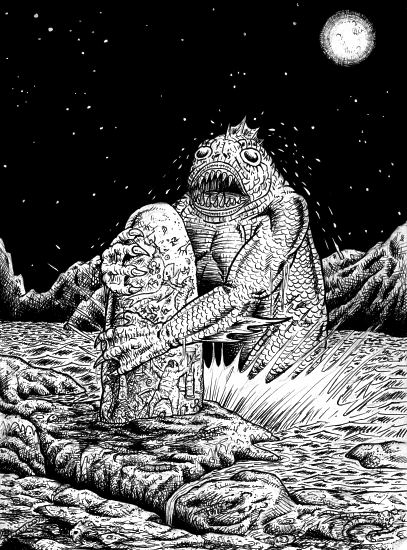


![Dracula [Audible Edition] cover art](data:image/svg+xml,%3Csvg%20xmlns='http://www.w3.org/2000/svg'%20viewBox='0%200%20250%20250'%3E%3C/svg%3E)
![Dracula [Audible Edition] cover art](https://m.media-amazon.com/images/I/51ef+s6y42L._SL500_.jpg)


