An online magazine about the paranormal, haunted and macabre. We collect the ghost stories from all around the world as well as review horror and gothic media.
With stiff limbs after rigor mortis has set in, the Chinese vampire entity, the Jiāngshī is after the life force of the living. But where did the lore of the hopping undead really come from?
With stiff limbs after rigor mortis has set in, the Chinese vampire entity, the Jiāngshī is after the life force of the living. But where did the lore of the hopping undead really come from?
The concepts of vampires and the undead is not a modern notion. Long before Bram Stoker’s Dracula, and centuries before Hollywood’s suave, bloodthirsty counts graced silver screens, the people of ancient China harbored their own chilling tales of the dead refusing to stay buried.
Read More: Check out all haunted stories from China
In Chinese folklore, these restless corpses came not with bat wings or seductive stares, but with stiff limbs, pallid skin, crimson eyes, and long hooked claws. Their name? Jiāngshī (殭屍) — roughly translating to “stiff corpse” or more colorfully, “corpse-hopper.”
Yes — they hopped. And it was every bit as unsettling as it sounds.
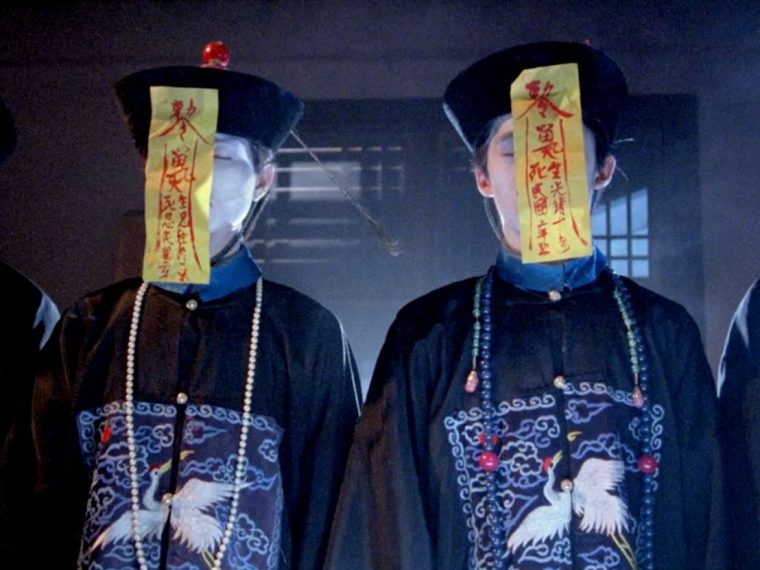
Mr. Vampire (1985)
What is a Jiāngshī?
The Jiāngshī (僵尸) is a reanimated corpse, a creature caught somewhere between life and death. It goes under many names like Chiang Shi, Kang Shi and Geungsi. The myth also appears in other parts of Asia; such as South Korea, Japan, and Vietnam.
Unlike your typical Western vampire, which drains blood with charm and elegance, a Jiāngshī is known for its stiff, rigor mortis-bound body that can only move by hopping, arms outstretched like some grim parody of a child’s game.
Its arrival is accompanied by the scent of decay and often a sinister green phosphorescent glow. Traditionally, it feeds on the life essence or qi of the living or by simply draining their vital energy. Victims struck down by a Jiāngshī would either die outright or rise again as one of its own.
As for appearance — imagine a corpse with ashen or moldy green skin, protruding fangs, claw-like fingernails, and red, hungry eyes. In some accounts, it wears the clothes it was buried in: threadbare robes from dynasties long past.
In some folkloric accounts it had more powers and was capable of running and chasing people at high speed.
Origins of the Legend of the Jiāngshī
The origins of the Jiāngshī legend are as murky as a midnight fog rolling through a mountain pass. Tales of reanimated corpses in Chinese culture can be traced as far back as the Qing Dynasty (1644–1912), with possible roots stretching into even earlier dynasties.
One plausible theory ties their genesis to the folk custom of “transporting corpses over long distances, “ ((千里行屍; 千里行尸; qiān lǐ xíng shī)In rural China, Xiang province (present-day Hunan), when people died far from home, families often couldn’t afford to transport the body by cart. A lot of people worked construction work in the backwaters of western Hunan and the death toll was high. But they all preferred to be buried with their family in their ancestral homeplace.
the first emperor of China, Qin Shi Huang, whose reign was rife with war and conquest in an attempt to claim land and establish the Chinese states.
Instead, local priests or corpse-handlers were hired to bind the corpses upright between bamboo poles, carried by porters walking in unison. They avoided driving during the day as people feared dead bodies. From a distance, the swaying of the corpses might have resembled hopping — giving birth to stories of corpse-hoppers prowling the countryside.
Couple this with deep-seated fears of improper burials, vengeful spirits, and death-related taboos, and you had the perfect storm for spawning the Jiāngshī myth. This practice also gave rise to the belief that Taoist sorceres could be paid for the corpse to “hop their way home” if they couldn’t afford the transportation costs.
The Jiāngshī’s Vampiric Traits
The Jiāngshī shares enough blood-chilling traits to land itself firmly in the category of vampiric folklore like the eastern European one. In some ways it could also look more like a mindless zombie than an immortal and intellectual vampire. If absorbing enough energy, it could even fight. It was said to come from the hills, soaring through the air to devour infants.
They believed they could be created with dark magic or by spirits possessing the dead bodies, or even by absorbing enough yang qi energy to return. There were also more specific ways to become this entiry like When the dead person is not buried even after a funeral has been held. The corpse comes to life after it is struck by a bolt of lightning, or when a pregnant cat (or a black cat in some tales) leaps across the coffin.
Its victims may fall ill, die, or rise as new Jiāngshī. It is repelled by sunlight and sleeps in their coffins, caves or dark forests during the day.
Like its Western counterparts, a Jiāngshī is often born of violent death, improper burial rites, or spiritual unrest. In some tales, even a strong grudge or curse could tether a soul to its body, animating it into a hopping nightmare.
Unlike its western counterparts though, there is rarely talk about the Jiāngshī feeding on human blood with fangs.
How to Stop a Jiāngshī
Chinese folklore, practical as ever, offers several creative ways to ward off or destroy a Jiāngshī and they have several weaknesses. As with most undead, exposure to daylight causes the creature to decay or combust.
They also feared their own reflection and mirror could also repel them. They were also afraid of things made from peach trees, a rooster calling, fire and hooves of a black donkey, dropping a bag of coins as they must count them, glutinous riceand blood of a black dog among other things.
Fulu or Taoist talismans are also a classic way of fighting dark entities. Written on yellow paper in red ink and affixed to the creature’s forehead, these magical scrolls could immobilize or dispel the vampire.
The Jiangshi in Pop Culture
The legend of the Jiāngshī didn’t fade with the passing of imperial China. Instead, it found new life in Hong Kong horror comedies of the 1980s and 90s, notably the cult classic Mr. Vampire (1985), which turned the hopping vampire into an iconic figure of Chinese pop culture. Interestingly, the use of the entity in pure horror movies without comedy has proved to not work.
It is also perhaps from Hong Kong cinema that we get the depiction of a stiff corpse dressed in official garments from the Qing dynasty. The Manchu style qizhuang and the headpiece Qingdai guanmao could come from anti- Manchu propaganda.
Modern adaptations often blend humor with horror, depicting Taoist priests armed with incense sticks and spirit scrolls battling swarms of hopping undead. While the Jiāngshī might seem quirky or even comedic in some modern depictions, at its core it’s a reflection of ancient anxieties about death, spiritual unrest, and the consequences of neglecting the dead.
Beneath the slapstick lies a persistent echo of ancient fears: that death, if disrespected, will come hopping after you.
In the windswept landscape of Norway’s west coast lies the Utstein Monastery, a site steeped in history and haunting tales. Known as Norway’s best-preserved medieval monastery, its ancient stone walls and iconic Gothic windows whisper stories of faith, love, and loss as well as the ghost of a Lady in White.
In the ancient St. Patrick’s Cathedral in Dublin, there are said to be restless spirits still lingering. One of the more well known is said to be the ghost of Jonathan Swift, perhaps best known as the author of Gulliver’s Travels.
In one of the city’s oldest buildings, the freshest food is served in the ancient locale. For years though, there have been talks about Stortorvet Gjestgiveri restaurant being haunted, and even made it as one of the most haunted clips in the national ghost hunting show.
Haunting Jone’s Road in Dublin, a headless horseman is said to roam after his life turned dark after scheming peers. And the former Dublin Sheriff, Buck Jones has become one of Ireland’s most well known headless horseman ghosts.
Next to the Glasnevin Cemetery in Dublin, there is a pub called John Kavanagh’s ‘The Gravediggers’, where they went to have a pint after working at the cemetery. Rumor has it that the pub is haunted by those buried next door.
Said to be a protector of the Valleys in Armenia, the Dakhanavar vampire hides in the caves in the mountains, waiting for intruders to quench his thirst.
Could the Connolly Station in Dublin be haunted? Some claim that the ghosts of the victims from the Dublin Bombing in world war two could still be lingering near the tracks.
Once a place for executions, the place the Ruffinihaus in Munich, Germany is built upon is said to be haunted. It is said that in the dead of night, the undead rises from their graves, still carrying their heads the executioners took.
Where the former country estate Campagne Mon Repos in Bern once was, the ghostly council of the military leader from General Robert Scipio von Lentulus was given in times of unrest. Is he still haunting the Könizwald woods, even after his estate is gone?
One of the old cemeteries in Munich said to be haunted is the Alter Südfriedhof, or the old south cemetery. According to lore, the ghostly voices of the so-called Eskimo Tragedy are still heard at night.
In the darkness of night and under the foliage cover of the forest, the demonic spirit of Uhaml is said to roam. The only way to escape it is getting out of the forest faster.




4 Comments »