An online magazine about the paranormal, haunted and macabre. We collect the ghost stories from all around the world as well as review horror and gothic media.
There is a ghost legend from Roman times in Zurich. The story of the martyrs and saints Felix, Regula and Exuperantis who rose from their deaths and walked with their heads under their arms, is still an important story for the city.
There is a ghost legend from Roman times in Zurich. The story of the martyrs and saints Felix, Regula and Exuperantis who rose from their deaths and walked with their heads under their arms, is still an important story for the city.
Before it became the iconic Swizz city it is today, it once was a Roman outpost as well. Becoming the image of Zurich city, the ghostly tale of Felix, Regula and Exuperantis helped shape the city to become what it is today.
Read More: Check out all ghost stories from Switzerland
One of the earliest ghost stories Zurich has to offer is the story of the three patron saints and what happened after their execution when they rose from the ground where they had been executed.
The Legendary Theban Legion and The Saints of Zurich
Felix, Regula and Exuperantis fled to Zurich in the third century. Felix and Regula were siblings and members of the Theban legion based in Egypt. It is said they came from Egyptian nobility. Exuperantis was their servant. The legion, also known as the Martyrs of Agaunum, were stationed in the Roman outpost, Agaunum in the Valais in Switzerland. The legion consisting of 6666 med were all Christians led by the holy Mauritius, dying as a martyr around 287.
The Ten Thousand Martyrs
They were going over the alps to put down a Gallian rebellion on the command from emperor Diokletians. When the legion refused to sacrifice to the Emperor Maximian of the Roman empire, they fled as they started executing every ten men.
They went through Valesia, preaching the gospel. They stayed in a cave in the wilderness for a while as well. The coptic Christians reached Zurich, which then was called Turicum in 286 and stayed with a Christian family.
They were discovered by a man called Decius who was ordered to hunt the heathens down. First he tortured them, beating them and putting them in boiling oil to turn them. Still, they refused to worship the Roman gods. Then they were beheaded on the location where the Wasserkirche now is.
The Saints of Zurich:Detail from the former altarpiece of the Chapel of the Twelve Apostles in the Grossmünster in Zurich : Martyrdom of the Zurich city saints Felix and Regula and their servant Exuperantius (right). In the background, the Lindenhof and Uetliberg can be seen from the panorama of the medieval city of Zurich. Condition after restoration and uncovering of the figures in 1937.
Their story was not done however, and after dying, their corpses stood up and picked up their heads on the ground before walking off. A trail of blood followed behind them. They walked around forty paces uphill, all the way to a hill where they prayed before laying down, thinking that this was a better place to be buried.
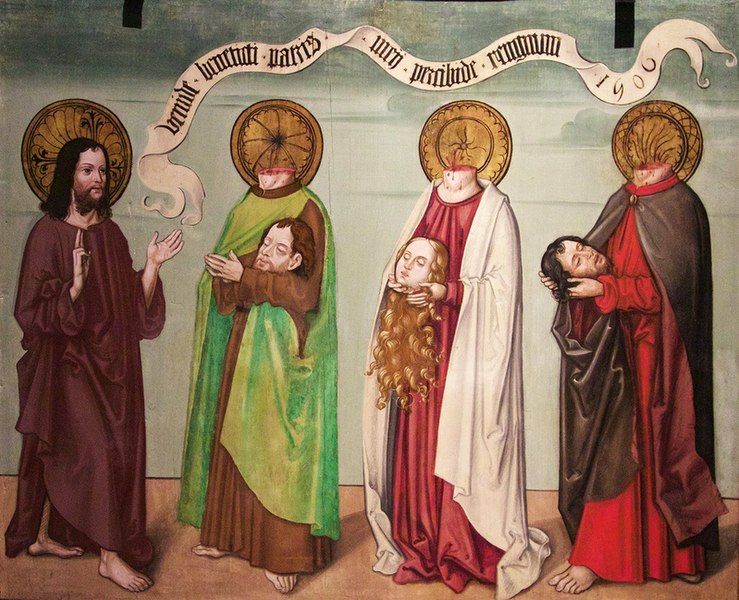
Martyrs: The Zurich city saints Felix, Regula, and Exuperantius, as head bearers, offer their severed heads to Christ and are led by him into heaven. Banner: venide benedicti patris mey percibide rengnum 1506
The Truth Behind the Legend of Felix, Regula and Exuperantis’ Death
So what really happened in Roman times? Is this one of the ancient ghost stories? Some experts would even question the foundation of the story at all.
The story of how they fled and carried their heads to the hill actually came to the monk, Florentius in a dream in the 8th century. In the 9th century there was a small monastery there and the holiness of the place grew over time.. The site where their supposed graves now are is Zurich’s most well known landmark, Grossmünster church that was built from around 1100. The Wasserkirch was built at the site of their execution.
They have since the 13th century been saints and important for the people in Zurich. But at the dissolution of the monasteries in 1524, their graves were opened. Some claimed that they were already empty except for a few bone fragments. Some say that an Uri man stole the bones to Andermatt where the skulls of Felix and Regula can be seen today. The rest of the remains were sent back to Zurich today in the church dedicated to the saints.
The Crypt: Crypt of the Wasserkirche in Zurich: Martyr’s Stone on which, according to legend, the city’s saints Felix and Regula and their servant Exuperantius were beheaded; a natural boulder deposited hereby the Linth glacier during the Würm glaciation. //Source: Roland zh/ Wikimedia
The skulls in question have been carbon dated, where one dates to the Middle Ages. The other skull is actually fragments of two different ones. One from the middle ages, and the other could be from Roman times.
Were they even there? Some say that the Theban legion is fictitious, although some historians still claim that evidence places the legion in Switzerland at that time in history. Still, their feast day is 11th of September in the Gregorian calendar, and the story is still told, that they rose from their death, head in hand.
What really happened around the Pollingsried Chapel, and its supposed plague cemetery? Is there really a curse around the area? As far as the ringing of the bells can be heard?
Searching for its name, the utburd ghost from Norwegian folklore haunts the forests, waters and houses its parents left them to die. For the most part, they remained in folk tales, but sometimes, the stories about the dead children got real life consequences.
Perhaps one of the most well known figures from Irish mythology is the Banshee, the omen of death, wailing as death comes to a house. But where does she come from? And what does she want from the dead?
Before meeting a vampire in Transylvania, a short story places Jonathan Harket facing the undead outside of Munich. Could it have a connection to the village that according to legend, vanished suddenly in the middle ages.
One of the dark entities on the emerald island, there is the Death Coach who comes to collect the souls of the dead. Pulled by headless horses, the Cóiste Bodhar stops at nothing before its mission is complete, and misfortune happens upon those getting in its way.
In 1687, the ghost of a murdered child started to testify against its mother in northern Norway and people took it seriously. Today, the Utburd of Skåvoll or the Nille-case is remembered as the ghost story that condemned a woman to her death.
Have a look at some of the most haunted places in Dublin, from the mysteries of the Hellfire Club, churches where you can supposedly summon the devil and the dead lingering in the dusty libraries and colleges.
After strange knocking and poltergeist activity made the people at Erstad Farm believe it was haunted. And when they asked the ghost what it wanted, it unraveled the lives of more than one person forever.
Was there an iberian vampire before the European vampire panic in Eastern Europe? Who was really Conde Estruch, the vampire of Catalonia, and what happened to the witches of Llers Castle the count was said to use as his lair.
Join a haunted pub crawl through Dublin’s ancient streets for ghosts and a pint of Guinness. From plotting revolutionaries to somber writers, these pubs and bars are said to be a place where some of the patrons have been lingering for a long time.
In 1852, the alleged psychic Erika Larsdatter Bogen, arrived at Børholmen, a small island in western Norway. She claimed that she had found the ghost and corpse of the dead child, and she named the mother who allegedly buried it. But what was the truth?




3 Comments »